


Get to know Qilihe District
- Administrative area
- District · 市辖区
- Part of
- Lanzhou
- Chinese name
- 七里河区
- Local areas
- District guide
Area & population
- Area
- 397.00 km²
- Population · 2018
- 635,000
Source: English Wikipedia, as of the dates shown.
Qilihe District is a long, varied part of south-central Lanzhou: the built-up Yellow River corridor holds a major provincial museum, old temple grounds and a waterside park, while the district reaches south into the Agan mountain and forest area. Come here to combine Lanzhou’s everyday river-city landscape with a museum visit, then treat the southern hills as a separate outing rather than assuming the whole district is walkable.
Qilihe lies on the south bank of the Yellow River in south-central Lanzhou. Its terrain rises from the river toward the south, and the district includes both the dense central-city strip and rural, mountainous areas. The provincial government lists Qilihe as one of Lanzhou’s five urban districts; the district government describes its north–south span, river setting and southern forest and village areas.
That change of scale is the reason to visit. Around Xijin Road and the riverfront, museums, older religious and civic buildings, parks and shopping streets sit in a connected urban belt. Farther south, the Agan area and Shifogou National Forest Park belong to a different kind of day: road travel, open hills and forest rather than a stroll between city sights. Qilihe’s own overview also points to local produce such as lily, yellow chives, peaches and sweet fermented grains, but these are district products, not a single fixed “Qilihe dish.”
The urban belt
The Gansu Provincial Museum (甘肃省博物馆) is the clearest first stop for understanding the wider province. Its galleries offer a provincial cultural and archaeological overview; the museum’s home page gives the Han-era Bronze Galloping Horse from Wuwei as a useful anchor for a first visit. Admission is free by reservation. The published routine is Tuesday to Sunday, 09:00–17:00, with reservations ending at 16:00 and entry stopping at 16:30; Monday is normally closed except when a holiday notice changes the schedule. A notice dated 28 October 2026 says the museum will close for equipment maintenance from 2 to 11 November and reopen on 12 November, so check the latest notice before travelling.
The museum is at 3 West Xijin Road (甘肃省兰州市七里河区西津西路3号). Its own directions say to take Lanzhou Metro Line 1 to Xizhan Shizi (西站什字), leave via Exit A and walk east for about 500 metres. It also lists buses 31, 32, 53, 58 and K102 to the Gansu Provincial Museum stop, with the museum about 100 metres south of the stop. These are venue directions, not a single entrance for the whole district.
Jintian Temple (金天观) gives the city belt a different texture. The site was founded in 1400 on the grounds of earlier religious buildings, and its name refers to its position west of the old city in the traditional five-elements scheme. The district government records three surviving Tang locust trees, several Ming–Qing cypresses and stone inscriptions. Since 1956 the complex has served as the Lanzhou Workers’ Cultural Palace, so it should be understood as a historic site with a later civic life, not as a frozen temple attraction. Check the current visitor arrangement before planning an interior visit.
Xiaoxihu Park (小西湖公园) lies between Xijin Road and the riverside road. It began as the Ming Prince of Su’s western garden, later became associated with the old “Eight Views of Lanzhou,” and was rebuilt as a public park in 1984. Its design deliberately borrows from Jiangnan garden landscapes while keeping the broad, dry-region light and Yellow River setting. Walk slowly rather than looking for a single monument: the useful contrast is between water, planted courtyards, nearby traffic and the riverfront beyond.
These urban places work well as separate choices, not as a promise of one continuous tourist route. Pair the museum with Xiaoxihu Park when you want an indoor collection followed by an open public space. Choose Jintian Temple only after confirming that the relevant buildings and grounds are open. The surrounding streets are lived-in city space; ask before photographing people, workers or worshippers.
The southern side
South of the built-up corridor, Qilihe reaches into the Agan area, village landscapes and forested mountain destinations including Shifogou National Forest Park. The district government presents this as part of Qilihe’s tourism landscape alongside its urban parks and museums. It is not a short extension of the museum outing. Allow a separate half-day or longer, use the exact park or village name in Chinese, and confirm the current road access, visitor gate, opening status, weather and return plan before setting out. Do not treat an old festival date, a map pin or a scenic-road photograph as proof that a trail, shuttle or event is operating now.
There is no district-wide ticket, reservation system or universal visitor gate. Individual museums, parks and mountain sites set their own rules. A current notice may also matter more than a general district page for a seasonal mountain visit.
Getting around
Qilihe has no single “nearest station.” The operator’s current service page lists these Line 1 stations within or serving the district corridor: Lanzhou West Railway Station North Square (兰州西站北广场), Xizhan Shizi (西站什字), Qilihe (七里河), Xiaoxihu (小西湖) and Culture Palace (文化宫). Take a train marked Donggang or Chenguanying according to the direction of travel. Use the museum’s more specific Exit A instruction only for the Gansu Provincial Museum; do not extend it to other district destinations.
Lanzhou West Railway Station (兰州西站) is the district’s principal intercity arrival point. The district government describes it as a railway passenger hub with high-speed and intercity rail, metro, long-distance coaches, buses, taxis and private-car connections. Read the station named on your ticket, then follow signs inside the complex to the metro or ground transport and give a driver the exact Chinese destination. The station is a transport hub, not the entrance to every Qilihe attraction.
For a taxi or ride-hailing car, name the exact place rather than “Qilihe District.” For the museum, use “甘肃省博物馆,兰州市七里河区西津西路3号.” For Jintian Temple, Xiaoxihu Park or a southern mountain site, use the current Chinese destination supplied by that venue or map service. The sources read do not establish one reliable district-wide drop-off point, southern shuttle timetable or return bus, so those details need a same-day check.
Explore Qilihe District
Core places to explore, with English and Chinese names.
Places to explore around Qilihe District
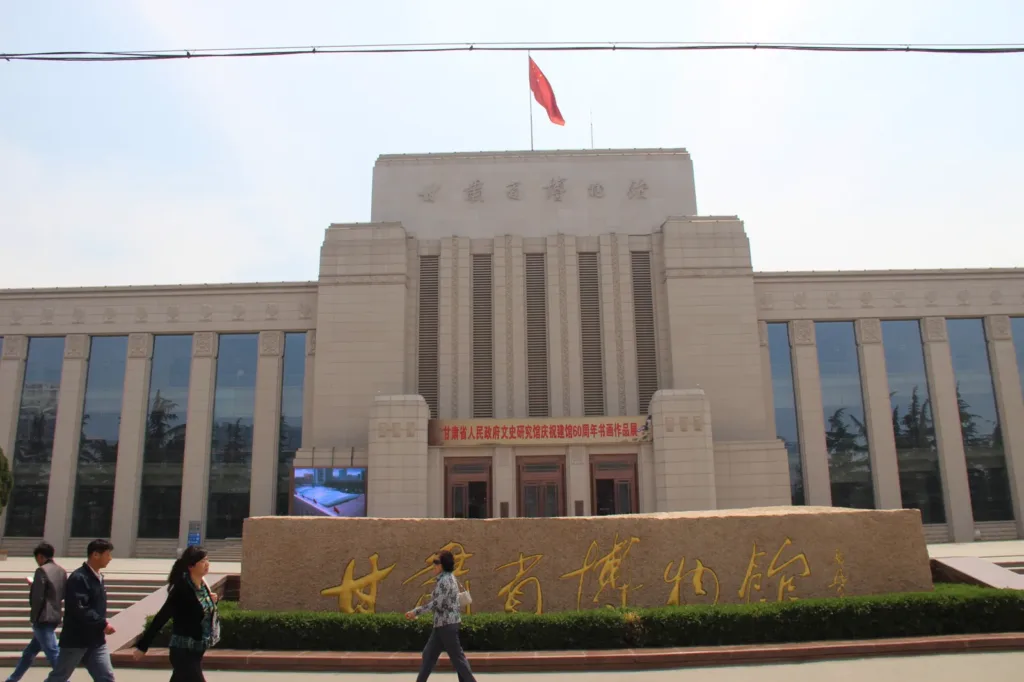 Front façade of Gansu Provincial Museum on Xijin West Road, Lanzhou. Photo: Gary Todd · CC0 1.0
Plan your visit
Getting there
Qilihe District is about 4 km (straight-line distance) from central Lanzhou. Search for 七里河区 in a map app to find stations and your accommodation.
Where to stay →Build your route
Start with Gansu Provincial Museum. The linked place guides have entrance and visit details.
Continue with Lanzhou →More in Lanzhou
Sources & geographic information
Administrative names and parent areas: Official geographic directory (dmfw.mca.gov.cn) · Reference date 2026-09-06.
Background text adapted from Qilihe, Lanzhou — Wikipedia contributors, under CC BY-SA 4.0. Text has been shortened and reorganized; source revision 1314757171.
Map data © OpenStreetMap contributors. Pins mark approximate centres, not entrances or boundaries.
Image credits & notes (1)
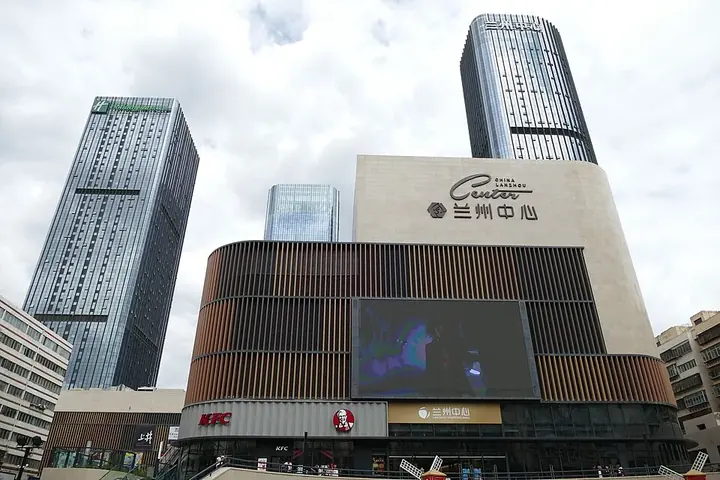
- Lanzhou Center shopping mall seen from Jianlan Pedestrian Street in Qilihe District, Lanzhou. Photo: 2019-05-29 09:32:41.Photo: Pieceofmetalwork · CC BY-SA 4.0Resized for the web; the photo itself has not been edited. Thumbnails may show a cropped view.
