

Explore the region
A city within a much larger landscape
Guilin is a prefecture-level city in northeastern Guangxi. Its current municipal territory comprises 17 county-level divisions; that wide jurisdiction includes compact central Guilin as well as distinct county-level destinations such as Yangshuo, Longsheng, Xing’an, Lipu, and Gongcheng. The city’s karst scenery is not confined to one attraction or to its downtown streets, and the different districts and counties are not interchangeable bases.
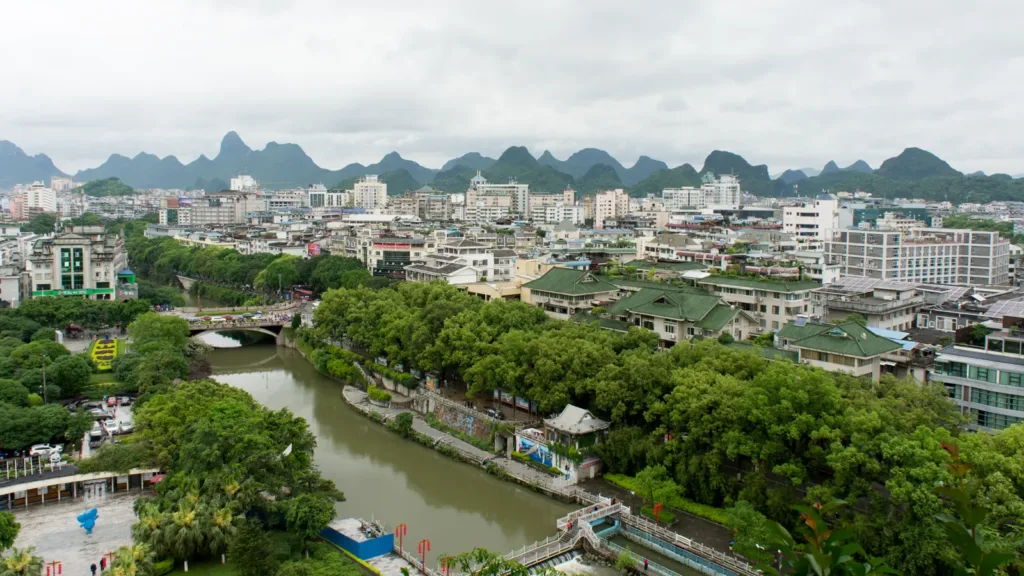
The landscape makes more sense as a meeting of stone and water than as a single postcard view. In the Guilin Karst component of the UNESCO-listed South China Karst property, tower-shaped fenglin and clustered-cone fengcong formations occur together; the Li River’s waterways and low basin help shape the riverine scenery. This UNESCO property has defined component areas, so the designation does not mean every hill or urban riverbank across Guilin is a protected World Heritage visitor site. In the central city, limestone peaks rise behind built-up streets and the Li River, while the river and connected lakes offer a quieter way to read the city’s topography. The wider region changes markedly: Yangshuo is a separate southern county landscape, Longsheng’s mountain villages and terraces lie to the north, and Xing’an’s Lingqu Canal is a distinct heritage outing.
Explore central Guilin slowly
Begin with a walk that combines an urban landmark with the everyday city around it. Elephant Trunk Hill (象鼻山) is named for the limestone ridge and arch that resemble an elephant lowering its trunk toward the water. Inside the scenic area, look for the opening known as Water Moon Cave (水月洞), then view the rock from several river-facing angles rather than treating the first overlook as the whole visit. The scenic area also contains the Ming-era Puxian Pagoda and other features; entry arrangements can vary, so check the current visitor notice before going.
The lakeside city core offers a different experience from the hill. The Sun and Moon Pagodas (日月双塔) are a paired waterside landmark; the surrounding lake paths make a good evening stroll when weather and access allow. The historic precinct at Jingjiang Prince’s Mansion (靖江王府) brings city history into the streetscape beneath Solitary Beauty Peak (独秀峰). Take time to notice how the old walls, steep limestone peak, waterways, and present-day shops sit close together. The UK China National Tourist Office presents both the mansion and Lingqu among Guilin’s heritage highlights.
For a grounded taste of daily Guilin, order Guilin rice noodles (桂林米粉) at a neighborhood noodle shop. The soft, springy rice-flour noodles are briefly reheated, then dressed with a shop-specific brown braising gravy (卤水), often sliced pork or beef, and sometimes fried soybeans. Diners add their own pickled vegetables—commonly bamboo shoots, long beans, or radish—plus scallions, cilantro, peanuts, and chili. Many bowls arrive relatively dry, with light broth available to add or sip; soupier preparations and flat-cut noodles are also found. Mix the toppings through the noodles so the briny, savory gravy meets the sour crunch and any heat you choose. Recipes, meat, toppings, and broth differ from shop to shop; a familiar bowl is a local pattern, not a single compulsory formula.
After breakfast or in the evening, browse a market or an ordinary food street at your own pace, then follow the public paths around the central lakes and riverfront. Shop hours and public activity vary by day; do not plan around an assumed fixed performance or community event. Give residents space, ask before photographing people, and avoid recording anyone’s private documents or conversations.
Add the counties as separate trips
Yangshuo, Longsheng, Xing’an, Lipu, and Gongcheng are destinations in Guilin’s administrative territory, but none is a downtown neighborhood. Plan each with its own arrival point and return transfer. A Li River sightseeing cruise is a regional journey rather than a city ferry: some itineraries board at Zhujiang Pier (竹江码头) in the Guilin area and land near Yangshuo at Longtou Shan (龙头山) Pier. Confirm the actual pier, route, landing point, and onward connection on the ticket; do not assume a return sailing to central Guilin. If travelling overland instead, check the named coach station or railway station for the date of travel.
Longsheng’s mountain terraces need a final road transfer beyond the county-level gateway, while the Lingqu Canal is in Xing’an. Treat either as its own day or overnight excursion rather than counting it as a central-city walk. The city’s varied scenery is one reason to choose a base around the particular river, village, or heritage site you want to see, rather than trying to cover the entire prefecture as one small sightseeing zone.
Getting to and around Guilin
Guilin Liangjiang International Airport (桂林两江国际机场) is the city’s active airport, in the Lingui area southwest of central Guilin. Long-distance trains serve three distinct stations: Guilin Railway Station (桂林站), Guilin North Railway Station (桂林北站), and Guilin West Railway Station (桂林西站). Check the exact station printed on your rail ticket before choosing a transfer; they are not alternate names for one downtown terminal.
There is no operating urban metro in Guilin. Local buses and taxis are the practical city options. A scenic-area transport guide lists Bus 16 from Guilin Railway Station toward Xiangshan Scenic Area Stop (象山景区站), and Buses 99 or 100 from the North Railway Station area toward Yangqiao Stop (阳桥站), followed by a walk along Wenming Road to a signed visitor gate. Those published route directions are guidance, not a guarantee of current service or stop placement: verify the live route and entrance before setting out. No metro line or station applies.
From the airport, use the airport’s marked taxi rank or confirm a current airport coach directly with the operator; a current timetable, city terminal, and fare were not verified for this guide. For a central-city visit, show a driver the Chinese destination 象鼻山景区,桂林市象山区民主路1号. A current visitor listing gives that address; follow signs to the operating public entrance and use a lawful passenger drop-off area rather than asking a vehicle to stop in a traffic lane. For rail arrivals, show the exact Chinese station name from the ticket, then your hotel’s Chinese address. This avoids confusion among the three railway stations.
Combine your visit
Suggested order for the visit:
-
Elephant Trunk Hill象鼻山
Begin with the natural river landmark.
-
Shan Lake and pagodas
Continue with the lake-side cityscape.
This is an editorial sequence of named spaces or places. It does not imply a verified walking connection or promise opening, ticket availability or a journey time.
Find Guilin overview
桂林 · 秀峰区
The pin marks the area, not the entrance.
More places nearby
Approximate straight-line distances between map pins, not travel distances.
Shangshui Food Street 尚水美食街
Less than 1 km awayShangshui is a compact food quarter between Zhengyang Pedestrian Street and the Sheraton side of Binjiang Road. Its shopfronts borrow forms from northern Guangxi houses, giving the eating lanes a more intimate setting than the…
View guide →Zhengyang Pedestrian Street 正阳步行街
Less than 1 km awayZhengyang is a central shopping street that links the Shan Lake side of the city with Jiefang East Road. Its red clock tower makes a useful meeting point among restaurants, souvenir shops and clothing stores. The side streets…
View guide →Sun and Moon Pagodas 日月双塔
Less than 1 km awayThe Sun and Moon Pagodas rise from Shan Lake in central Guilin as a paired waterside landmark. Both have octagonal plans, but their finishes and proportions differ: the Sun Pagoda is faced in bronze, while the Moon Pagoda uses…
View guide →Sources & visit information
Sources checked on 21 October 2026. Hours, tickets, reservations and transport can change; confirm with the operator before you go.
Image credits & notes (1)
- Guilin’s urban riverfront and karst skyline viewed from Elephant Trunk Hill. Photo: ShujianyangPhoto: CC0 1.0