


Get to know Lubei District
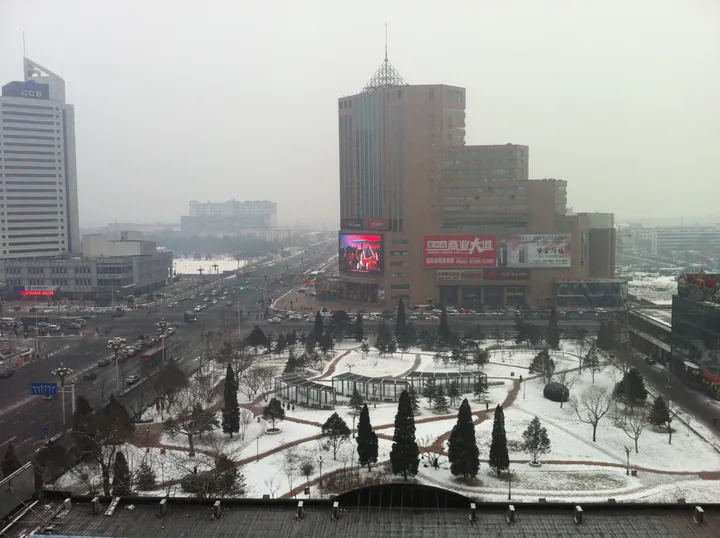
Photo adjustments
Full frame retained; proportionally resized and converted to WebP. No retouching or changes to the photographed subject. Card displays may crop the view.
- Administrative area
- District · 市辖区
- Part of
- Tangshan
- Chinese name
- 路北区
- Local areas
- District guide
Area & population
- Area in the source
- 123.95 km²
- Population · 2020 census
- 784,667
- Administrative seat
- Qiaotun Subdistrict
Source: cited geographic source, as of the dates shown.
Setting and landscape
Four hills stand within the district, Dacheng (大城山), Fenghuang (凤凰山), Wandao (弯道山) and Liangjia (亮甲山), and the Dou River (陡河) and Qinglong River (青龙河) curve around it. Dacheng Hill is the hill once called Tangshan, from which the city took its name. Its main, western peak is limestone, 122 metres above sea level, and the Dou River, formerly the Tang Stream (唐溪), is turned east by it. Qinglong Lake (青龙湖), a 25-hectare artificial lake in the northwest of the city, connects with the ring of waterways around the main urban area.
What to see
Dachengshan Park (大城山公园) holds a Longshan culture site, Xingguo Temple (兴国寺) and a monument to the anti-Japanese uprising in eastern Hebei. Tangshan Museum (唐山博物馆), a national first-grade museum in Fenghuang Hill Park, opened in April 2012; its core display traces local history through stone, pottery, bronze and porcelain, and its prized pieces include a fossil tusk of a Namadicus elephant and a Liao-dynasty carved pomegranate-shaped zun from the Ganwayao (缸瓦窑) kilns.
Much of the rest is industrial heritage. The China (Tangshan) Industrial Museum (中国(唐山)工业博物馆) on Dachengshan West Road opens with a sculpture modelled on the "Dragon" locomotive built by Tangshan workers in 1881; one of its halls is named after Hans Kunder, who came to the Tangshan cement works in 1900 and made China's first piece of sanitary ware. Qixin 1889 (启新1889) reuses the core of the Qixin cement works, which ran for more than 120 years; its cement museum keeps five complete kiln lines and a German AEG generator. Peiren Historic and Cultural Street (培仁历史文化街) centres on a girls' school that began as an orphanage founded by the French Catholic church in 1911, and has a memorial hall for the British engineer Claude Kinder. The Tangshan Ceramics Museum (唐山陶瓷博物馆), Hebei's first state-owned ceramics museum, has more than 1,200 exhibits, and a kiln-god temple in the neighbouring Ceramics Park restages kiln-lighting ceremonies.
Getting oriented
Tangshan railway station is in the district, where the Beijing–Harbin, Tianjin–Shanhaiguan, Tianjin–Qinhuangdao passenger and Zhangjiakou–Tangshan lines meet. Tangshan Port is 80 kilometres away.
Highlights
- Dachengshan Park 大城山公园: The hill once called Tangshan, with a Longshan culture site and Xingguo Temple.
- Tangshan Museum 唐山博物馆: National first-grade museum in Fenghuang Hill Park, opened in 2012.
- China (Tangshan) Industrial Museum 中国(唐山)工业博物馆: Industrial museum on Dachengshan West Road with a sculpture of the 1881 Dragon locomotive and a hall named after Hans Kunder.
- Qixin 1889 启新1889: Former Qixin cement works with a cement museum keeping five kiln lines.
- Peiren Historic and Cultural Street 培仁历史文化街: Street built around the Peiren girls' school, which began as an orphanage founded by the French Catholic church in 1911.
- Tangshan Ceramics Museum 唐山陶瓷博物馆: Hebei's first state-owned ceramics museum, beside a park with a kiln-god temple.
Sources for this guide
唐山市路北区区情概况 · Lubei District People's Government, Tangshan
唐山博物馆 · Lubei District People's Government, Tangshan
培仁历史文化街 · Lubei District People's Government, Tangshan
中国(唐山)工业博物 · Lubei District People's Government, Tangshan
大城山公园 · Lubei District People's Government, Tangshan
唐山陶瓷博物馆 · Lubei District People's Government, Tangshan
启新1889 · Lubei District People's Government, Tangshan
青龙湖 · Lubei District People's Government, Tangshan
唐山市 · Wikipedia (Chinese) · CC BY-SA 4.0
Original English written from the listed sources and checked sentence by sentence against quoted extracts by a separate reviewer. Updated 2026-09-24.
Explore Lubei District
Core places to explore, with English and Chinese names.
Lubei District 路北区
Plan your visit
Getting there
Lubei District covers the centre of Tangshan. Search for 路北区 in a map app to find stations and your accommodation.
Where to stay →More in Tangshan
Sources & geographic information
Administrative names and parent areas: Official geographic directory · Reference date 2026-09-06.
Some facts checked against 唐山市 — Wikipedia contributors, CC BY-SA 4.0.
Map data © OpenStreetMap contributors. Pins mark approximate centres, not entrances or boundaries.