

Explore the region
Tap any red Chinese text to hear it in Mandarin.
What the visit is about
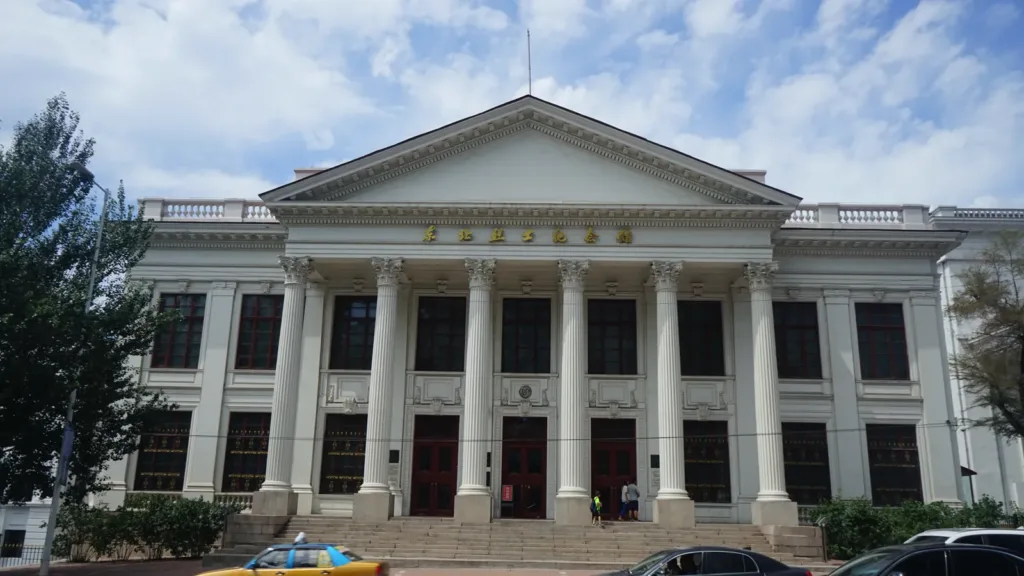
The hall was established on 10 October 1948, after Harbin’s liberation, to commemorate people who died in the Northeast’s War of Resistance against Japanese Aggression and the War of Liberation. Its building was the former Harbin Police Department under the Manchukuo regime, so the architecture is not just a backdrop: the site’s institutional history is part of what the museum asks visitors to confront.
The main memorial exhibition, Black Soil Heroes — Martyrs’ Deeds during the War of Resistance against Japanese Aggression and the War of Liberation in Northeast China (《黑土英魂——东北抗日战争和解放战争时期烈士事迹陈列》), follows eight stages from the rise of resistance after the Northeast fell under occupation to the liberation of the region. It highlights 280 individual martyrs, eight groups of heroes and a roll of about 56,000 names. A second basic exhibition uses the former police headquarters and its surviving historical evidence to explain the institution’s crimes under the occupation.
The collection contains more than 11,000 cultural relics and sets, focused on the modern history of Northeast China. The official profile names, among other examples, a coat worn by Yang Jingyu during underground work in Harbin, the pistol used by Zhao Shangzhi, the tram associated with Zhao Yiman’s strike by Harbin tram workers, and a machine tool from the Qixinglazi arsenal of the Northeast Anti-Japanese United Army. These are collection examples rather than a promise that every object will be on view on the day of your visit.
This is a place for a quiet, unhurried reading of names, objects and testimony. Avoid treating the wartime material as spectacle. Do not touch exhibits, climb barriers or use flash photography; a recent visitor notice also asks audiences to remain quiet and follow staff directions during busy periods.
Before you go
Admission is free. The venue’s official profile lists regular hours as Tuesday to Sunday, 9:00 am–4:00 pm, with ticket issuance stopping at 3:30 pm and Monday closure. The exact schedule can change, so check the museum’s official website or call before setting out.
A Heilongjiang Provincial Department of Culture and Tourism notice dated 30 September 2026 required real-name reservations for the special National Day period of 1–7 October 2026. It said that visitors could reserve a free timed ticket up to seven days ahead through the museum’s official WeChat account or Alipay mini-program. That notice was specific to the holiday period; it does not by itself establish the booking rules for another date. The notice also does not say whether a foreign passport can be used in the reservation system. International visitors should ask the museum about passport booking and entry documents before travelling. The published consultation number is 0451-53643712.
The memorial hall is one venue within a larger institution that also manages other history and memorial museums at or connected with the Yiman Street site. Check that your reservation and map result name 东北烈士纪念馆 Dōngběi Lièshì Jìniànguǎn, rather than assuming that a ticket for another venue covers this hall.
Getting there
The address is 241 Yiman Street, Nangang District, Harbin — 哈尔滨市南岗区一曼街241号.
For the metro, the provincial visitor listing directs visitors to Line 1 and Yida Yiyuan (医大一院) station. It does not provide an exit number or a walking time.
The same listing gives these bus options:
- Lieshiguan (烈士馆) stop: routes 7, 105, 107, 108, 109 and 120.
- Ha San Zhong (哈三中) stop: routes 2, 8, 89 and 115.
The transport page was published in 2020, so confirm that the route still serves the named stop before travelling. For the return journey, check the current direction at the same station or stop rather than relying on an old timetable.
For a taxi or ride-hailing car, show the full Chinese destination: 哈尔滨市南岗区一曼街241号 东北烈士纪念馆. The cited visitor listing does not identify a separate vehicle entrance or drop-off curb, so do not assume that a particular gate is the public entrance.
A useful way to read the site
Start by looking at the façade and considering why this building matters. Inside, read the memorial exhibition’s individual lives and the long roll of names before moving to the exhibition on the former police headquarters. That order is an editorial suggestion, not a claim about a required route or access to every building area. The point is to connect the people commemorated with the historical machinery that the second exhibition documents.
Combine your visit
Suggested order within this visit:
-
Historic façade
Start with the building that houses the memorial.
-
Resistance-history exhibition
Read the individual histories and material evidence.
-
Former police-headquarters history
Relate the exhibition to the building's wartime use.
This sequence is an editorial suggestion based on the features described in the sources. Access to individual buildings or areas should be checked locally; no travel time or shared admission is implied.
Find Northeast China Revolutionary Martyrs’ Memorial Hall
东北烈士纪念馆 · 哈尔滨市
The pin marks the area, not the entrance.
More places nearby
Approximate straight-line distances between map pins, not travel distances.
The Liao & Jin History Museum of Heilongjiang 黑龙江辽金历史博物馆
Less than 1 km awayThis privately established museum focuses on objects associated with the Liao and Jin periods. Published collection descriptions emphasise decorated belt fittings, Buddhist objects and ceramics, bringing personal ornament and…
View guide →Heilongjiang Provincial Museum 黑龙江省博物馆
Less than 1 km awayHeilongjiang Provincial Museum brings together the province's archaeology, historical objects and natural-history collections in the former Moscow Department Store building on Hongjun Street. Its holdings include the Jin-period…
View guide →Heilongjiang Art Museum 黑龙江省美术馆
1 km awayHeilongjiang Art Museum is especially useful for understanding the province's printmaking tradition. Artists associated with Beidahuang recorded agriculture, industrial work and northern landscapes, giving woodcuts a prominent…
View guide →Sources & visit information
Sources checked on 23 October 2026. Hours, tickets, reservations and transport can change; confirm with the operator before you go.
Image credits & notes (1)
- Front-facing exterior of the Northeast China Revolutionary Martyrs’ Memorial Hall in Harbin, photographed in July 2017. Photo: HuanokinhejoPhoto: CC BY-SA 4.0