

Explore the region
Luoyang feels less like one preserved old town than a city whose history appears at several distances. It sits on the Luo River plain, and its name refers to the north bank of the Luo. Local government history records successive capitals and political centres from the Xia and Zhou eras through the Eastern Han, Wei, Sui and Tang periods; UNESCO places Chang’an/Luoyang at the eastern end of the Silk Roads’ Chang’an–Tianshan Corridor. This is why a visit can move from excavated palace-city evidence to Buddhist art and then back into ordinary streets without changing the city’s subject.
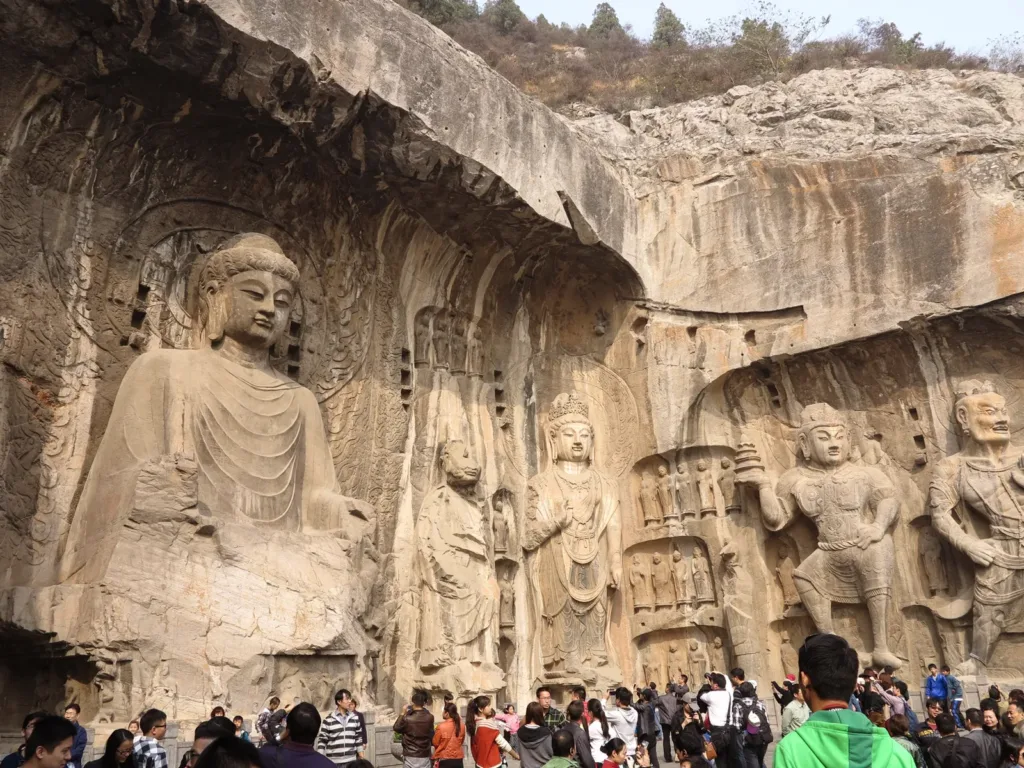
Start with what can be seen rather than a dynasty list. At Longmen, more than 2,300 caves and niches are cut into limestone cliffs on both sides of the Yi River. Almost 110,000 Buddhist statues and thousands of inscriptions survive, with the most intensive carving dating from the late fifth to the mid-eighth centuries. The scale is monumental, but the experience is also close-looking: compare small niches and inscriptions with the large Tang sculptures, and allow time on both riverbanks. In the city centre, museums and palace-site remains provide the urban and political context that the cliffs alone cannot.
East of the central city, White Horse Temple is a religious and heritage setting associated with the Eastern Han arrival of Buddhism in China. The Ministry of Culture’s account dates its founding to 68 CE and describes it as the first government-sponsored monastery built after Buddhism entered China. Visit quietly: halls, courtyards and religious practice matter more than staging a photo. Do not treat worshippers or rituals as a performance.
Luoyang’s daily rhythm is equally legible in bowls. A local cultural-heritage account describes a soup-centred food tradition: beef, mutton, donkey, tofu and Bufan soups appear in everyday life, while water banquet marks ceremonial and festival meals. Bufan soup has a particularly tangible technique: thin green-bean batter is poured into a pan and cooked without flipping, then softened in hot pork-bone broth with vermicelli, wood ear, kelp and seasonings. A water banquet is not one fixed soup but a staged meal of 24 courses—eight cold dishes and sixteen hot dishes—where each hot dish carries soup and the sequence is part of the craft. Menus and meat or broth ingredients vary; ask about ingredients and cross-contact if you have dietary restrictions.
For everyday texture, combine a breakfast soup or a water-banquet meal with older-city streets, then use a museum or palace-site visit to understand how the food culture sits inside the larger city. This is a way of reading Luoyang as a lived place, not just a sequence of imperial labels.
A practical arrival note
Luoyang’s two main rail arrivals should be treated as different gateways. The city’s official transport planning distinguishes Luoyang Longmen for high-speed and intercity services from Luoyang Station for conventional rail; the municipal transport bureau’s 2025 report says public buses cover both stations and reports separate operating windows for them. The metro operator lists Line 2 stops at 龙门高铁站 (Longmen High-Speed Railway Station) and 洛阳火车站 (Luoyang Railway Station), while Line 1 serves central stops including 应天门 (Yingtianmen), 丽景门 (Lijingmen) and 洛邑古城 (Luoyi Ancient City). Check the Chinese station name on your ticket before choosing a hotel or onward ride. A station name is not an attraction entrance.
Luoyang Beijiao Airport is another arrival portal rather than a city-centre sight. The airport transport listing shows bus 1 between the terminal and Longmen High-Speed Railway Station, and routes 27 and 98 to city stops; it warns that schedules can change. For any rail, airport or distant county extension, keep the exact Chinese name and entry address, verify the last leg and return connection on the day, and use a taxi or ride-hailing destination that matches the venue’s official entrance. Attraction tickets, opening hours and reservations are venue-specific; check each site’s current official notice rather than treating the city page as a pass.
Luoyang is worth planning as a set of connected scales: river cliffs for sculpture, museums and palace remains for capital history, White Horse Temple for living religious heritage, and soup-centred food for daily continuity. Give each zone its own transfer and time; that is more faithful to the city than compressing it into one imperial-capital label.
Combine your visit
A suggested sequence linking the specific features of this visit.
-
Luoyang Museum洛阳博物馆·聂泰路馆址
Start with archaeological context for the city’s successive capitals.
-
Yingtian Gate应天门遗址
Connect that context with the central palace-site landscape.
-
Longmen Grottoes龙门石窟
Give the southern cliff-carving site its own transfer and substantial visit.
This order is editorial. Confirm access and any transfers between stops; it does not establish a walking route, same-day connection or common admission ticket.
Find Luoyang overview
洛阳 · 洛阳市
The pin marks the area, not the entrance.
More places nearby
Approximate straight-line distances between map pins, not travel distances.
Guanlin 关林
2 km awayGuanlin in Luoyang’s Luolong district is traditionally identified as the burial place of Guan Yu’s head. Its historical complex combines tomb, temple and commemorative grove.
View guide →Luoyang Museum · Nietai Road 洛阳博物馆·聂泰路馆址
3 km awayLuoyang Museum presents objects from the successive cultures and capitals of the Luo River valley. Its bronze collection is especially distinctive: a three-wheeled dove cart turns an animal into a small vehicle, while ritual…
View guide →Museum of Luoyang Eastern Zhou Royal Horse and Chariot Pits 洛阳天子驾六博物馆
6 km awayThis museum preserves an Eastern Zhou horse-and-chariot burial beneath the modern centre of Luoyang. The six-horse team gives the site its name and raises questions about the status of the people buried here. Other arrangements…
View guide →Sources & visit information
Sources checked on 23 October 2026. Hours, tickets, reservations and transport can change; confirm with the operator before you go.
- UNESCO, Silk Roads: the Routes Network of Chang'an-Tianshan Corridor ↗
- Luoyang Municipal Government, History and development of Luoyang ↗
- UNESCO, Longmen Grottoes ↗
- Ministry of Culture and Tourism, White Horse Temple ↗
- Ministry of Culture and Tourism, Bufan soup ↗
- CCTV, Luoyang Water Banquet ↗
- Luoyang Culture, Radio, Television and Tourism Bureau, He-Luo cultural heritage materials ↗
- Luoyang Rail Transit Group, Metro guide ↗
- Luoyang Municipal Transport Bureau, response on key-node transport services ↗
- Ctrip, Luoyang Beijiao Airport ground transport ↗
- Luoyang Municipal Government, interpretation of the integrated transport development strategy ↗
Image credits & notes (1)
- The Fengxian Temple cliff face at Longmen Grottoes in Luoyang, with the Vairocana Buddha and attendant figures above visitors. Photo: Nyx NingPhoto: CC BY-SA 3.0