

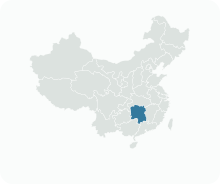
Get to know Jinshi

- Administrative area
- County-level city · 县级市
- Part of
- Changde
- Chinese name
- 津市市
- Local areas
- County-level city guide
Area & population
- Area in the source
- 556.20 km²
- Population · 2017
- 244,000
Source: cited geographic source, as of the dates shown.
History
The Xinzhou walled-city site (新洲古城遗址), about 5 kilometres south of the city in Xinzhou town (新洲镇), is a roughly triangular town with the Li River on its east and Jiashan (嘉山) and Baoming Mountain (豹鸣山) to the south. Parts of its walls and moats survive, hundreds of tombs from the Warring States to the Jin lie in and around it, and archaeological finds show that it was the political, military, economic and cultural centre of the Li valley by the Eastern Zhou at the latest.
Jinshi is named as the source of the legend of Meng Jiangnu (孟姜女) weeping at the Great Wall, a story on the national intangible-heritage list, and as the hometown of Che Yin (车胤), whose story of reading by the light of fireflies is on the provincial list. The Huzhaoshan Palaeolithic site (虎爪山旧石器遗址), dated to about 500,000 years ago, and the former headquarters of the Red Second Army Group (红二军团指挥部旧址) are national key protected sites. By the 1970s Jinshi was a well-known industrial town in Hunan, and products such as Zebra (斑马) mosquito coils and Maisui (麦穗) monosodium glutamate were popular across China.
What to see
The city government names Maoli Lake (毛里湖) as the largest stream-fed lake in Hunan and one of 22 key national wetland parks. Yaoshan Temple (药山寺), south of Xinzhou, is named as the ancestral temple of the Caodong school (曹洞宗) of Buddhism. It dates from the early Tang, and the monk Weiyan (惟俨) moved here from Mount Heng (衡山) in the Zhenyuan era and is buried on Yaoshan (药山). A large Ming iron bell, old camphor trees and several Buddhist pines (罗汉松) remain, and Japanese Buddhist groups have come on pilgrimage four times since 1983.
Food and local products
Jinshi beef rice noodles (津市牛肉粉) are a distinctive branch of Changde rice noodles, described by the city government as savoury and smooth without being greasy. Jinshi jiaoguo (津市藠果), the local Chinese onion bulb, is a national geographical-indication product. The city leads Hunan in brine reserves and salt output.
Highlights
- Xinzhou Ancient City Site 新洲古城遗址: Triangular walled town on the Li River, a regional centre by the Eastern Zhou.
- Yaoshan Temple 药山寺: Tang-founded ancestral temple of the Caodong school, where the monk Weiyan is buried.
- Maoli Lake 毛里湖: Listed as Hunan's largest stream-fed lake and a key national wetland park.
- Jinshi beef rice noodles 津市牛肉粉: Beef rice noodles, a distinctive branch of Changde rice noodles.
- Jinshi jiaoguo 津市藠果: National geographical-indication product.
Sources for this guide
津市概况_走进津市_津市市人民政府 · Jinshi Municipal People's Government
历史渊源_走进津市_津市市人民政府 · Jinshi Municipal People's Government
药山寺_特色津市_走进津市_津市市人民政府 · Jinshi Museum (on the Jinshi city government portal)
新洲古城遗址_特色津市_走进津市_津市市人民政府 · Jinshi Bureau of Culture, Tourism, Radio, Television and Sports (on the Jinshi city government portal)
Original English written from the listed sources and checked sentence by sentence against quoted extracts by a separate reviewer. Updated 2026-09-24.
Explore Jinshi
Core places to explore, with English and Chinese names.
Plan your visit
Getting there
Jinshi is about 55 km in a straight line from central Changde. Search for 津市市 in a map app to find stations and your accommodation.
Where to stay →More in Changde
Sources & geographic information
Administrative names and parent areas: Official geographic directory · Reference date 2026-09-06.
Map data © OpenStreetMap contributors. Pins mark approximate centres, not entrances or boundaries.