

Explore the region
The pagoda that 17th-century European travellers called the “porcelain tower” is the glazed pagoda of the Great Bao’en Temple (大报恩寺琉璃塔), and the Ming building is gone: it was destroyed in 1856 during the Taiping conflict, leaving only its base and a scatter of glazed components. What stands on the site today is the Grand Bao’en Temple Ruins Museum (大报恩寺遗址博物馆), opened in 2015 on the excavated temple grounds outside 中华门, with a steel-and-glass tower rising over the pagoda base and its underground palace.
That layering is the point of the visit, and also the most common misunderstanding. The tower you photograph from 雨花路 is a 21st-century protective structure, not restored Ming masonry, and the real historic fabric is the excavated temple below and around it. Come for the archaeology, the reliquary finds and the story of how the lost pagoda was imagined abroad — and go up the new tower for the view while you are there.
The Ming pagoda, and its long afterlife in Europe
The Yongle emperor ordered the temple and its pagoda in 1412 on the site of the older Changgan Temple (长干寺) at 长干里, and the work was finished in 1431. In March 1428 the Xuande emperor had ordered Zheng He (郑和) and others to supervise the rebuilding and repair of the temple. Chinese accounts give the finished pagoda as 78.2 m over nine storeys and eight faces, the tallest structure in southern China when it was built; it was faced in white glazed brick, banded with five-colour glazed tiles and Buddhist figures, hung with 152 wind bells and lit by more than 140 lamps inside and out. Records say every glazed unit was fired in triplicate so that replacements could be dug out of the ground, and large quantities of numbered glazed components were in fact recovered in 1958 near the kilns at 眼香庙, 芙蓉山 and 窑岗村; they are now held by the National Museum of China, Nanjing Museum and Nanjing Municipal Museum.
Europe saw the pagoda through Johan Nieuhof’s drawings, made during the Dutch embassy of 1655 and published in 1665. The French edition added a tenth storey that the building never had, and that ten-storey image shaped European Chinoiserie for a century: Louis XIV’s porcelain Trianon at Versailles (1670) imitated its tiles, William Chambers’s roughly 50-metre pagoda at Kew Gardens (1762) copied the invented silhouette, and Hans Christian Andersen used the “porcelain tower” as shorthand for China in his tale The Garden of Paradise. In John Emslie’s 1850 chart comparing the world’s principal buildings, it was the only Chinese structure included.
Chinese accounts say the pagoda was blown up in 1856 on the order of the Taiping leader Wei Changhui (韦昌辉) during the movement’s internal purge; contemporary Western accounts describe demolition so that the tower could not serve as an observation and artillery platform. Western travellers also record that a lightning strike in 1801 knocked off the top four storeys, after which the tower was repaired. What survived 1856 was the base, a bronze finial that disappeared after the 1930s, and an 8-metre stele.
Why the new tower is glass, not glazed brick
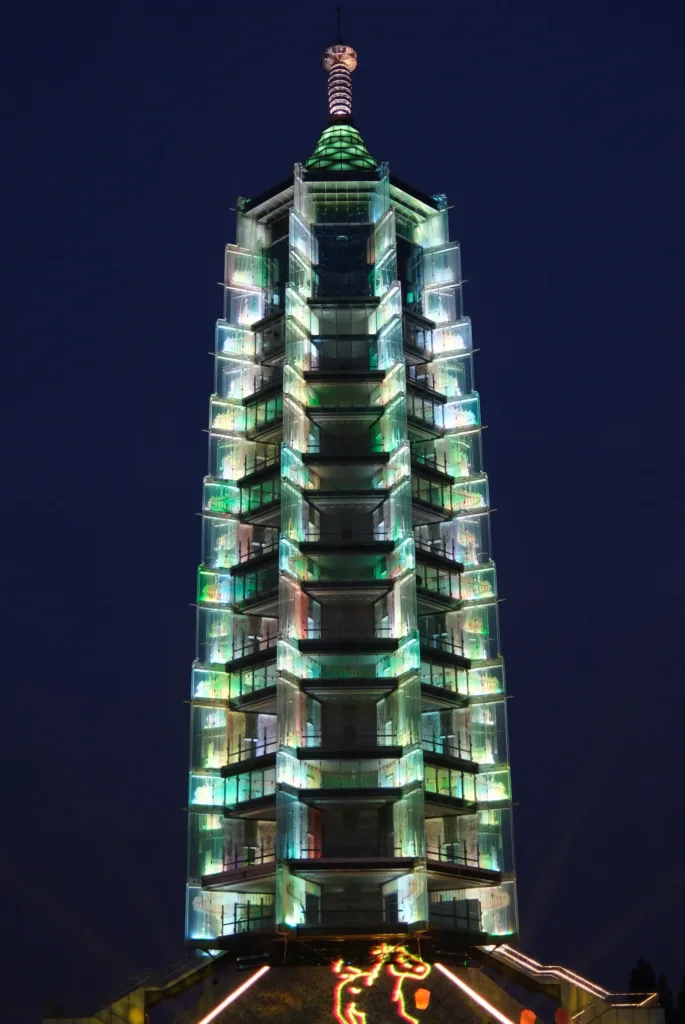
Archaeology, not rebuilding, drove the present design. Excavations from 2007 to 2010 uncovered the temple layout and, in 2008, the underground palace of the Changgan Temple’s true-body pagoda, sealed in 1011: a stone casket, an iron casket inside it, and within that a gilt-silver “seven-treasure” Ashoka pagoda holding gold and silver coffins. Plans for a 108-metre replica pagoda with lifts were dropped once the underground palace was found, and the project became a ruins park with a lightweight protective tower instead. State heritage practice discourages rebuilding monuments that no longer exist, so the design team at Southeast University Architectural Design Institute kept the original’s nine-storey form, taper and slenderness ratio while building in steel and glass: four groups of inclined steel tubes land outside the pagoda base so the loads bypass the underground palace. The glass panels are fired with glaze colour rather than being coloured glass, and the corner beams carry wind bells like the old ones. The tower measures 93 m to the top, and its ninth level opens into a 20-metre-high void under a transparent roof.
Inside the ruins park: what to look at, in order
The site is laid out facing west, and the entrance is off 雨花路 on the west side. The order below is an editorial suggestion rather than a fixed route, but it follows the axis and keeps the open-air sections for daylight: outdoor sequence first, then the covered halls and the tower.
You cross the Ming 香水桥 over the 香水河 and walk the 御道, the stone-paved approach that follows imperial practice — the same axial logic you can see at the Ming palace sites. Two large 龟趺 (tortoise pedestals) flank the way; the Yongle stele is lost, the Xuande stele survives with part of its inscription legible, and both stele pavilions are marked only by their rammed-earth platforms.
The first covered building sits over the excavation of the 天王殿 (Heavenly Kings Hall), with the trenches, column bases, brick paths and drainage channels visible under a glass floor; the hall site measures about 28.2 m by 17.6 m. The colonnades either side of the axis were the temple’s famous north and south galleries: at the north gallery, white light columns mark the bays of the vanished colonnade, and the south gallery, whose original form is lost, has been turned into an art space showing 28 reproductions of 17th- to 19th-century engravings of Nanjing and the pagoda. North of the pagoda base, the 伽蓝殿 site shows Song and Ming layers stacked in the same footprint.
The museum galleries hold what came out of the ground: the stone and iron caskets, the gilt-silver seven-treasure Ashoka pagoda — the largest found in China, about 1.17 m tall, with 452 settings for gems and more than 300 characters of donor inscriptions — gold and silver coffin sets, crystal prayer beads, and large quantities of glazed architectural components from the temple and from the kiln sites. A separate section explains Nanjing’s Buddhist history from the Jianchu Temple (建初寺), the first Buddhist temple in southern China, through the “four hundred and eighty temples” of the Southern Dynasties and the Nanjing woodblock scripture tradition. The museum also runs digital displays, including a virtual walk through the Ming pagoda and a large-scale reconstruction of it.
One point of confusion is worth settling before you go: the Buddha’s parietal-bone relic recovered here in 2010 is not displayed at this site. It has been enshrined at 牛首山 (Niushoushan) in Jiangning since 27 October 2015, and is shown to the public only on specified festival days. What the Bao’en Temple site presents is the underground palace area and the reliquary objects themselves.
Then climb the new tower. Visitors can go up, and the top levels give a view over the city wall, the Qinhuai River and 雨花台; the ascent closes earlier than the grounds do, so go up before you settle in for the evening.
Tickets, hours and the evening
Adult admission is 90 yuan, the price given by the Qinhuai District government’s page for the scenic area and by China Daily’s museum listing. Advance booking is not required: the museum dropped its reservation system on 18 July 2024, keeps its own ticket windows open for same-day sales, and accepts online purchases, card and cash, with multi-language ticket machines added for international visitors in 2024. Ticketing platforms also publish a broad concession list — free entry for children up to 6 or 1.4 m with an adult, and for visitors aged 70 and over, disabled visitors and serving or veteran military personnel; half price for ages 6–18, full-time undergraduates and visitors aged 60–69 — and every category is checked against original documents, so carry your passport. Treat that list as indicative and read the board at the gate, because the official page publishes only the 90-yuan adult price.
Opening hours are seasonal. The museum is open every day of the year and does not close on Mondays. In autumn 2026 ticketing platforms listed 8:30–20:00 with last entry around 19:15–19:30, while an earlier English listing gave 8:30–19:30 with last entry at 19:00; the park stays open late on more than 60 nights a year, so an evening session is normal rather than exceptional. Budget 1.5–3 hours for the site.
Evenings are when the tower performs: its glass skin is lit with computer-controlled LED and projection colour, and the museum has staged a “lighting ceremony” (点灯人) with recorded bells and drums, holographic calligraphy and a lantern-led walk into the darkened galleries; a limited number of free hand lanterns are handed out beforehand, first come, first served. If you want both the indoor exhibitions and the lighting, arrive in the late afternoon — one 2026 guide suggests entering between 17:00 and 18:00, and notes that the last ascent to the tower was at 18:30.
Getting there
Metro. The nearest station on Line 1 (1号线) is 中华门 (Zhonghuamen). Leave by Exit 2 and walk east: the route follows 应天大街 (Yingtian Avenue) to 雨花路 (Yuhua Road), then along the road to the gate. Local guides describe this as roughly a 950-metre walk, with the first 400 m or so taking you from the station to Yuhua Road, so allow 10–15 minutes on foot.
Line 3 (3号线) runs on a different alignment and offers two options. From 武定门 (Wudingmen) the park’s own directions run along 养虎巷 and 扫帚巷, the lanes on the 老门东 side. From 雨花门 (Yuhuamen), take Exit 4 and transfer to a bus for the site’s own stop.
Bus. Routes 16, 49, 63, 202, 701, 706 and the night route Y2 call at the stop named 大报恩寺遗址公园(建初寺) — Grand Bao’en Temple Ruins Park (Jianchu Temple) — which is the former 雨花路 stop. Two changes matter in practice: routes 2 and 38, which also served the stop, were temporarily rerouted by the Nanjing Transport Bureau from 26 June 2026 so that their calls at 大报恩寺遗址公园 and 中华门地铁站 in the direction of the metro station were suspended; and the night routes Y14 and Y20 that once stopped here have been discontinued, Y20 in November 2024 and Y14 in January 2025. Read the stop board rather than an old list.
By train. Both of Nanjing’s main rail stations sit on Metro Line 1, so the connection is direct with no interchange: from 南京站 (Nanjing Railway Station) or 南京南站 (Nanjing South Railway Station), ride Line 1 to 中华门 and continue as above. Line 3 also links both stations to 武定门 and 雨花门, which is convenient if you are coming from the 老门东 or 夫子庙 side of the city.
Taxi and driving. Give the driver 大报恩寺遗址景区 or 大报恩寺遗址博物馆, 雨花路1号 (No. 1 Yuhua Road). The visitor entrance is on the west side off Yuhua Road, and self-driving visitors are directed to the car park on the west side of the road. No metro station sits at the gate itself, so arriving by taxi or ride-hailing at the 雨花路 entrance avoids the walk from 中华门.
Around the site, and what to pair it with
The museum stands beside 中华门, the Ming city gate, and the excavated site adjoins the outer Qinhuai River; the wall, the gate and the river are all visible from the upper levels of the new tower, which makes the two a natural half-day together. On the north side, the lanes 养虎巷 and 扫帚巷 lead towards 老门东, the lane quarter inside the wall, which is why the 武定门 walking route works as a through-route rather than a detour. The rebuilt 建初寺 (Jianchu Temple) beside the park was announced at the 2015 opening as free to the public all year, unlike the ticketed ruins museum.
Two locational points are worth fixing in your head before you set out. The site is in 秦淮区 (Qinhuai District) on the south bank of the outer Qinhuai River, not on the 夫子庙 stretch of the inner river; and the Buddha’s parietal-bone relic recovered here is enshrined at 牛首山 in Jiangning, shown publicly only on specified festival days.
Combine your visit
A suggested sequence linking the specific features of this visit.
-
Historic temple-site interpretation
Begin with the original monument and its later destruction.
-
Reconstructed tower
Compare the present structure with the history it commemorates.
This order is editorial. Confirm access and any transfers between stops; it does not establish a walking route, same-day connection or common admission ticket.
Find Porcelain Tower of Nanjing
大报恩寺 · 南京市
The pin marks the area, not the entrance.
More places nearby
Approximate straight-line distances between map pins, not travel distances.
Memorial Hall of the Victims in Nanjing Massacre by Japanese Invaders 侵华日军南京大屠杀遇难同胞纪念馆
5 km awayThe Nanjing Massacre Memorial Hall stands at Jiangdongmen near a burial site associated with the killings of 1937. It combines preserved archaeological evidence with documentary exhibitions and a commemorative landscape.
View guide →John Rabe's former residence 拉贝与国际安全区纪念馆
5 km awayJohn Rabe’s former home in Nanjing interprets his life in China and the work of the Nanjing Safety Zone during the 1937 atrocities. The renewed exhibition places Rabe’s biography on the first floor and the Safety Zone’s…
View guide →Jiming Temple 鸡鸣寺
6 km awayJiming Temple rises on Jilong Hill beside the southern shore of Xuanwu Lake. Its present ensemble includes substantial modern reconstruction, including the seven-storey, eight-sided Medicine Buddha Pagoda. The Guanyin Hall is…
View guide →Sources & visit information
Sources checked on 22 October 2026. Hours, tickets, reservations and transport can change; confirm with the operator before you go.
- 景区历史·大报恩寺遗址景区 — 南京市秦淮区人民政府 ↗
- The Grand Bao'en Temple Ruins Museum — China Daily / China Services Info, updated 27 February 2025 ↗
- 深挖遗址价值激活文化记忆·你所不知道的一级馆 — 人民日报海外版, 2025年12月9日 ↗
- 南京大报恩寺重生,为何不原样复刻? — 新华日报·交汇点, 2025年6月25日 ↗
- 大报恩寺遗址公园今天开放 — 扬子晚报, 转载于东南大学, 2015年12月17日 ↗
- 金陵大报恩寺遗址公园及配套建设 / 东南大学建筑设计研究院 — 有方, 2020年11月20日 ↗
- 南京大报恩寺遗址博物馆取消预约参观机制 — 荔枝新闻, 2024年7月18日 ↗
- 南京大报恩寺遗址博物馆荣升国家一级博物馆 — 南京大学新闻网, 2024年5月18日 ↗
- 大报恩寺遗址景区开放时间与交通指南 — 去哪儿 ↗
- 公交2路、38路线路走向临时调整 — 南京市交通运输局, 2026年6月23日 ↗
- 南京大报恩寺遗址公园开放 建成耗时十多年 — 中国新闻网, 2015年12月17日 ↗
- 大报恩寺·南京 — 中文维基百科 ↗
- 南京地铁1号线 — 中文维基百科 ↗
- 南京地铁3号线 — 中文维基百科 ↗
- Porcelain Tower of Nanjing — English Wikipedia ↗
- 佛顶骨舍利 — 南京牛首山官方网站 ↗
- 去大报恩寺看新点灯仪式需要额外购票吗 — 新浪旅游, 2026年7月2日 ↗
- Seeing the Tower — Sixth Tone, 12 December 2025 ↗
- 南京大报恩寺在哪个地铁站?几号口 — 南京本地宝 ↗
Image credits & notes (1)
- The reconstructed Grand Bao'en Pagoda (大报恩塔) lit at night, June 2026. Photo: Kingswang192 (Wikimedia Commons user)Photo: CC BY 4.0