


Get to know Taicang
- Administrative area
- County-level city · 县级市
- Part of
- Suzhou
- Chinese name
- 太仓市
- Local areas
- County-level city guide
Area & population
- Area
- 794.00 km²
- Population · 2020 census
- 831,113
- Administrative seat
- Chengxiang
Source: English Wikipedia, as of the dates shown.
Taicang sits on the south bank of the Yangtze estuary, east of Kunshan and north of Shanghai. Its historic identity is not simply “another Suzhou water town”: the old port at Liuhe belonged to the maritime world of the Yangtze, while Shaxi grew along inland waterways and the central town developed its own garden culture. Taicang remains a county-level city within Suzhou’s jurisdiction, not an additional urban district beside Gusu or Wujiang.
A three-part visit
In the central town, begin at Nanyuan (南园), the Ming-period garden associated with senior official Wang Xijue. Walk slowly between the restored halls, pond-side spaces and covered passages rather than treating it as a checklist of buildings. Look for Xiu Xue Hall (绣雪堂), Tan Ying Xuan (潭影轩) and Xiang Tao Pavilion (香涛阁); the municipal guide also lists the Lou Dong Garden Display Hall and a family-history museum within the garden grounds. Seasonal lotus and chrysanthemum displays are described by the city, but their dates and scale vary, so do not plan around a guaranteed show. The current municipal visitor listing gives the address as No. 7 Nanyuan East Road (南园东路7号), a 25-yuan admission price, and seasonal opening hours of 06:30–17:00 in winter and 06:30–17:30 in summer; check the official page or venue before setting out because visitor terms can change.
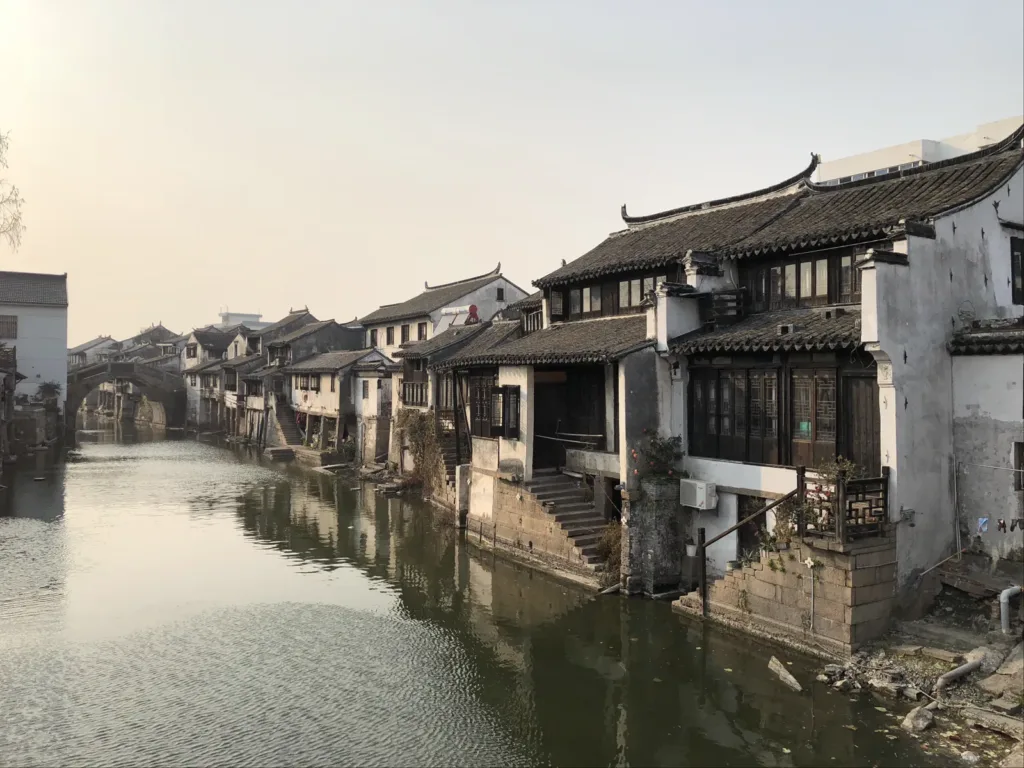
Give Shaxi (沙溪古镇) a separate half-day. The old settlement follows Qiputang River (七浦塘) and is organized around a waterway, two old streets, three bridges and an island. Walk the riverside streets and small lanes to see how bridges connect the two banks, how houses meet the water, and how the old market pattern sits within a living town. The official Suzhou account describes the named Yixing, An and Xin bridges, old shopfronts, carved interiors at Gong’s Mansion and the former residence of modern-dance pioneer Wu Xiaobang. These are cultural points to look for, not a promise that every interior or exhibition room is open on the day. Keep to public streets, respect residents’ privacy, and ask before photographing people or looking into homes.
A second, more dispersed outing leads northeast to Liuhe (浏河), at the mouth of the Loujiang waterway near the Yangtze. Its story is about shipping, river defence and the estuary: Liuhe was an important port, and local tradition connects it with the departure of Zheng He’s Ming voyages. The official town profile identifies Tianfei Palace (天妃宫) and the Military Reviewing Platform (阅兵台) as cultural landmarks, and describes views from the river embankment. Treat the public waterfront and the enclosed heritage sites separately: confirm visitor access before going to a temple or platform, and do not assume that the working port is a sightseeing pier or that a passenger boat runs.
For a simple plan, spend one day between Nanyuan and Shaxi, then use another outing for Liuhe. If you have only a few hours, choose one area rather than trying to cross the whole county-level city between appointments. Taicang’s everyday appeal is in these contrasts: a carefully composed garden, ordinary shopfronts and resident lanes beside a canal, and a working estuary whose history still shapes the town’s identity.
Getting around
There is no Taicang metro line or metro station to use for these visits. Taicang Station (太仓站) is on the operating Shanghai–Suzhou–Nantong railway. By contrast, the Shanghai–Suzhou–Wuxi–Changzhou intercity railway’s Taicang lead section was still in construction in the municipal report; do not treat a future intercity connection as a current metro transfer. Check the exact station printed on your China Railway 12306 ticket and the live train schedule before travel.
For Nanyuan, a taxi or ride-hail can be addressed to 太仓市南园东路7号. Use a legal public drop-off by the garden entrance; do not ask a driver to enter a pedestrian lane. Taicang’s municipal visitor page lists local bus routes 105 (toward 大润发) and 107, 111 or 129 (toward 城区换乘站), but it does not provide a current stop-by-stop walking instruction to the gate. Check the live bus direction and final walk before boarding rather than assuming the old listed interchange is still the best stop.
For Shaxi, use the destination 沙溪古镇景区,江苏省苏州市太仓市白云中路142号 and ask the driver to stop at a legal public access point or visitor parking area, not in the narrow historic lanes. A current transit listing shows Taicang routes 204, 205 and 206 serving the old-town area; its nearest named stop is Changshou Road (长寿路), with Shaxi Town Government (沙溪镇政府) and Shaxi Bus Station (沙溪车站) also listed nearby. Check the route direction and last return bus on the day; no departure interval or last-service time is promised here.
Liuhe is a separate town rather than an extension of the Shaxi old-town walk. If you go, enter 浏河镇 Liúhé Zhèn as the destination and confirm the exact public waterfront or heritage-site entrance with the local operator before departure; this guide does not assign a single taxi drop-off to the whole town. No passenger ferry or visitor boat route is verified here.
Guide sources
- Taicang Municipal Government — Taicang Overview
- Taicang Municipal Government — Nanyuan
- Suzhou Municipal Government — Shaxi Town of Taicang City
- Suzhou Municipal Government — Liuhe Town of Taicang
- China State Railway Group — Shanghai–Suzhou–Nantong Railway Opens
- Moovit — Public Transport to Shaxi Ancient Town
- Wing On Travel — Shaxi Ancient Town address
- Jiangsu Public News — Suzhou Administrative Divisions
- Suzhou Municipal Government — Taicang Intercity Railway Construction
Explore Taicang
Core places to explore, with English and Chinese names.
Places to explore around Taicang
 Canal-side homes and boats in Taicang Shaxi’s Zhongshi historic district, photographed in 2017. Photo:
Plan your visit
Getting there
Taicang is about 60 km (straight-line distance) from central Suzhou. Search for 太仓市 in a map app to find stations and your accommodation.
Where to stay →Build your route
Start with Shaxi Ancient Town. The linked place guides have entrance and visit details.
Continue with Suzhou →More in Suzhou
Sources & geographic information
Administrative names and parent areas: Official geographic directory (dmfw.mca.gov.cn) · Reference date 2026-09-06.
Background text adapted from Taicang — Wikipedia contributors, under CC BY-SA 4.0. Text has been shortened and reorganized; source revision 1366477269.
Map data © OpenStreetMap contributors. Pins mark approximate centres, not entrances or boundaries.
Image credits & notes (2)
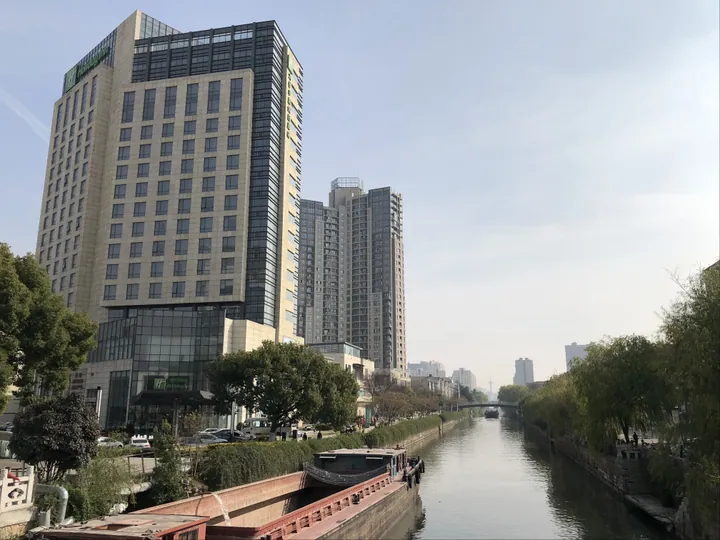
- Canal view from Maiyang Bridge towards buildings along the Yantie Tang canal in Taicang · 太仓卖秧桥眺望盐铁塘两岸建筑Photo: 白色瑰宝 · CC BY-SA 4.0 · taken 2017-12-23Resized for the web; the photo itself has not been edited. Thumbnails may show a cropped view.
- Historic houses along the Hengli River in Shaxi, Taicang. Photo: 白色瑰宝Photo: CC BY-SA 4.0
