

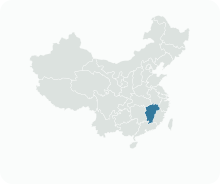
Get to know Ji'an County

Photo adjustments
Full frame retained; EXIF orientation normalized, proportionally resized to at most 800 pixels and converted to WebP. No generated pixels or subject changes. Cards may crop the display.
- Administrative area
- County · 县
- Part of
- Ji'an
- Chinese name
- 吉安县
- Local areas
- County guide
Area & population
- Area in the source
- 2,117.00 km²
Source: cited geographic source, as of the dates shown.
History
Luling County was created in 221 BC, when the Qin divided the empire into commanderies and counties; the classical geography Shuijing Zhu (水经注) says it was named after the Lu River (泸水). The name Ji'an first appeared in 1295, when the Yuan made the area Ji'an Circuit (吉安路), and Luling County itself was renamed Ji'an County in 1914 after Ji'an Prefecture was abolished. The county seat moved out of Ji'an city to the new town of Dunhou (敦厚镇) in November 1979.
The county was an important part of the Jinggangshan revolutionary base. Jiangxi Daily writes that it produced Zeng Shan (曾山) and 46 generals of the founding generation of the People's Republic, and calls it a nationally known "generals' county" (将军县).
What to see
The Jizhou kiln at Yonghe (永和镇) was founded in the Tang dynasty and flourished under the Song; porcelain firing there continued into the late Ming, a span of about 600 years. The kiln site is a major historical and cultural site protected at the national level. Jiangxi Daily describes Song-era Yonghe as a town with streets such as Porcelain Street (瓷器街), three markets and 24 large dragon kilns whose fires lit the night sky, and notes that the scenic area now shows the uncovered kiln mounds and offers pottery-making sessions.
Langshi Village (朗石古村) in Denglong (登龙乡) has 120 old buildings and sites, among them 11 revolutionary sites and 22 legible Red Army slogans on the old houses. Jiangxi Daily also names two newer leisure scenic areas, Yuntian Lugu (云天麓谷) in Tongping (桐坪镇) and Dafeng Tianyuan (大丰田园).
Food and local products
Hengjiang (横江镇) grows grapes on 12,000 mu, and the town has held an annual grape festival at Gongtang Village (公塘村) since 2004. The county also produces Jinggang pomelos (井冈蜜柚), Dachong passion fruit (大冲百香果) and Youtian black wood-ear fungus (油田黑木耳).
Highlights
- Jizhou kiln site 吉州窑遗址: Tang-founded, Song-era porcelain kiln at Yonghe, fired for about 600 years; national-level protected site.
- Langshi Village 朗石古村: Old village in Denglong with 11 revolutionary sites and 22 legible Red Army slogans.
- Hengjiang grapes 横江葡萄: Grown on 12,000 mu in Hengjiang; grape festival held every year since 2004.
Sources for this guide
吉安县 · Wikipedia (Chinese) · CC BY-SA 4.0
吉州窑 · Wikipedia (Chinese) · CC BY-SA 4.0
江西吉安县:织就全域旅游璀璨画图 · Jiangxi Daily, via People's Daily Online (Jiangxi)
Original English written from the listed sources and checked sentence by sentence against quoted extracts by a separate reviewer. Updated 2026-09-25.
Explore Ji'an County
Core places to explore, with English and Chinese names.
Places to explore around Ji'an County
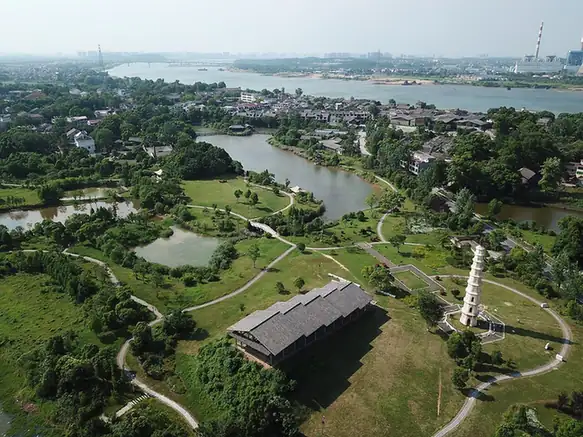 Jizhou Kiln Site ·
 Plan your visit
Getting there
Ji'an County is about 35 km in a straight line from central Ji'an. Search for 吉安县 in a map app to find stations and your accommodation.
Where to stay →Build your route
Start with Jizhou Kiln Site. The linked place guides have entrance and visit details.
Continue with Ji'an →More in Ji'an
Sources & geographic information
Administrative names and parent areas: Official geographic directory · Reference date 2026-09-06.
Some facts checked against 吉安县 — Wikipedia contributors, CC BY-SA 4.0.
Some facts checked against 吉州窑 — Wikipedia contributors, CC BY-SA 4.0.
Photo: Jizhou Kiln Site · Zhangzhugang · CC BY-SA 4.0. EXIF orientation normalized; resized without changing aspect ratio; converted to WebP. No subject edits.

Map data © OpenStreetMap contributors. Pins mark approximate centres, not entrances or boundaries.