

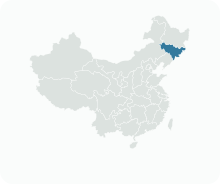
Get to know Fusong County

Photo adjustments
Full frame retained; EXIF orientation normalized, proportionally resized to at most 800 pixels and converted to WebP. No generated pixels or subject changes. Cards may crop the display.
- Administrative area
- County · 县
- Part of
- Baishan
- Chinese name
- 抚松县
- Local areas
- County guide
Area & population
- Area in the source
- 6,150.00 km²
- Administrative seat
- Fusong Town (抚松镇)
Source: cited geographic source, as of the dates shown.
Setting and landscape
The Erdao Songhua River (二道松花江) marks the northern boundary with Huadian (桦甸市) and Dunhua (敦化市); to the east Fusong reaches Antu County (安图县) and the North Korean border, and to the west it faces Jingyu County (靖宇县) across the river. The land tilts down from southeast to northwest over a drop of 2,383 metres, from the summit of Baiyun Peak (白云峰), 2,691 metres high, to Sanjiangkou (三江口) in Xingshen town at 308 metres. The county government lists 86.7 percent forest cover.
Winters are long and cold with deep snow, summers are short and fairly hot, with the rain concentrated in them, and locals speak of a late-spring cold snap (倒春寒) and an autumn 'little spring' (小阳春). Temperature falls with altitude, and the frost-free period varies widely, from 79 to 150 days.
Food and local products
The Wanliang Changbai Mountain Ginseng Market (万良长白山人参市场) is described by the county government as the largest in the world, and ginseng also grows under the forest canopy as wild-simulated mountain ginseng. The county has 41 mineral-water sources considered worth developing, drawing on deep volcanic and basalt rock, and the Jilin provincial government named it a Changbai Mountain natural mineral-water base in 2003. In 2006 Fusong was named 'home of Chinese blueberries' (中国蓝莓之乡); large blueberry parks include Xinglong Dadianzi (兴隆大甸子) and Wanliang Yicuomao (万良一撮毛).
History
The county was approved by the Qing court in January 1910 with its seat at Shuangdianzi (双甸子), now Fusong town, named for two stretches of meadow along the Malu gully. It took the name Fusong in August 1910 and came under Hunjiang city, today Baishan, in 1985. Ginseng hunting customs of Changbai Mountain (长白山采参习俗) are on the national intangible heritage list, and Changbai Mountain ginseng stories are on the provincial list. Jinjiang Log Cabin Village (锦江木屋村) in Manjiang town was among the first 50 traditional villages chosen for whole-village conservation, the only one in the three northeastern provinces.
Highlights
- Jinjiang Log Cabin Village 锦江木屋村: Village in Manjiang town on the first list of 50 Chinese traditional villages for whole-village conservation.
- Wanliang Changbai Mountain Ginseng Market 万良长白山人参市场: Ginseng market the county government describes as the largest in the world.
- Changbai Mountain ginseng hunting customs 长白山采参习俗: National intangible cultural heritage item from Fusong.
Sources for this guide
抚松县人民政府 — 自然地理 · Fusong County People's Government
抚松县人民政府 — 历史概况 · Fusong County People's Government
Original English written from the listed sources and checked sentence by sentence against quoted extracts by a separate reviewer. Updated 2026-09-25.
Explore Fusong County
Core places to explore, with English and Chinese names.
Fusong County 抚松县
Plan your visit
Getting there
Fusong County is about 100 km in a straight line from central Baishan. Search for 抚松县 in a map app to find stations and your accommodation.
Where to stay →More in Baishan
Sources & geographic information
Administrative names and parent areas: Official geographic directory · Reference date 2026-09-06.
Map data © OpenStreetMap contributors. Pins mark approximate centres, not entrances or boundaries.