

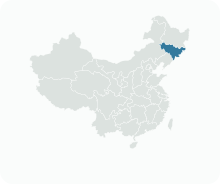
Get to know Kuancheng District

Photo adjustments
Full frame retained; proportionally resized and converted to WebP. No retouching or changes to the photographed subject. Card displays may crop the view.
- Administrative area
- District · 市辖区
- Part of
- Changchun
- Chinese name
- 宽城区
- Local areas
- District guide
Area & population
- Area in the source
- 877.00 km²
- Population · 2010
- 680,631
Source: cited geographic source, as of the dates shown.
History
In October 1937 the city of Xinjing (新京), as Changchun was then called, divided Changchun into 18 districts, creating Kuancheng north of the tracks and naming it after Kuanchengzi Station (宽城子站). The Beijing–Harbin railway still crosses the district, and the district has traditionally been divided into the parts south and north of the line (铁南, 铁北).
What to see
In May 1898 crews of the Russian-built Chinese Eastern Railway (东清铁路) put up Kuanchengzi Station about 10 kilometres west of old Changchun. After the Russo-Japanese War, Japan took the southern branch and opened a temporary Changchun station in August 1907. A permanent station building went up between 1913 and 1914, designed by Aoki Kikujiro (青木菊治郎) and Hirasawa Gihei (平泽仪平). The station was called Xinjing from November 1932 and became Changchun again in 1945. It is now a special-class passenger station and the starting point of the Changchun–Tumen railway and the Changchun–Hunchun intercity line.
The Museum of the Imperial Palace of Manchukuo stands at 5 Guangfu North Road (光复北路). Puyi moved his executive office here on 3 April 1932, into buildings that had housed the Jilin and Heilongjiang salt administration. After he took the title of emperor in 1934 the complex became his palace, with an outer court for government business and an inner court for the imperial household, until Japan's surrender in August 1945. An exhibition hall opened on the site in 1962; the museum opened to the public in 1984 and took its present name in 2001. The palace became part of a major national protected site in 2013, and the Chinese Museums Association rated it a national first-grade museum in 2017.
Getting oriented
Changchun Station, in the district, serves the Beijing–Harbin, Changchun–Baicheng and Changchun–Tumen railways and the Changchun–Hunchun intercity railway.
Highlights
- Museum of the Imperial Palace of Manchukuo 伪满皇宫博物院: Puyi's office and residence from 1932 to 1945; a national first-grade museum since 2017.
- Changchun Station 长春站: Main building of 1913–1914, designed by Aoki Kikujiro and Hirasawa Gihei; named Xinjing Station from 1932 to 1945.
Sources for this guide
宽城区 - 维基百科,自由的百科全书 · Wikipedia (Chinese) · CC BY-SA 4.0
长春站 - 维基百科,自由的百科全书 · Wikipedia (Chinese) · CC BY-SA 4.0
伪满皇宫博物院 - 维基百科,自由的百科全书 · Wikipedia (Chinese) · CC BY-SA 4.0
Original English written from the listed sources and checked sentence by sentence against quoted extracts by a separate reviewer. Updated 2026-09-25.
Explore Kuancheng District
Core places to explore, with English and Chinese names.
Places to explore around Kuancheng District
 Museum of the Imperial Palace of Manchukuo in Changchun, photographed in 2018.
Plan your visit
Getting there
Kuancheng District covers the centre of Changchun. Search for 宽城区 in a map app to find stations and your accommodation.
Where to stay →Build your route
Start with Museum of the Imperial Palace of Manchukuo. The linked place guides have entrance and visit details.
Continue with Changchun →More in Changchun
Sources & geographic information
Administrative names and parent areas: Official geographic directory · Reference date 2026-09-06.
Some facts checked against 宽城区 — Wikipedia contributors, CC BY-SA 4.0.
Some facts checked against 长春站 — Wikipedia contributors, CC BY-SA 4.0.
Some facts checked against 伪满皇宫博物院 — Wikipedia contributors, CC BY-SA 4.0.
Photo: Museum of the Imperial Palace of Manchukuo · xiquinhosilva · CC BY 2.0. Wikimedia thumbnail; fitted to the ranking-card frame.

Map data © OpenStreetMap contributors. Pins mark approximate centres, not entrances or boundaries.