

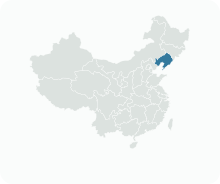
Get to know Xishi District

Photo adjustments
Full frame retained; proportionally resized and converted to WebP. No retouching or changes to the photographed subject. Card displays may crop the view.
- Administrative area
- District · 市辖区
- Part of
- Yingkou
- Chinese name
- 西市区
- Local areas
- District guide
Area & population
- Area in the source
- 268.30 km²
- Population · 2020 census
- 212,913
Source: cited geographic source, as of the dates shown.
History
When Yingkou port opened to foreign trade in 1861, Xishi became a trading hub linking China inside the Great Wall with the lands beyond it, and was nicknamed the 'Shanghai beyond the pass' (关外上海). Its present name dates from 1957.
What to see
The West Battery site (西炮台遗址), first called the Yingkou Great Battery, stands on the Bohai shore on the left side of the Liao River mouth. The Qing ordered it in 1881 to guard the gateway to the Northeast and finished it in 1886. Three gun platforms, a large one between two smaller ones, sit inside a moat, walls and gates, with a magazine and barracks, over about 60,000 square metres. Japanese troops wrecked it in 1894, and Russian forces stripped its barracks in 1900. Pearl River Film Studio (珠江电影制片厂) restored its original look in 1987 while shooting the film 'The Qing Artillery' (大清炮队), and a replica Krupp gun was mounted on the main platform in 2013. It was listed as a national key cultural relic in 2006.
The district government also lists Liaohe Old Street (辽河老街), the memorial hall of the Yingkou group of the Communist Party's Fengtian branch (中共奉天支部营口小组纪念馆), the Mogouying site (没沟营遗址), Xida Temple (西大庙) and Yongyuanjiao Wetland Park (永远角湿地公园) among its historic and tourist sites.
Setting and landscape
Liaodong Bay and the Liao River meet off the district's western edge, and the government counts more than 40 wild aquatic species there worth catching. To the south the Dahan River (大旱河) marks the border with Gaizhou, to the east Xinhua Road and Tiyu Road mark the border with Zhanqian District, and to the north the Liao River bridge leads straight to Panjin (盘锦).
Highlights
- West Battery site 西炮台遗址: Qing coastal battery of 1881–1886 at the Liao River mouth; national key cultural relic since 2006.
- Liaohe Old Street 辽河老街: Listed by the district government among its historic sites.
- Yongyuanjiao Wetland Park 永远角湿地公园: Wetland park named by the district government among its tourist sites.
Sources for this guide
西市概况 · Xishi District People's Government, Yingkou
西市区 · Wikipedia (Chinese) · CC BY-SA 4.0
西炮台遗址 · Wikipedia (Chinese) · CC BY-SA 4.0
站前区 · Wikipedia (Chinese) · CC BY-SA 4.0
Original English written from the listed sources and checked sentence by sentence against quoted extracts by a separate reviewer. Updated 2026-09-26.
Explore Xishi District
Core places to explore, with English and Chinese names.
Xishi District 西市区
Plan your visit
Getting there
Xishi District is about 5 km in a straight line from central Yingkou. Search for 西市区 in a map app to find stations and your accommodation.
Where to stay →More in Yingkou
Sources & geographic information
Administrative names and parent areas: Official geographic directory · Reference date 2026-09-06.
Some facts checked against 西市区 — Wikipedia contributors, CC BY-SA 4.0.
Some facts checked against 西炮台遗址 — Wikipedia contributors, CC BY-SA 4.0.
Some facts checked against 站前区 — Wikipedia contributors, CC BY-SA 4.0.
Map data © OpenStreetMap contributors. Pins mark approximate centres, not entrances or boundaries.