


Get to know Hualong Hui Autonomous County

Photo adjustments
Full frame retained; proportionally resized and converted to WebP. No retouching or changes to the photographed subject. Card displays may crop the view.
- Administrative area
- Autonomous county · 自治县
- Part of
- Haidong
- Chinese name
- 化隆回族自治县
- Local areas
- Autonomous county guide
Area & population
- Area in the source
- 2,740.00 km²
- Population · 2020
- 200,474
- Administrative seat
- Bayan
Source: cited geographic source, as of the dates shown.
Setting and landscape
The county rises from 1,884 to 4,484 metres, and the county government sums up its ground as "八分山、一分水、一分川" (eight parts mountain, one part water, one part valley floor). The Yellow River flows for 168 km through Hualong, which carries seven large and medium hydropower stations; fish farms along it raise rainbow trout, golden trout and whitefish.
History
Before the Qin the area was Qiang pasture. The name dates from 553, when the Western Wei renamed Shicheng County (石城县) after the Hualong Valley (化隆谷). In 1373 the Ming placed it under the Xining Garrison, and in 1744 the Qing set up the Bayan Rongge sub-prefecture (巴燕戎格抚番厅) at today's Bayan. It became Barong County in 1913, Bayan County in 1929 and Hualong County again in 1931, then a Hui autonomous area in the early 1950s and an autonomous county in 1955.
What to see
Qunke New Area (群科新区), a new town in the Yellow River valley at about 1,800 metres, has lined its streets with apricot, pear and other local fruit trees; Qunke town has grown apricots for more than fifty years. The county counts 352 mosques and 56 Tibetan Buddhist monasteries.
Food and local products
Qunke hand-held mutton (群科手抓羊肉) is on Qinghai's provincial intangible-heritage list. Haidong Daily describes cooks using Tibetan-breed grass-fed sheep of under 15 kg, putting the meat into cold water, skimming it at the boil and then simmering and resting it for nearly three hours, seasoned mainly with salt and Sichuan pepper and a little black cardamom (草果). Locals drink it with wheat tea, called "尤吉" (yuji), made by roasting local wheat until brown, crushing it and boiling it with a little salt; guests are served eight-treasure lidded-bowl tea (八宝盖碗茶) with goji berries, dried apple, raisins, red dates and chrysanthemum.
Hualong is also the home county of many hand-pulled noodle cooks. In August 1988 Ma Guifu (马贵福) of Hualong and his friend Han Lu (韩录) opened a halal noodle shop near Xiamen railway station, and others followed them out of the county; because Lanzhou beef noodles were better known, most of these shops traded as "兰州拉面" (Lanzhou lamian). The county government counts about 18,000 such shops across China, and in some cities they have been renamed "青海拉面" (Qinghai lamian).
Getting oriented
Xunhua (循化) and Jianzha (尖扎) counties face Hualong across the Yellow River to the south. Minhe lies to the east, Huangzhong and Guide to the west, and Ping'an and Ledu to the north.
Highlights
- Qunke hand-held mutton 群科手抓羊肉: Provincial intangible-heritage mutton slow-cooked for nearly three hours with salt and Sichuan pepper, eaten with wheat tea.
- Qunke New Area 群科新区: New town in the Yellow River valley at about 1,800 metres with apricot- and pear-lined streets.
- Eight-treasure lidded-bowl tea 八宝盖碗茶: Guest tea brewed with goji berries, dried fruit, red dates and chrysanthemum.
Sources for this guide
化隆回族自治县 - 维基百科,自由的百科全书 · Chinese Wikipedia · CC BY-SA 4.0
总体概况 - 化隆回族自治县人民政府 · Hualong Hui Autonomous County People's Government
历史概况 - 化隆回族自治县人民政府 · Hualong Hui Autonomous County People's Government
群科手抓背后的匠心与传承 · Haidong Daily (republished on the Hualong county government portal)
“果树进城”扮靓群科新区 · Haidong Daily (republished on the Hualong county government portal)
Original English written from the listed sources and checked sentence by sentence against quoted extracts by a separate reviewer. Updated 2026-09-26.
Explore Hualong Hui Autonomous County
Core places to explore, with English and Chinese names.
Places to explore around Hualong Hui Autonomous County
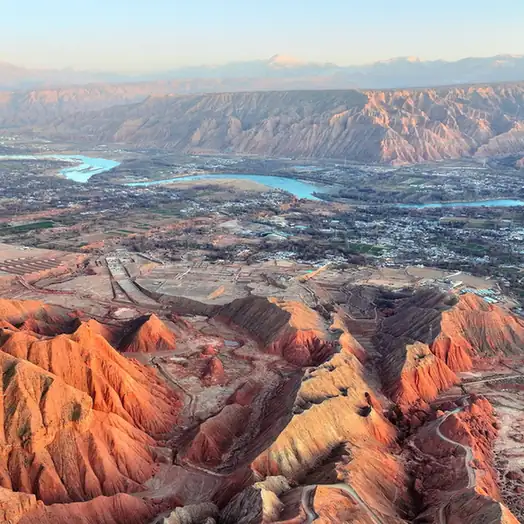 Qunke New District Yellow River Waterfront ·
 Plan your visit
Getting there
Hualong Hui Autonomous County is about 45 km in a straight line from central Haidong. Search for 化隆回族自治县 in a map app to find stations and your accommodation.
Where to stay →Build your route
Start with Qunke New District Yellow River Waterfront. The linked place guides have entrance and visit details.
Continue with Haidong →More in Haidong
Sources & geographic information
Administrative names and parent areas: Official geographic directory · Reference date 2026-09-06.
Some facts checked against 化隆回族自治县 — Wikipedia contributors, CC BY-SA 4.0.
Photo: Qunke New District Yellow River Waterfront · Source photographer · License not provided. EXIF orientation normalized; resized without changing aspect ratio; converted to WebP. No subject edits.
Map data © OpenStreetMap contributors. Pins mark approximate centres, not entrances or boundaries.