

Photo adjustments
Full frame retained; proportionally resized and converted to WebP. No retouching or changes to the photographed subject. Card displays may crop the view.
Explore the region
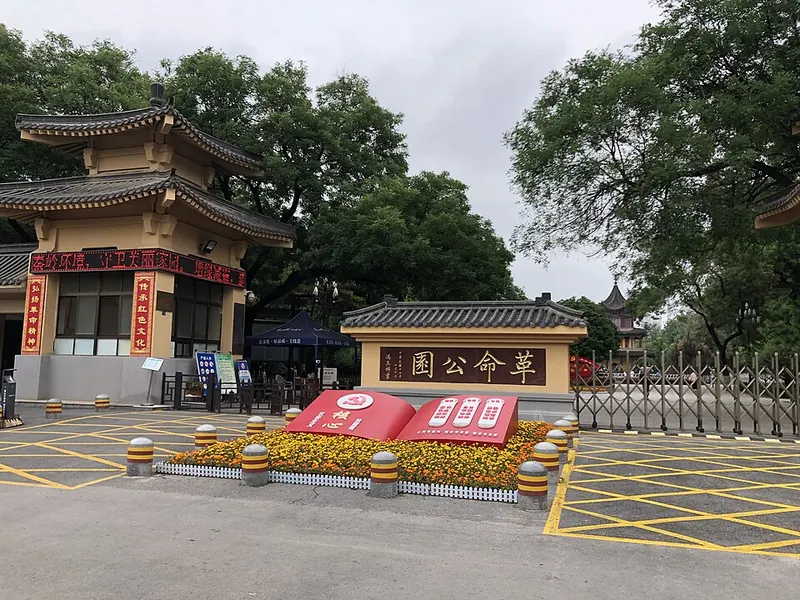
About Revolution Park
Its burial mounds and memorial architecture give the green space a purpose beyond recreation. The central Revolution Pavilion incorporates a building moved from the old examination compound, while statues and inscriptions add later commemorative layers. A quiet walk between these elements helps separate the park’s original memorial story from its everyday city-park use.
The park originated when the National Allied Army (国民联军) formed a preparatory committee in mid-December 1926 to hold a mass memorial for those who died in that year's siege of Xi'an, choosing a site at the city's northeast corner. On 12 March 1927, the army's Shaanxi command held a memorial and burial ceremony attended by more than 100,000 troops and civilians, including Feng Yuxiang (冯玉祥), Liu Bojian (刘伯坚) and Yu Youren (于右任); participants carried earth from the northern suburb of Caotan (草滩) to form two mounds holding 3,043 unidentified remains, men to the east and women to the west.
The park was renamed Dongfeng Park (东风公园) during the Cultural Revolution and restored to its original name in 1972. It was listed as a Shaanxi provincial cultural relic protection unit in 2003 and became a Major Historical and Cultural Site Protected at the National Level (全国重点文物保护单位) in 2019.
According to local tradition, a Taihu stone (太湖石) in the fountain pool in front of Revolution Pavilion (革命亭) came from the Tang-era Xingqing Palace (兴庆宫). The park's sculptures include bronze statues of Generals Yang Hucheng (杨虎城) and Xie Zichang (谢子长) and a white marble statue of General Liu Zhidan (刘志丹).
What to look for
- The memorial burial mounds associated with victims of the 1926 siege.
- Revolution Pavilion, adapted from the former examination compound’s Mingyuan Tower.
Location & getting there
Getting to Revolution Park
Go to 53 Xiwu Road in Xincheng District, inside the northeastern part of the old city.
- Use the park’s signed public entrance from Xiwu Road to begin at the memorial grounds.
Combine your visit
Suggested order within this visit:
-
Memorial grounds
Start with the siege victims commemorated by the park.
-
Revolution Pavilion
Look at the reused examination-building architecture.
-
Statues and inscriptions
Compare later commemorative additions with the original memorial purpose.
This sequence is an editorial suggestion based on the features described in the sources. Access to individual buildings or areas should be checked locally; no travel time or shared admission is implied.
Find Revolution Park
革命公园 · 新城区
The pin marks the area, not the entrance.
More places nearby
Approximate straight-line distances between map pins, not travel distances.
Eighth Route Army Xi’an Office Memorial 八路军西安办事处纪念馆
Less than 1 km awayThe Eighth Route Army’s Xi’an office occupied the western courtyard of Qixianzhuang, a compact residential compound near Beixin Street. From 1937 to 1946 it served as a liaison and supply base connecting Communist forces with…
View guide →Yongxingfang Food and Culture Quarter 永兴坊
1 km awayYongxingfang is a modern food-and-culture quarter inside Zhongshan Gate, designed to introduce traditions from across Shaanxi in a compact space. Its Guanzhong, northern Shaanxi and southern Shaanxi lanes make regional…
View guide →Muslim Quarter 回民街
2 km awayXi’an’s Hui neighbourhood is a network of residential and commercial lanes northwest of the Bell Tower, rather than a single food street. Beiyuanmen is its best-known visitor approach, with other streets such as Xiyangshi and…
View guide →Sources & visit information
The linked encyclopedia sources support background and place descriptions. Current opening hours, ticket prices, booking rules and transport schedules have not been independently verified for this guide. Confirm them with the venue or operator before travelling.
Visitor information adapted and edited from Wikipedia contributors · CC BY-SA 4.0. Source revision 94136903.
Background paragraphs translated and condensed from Wikipedia contributors, "革命公园", Chinese Wikipedia · CC BY-SA 4.0. Source revision 94136903.