

Explore the region
Tap any red Chinese text to hear it in Mandarin.
Water, forest and village landscape
Jiuzhaigou sits in Zhangzha Town of Jiuzhaigou County, within Ngawa Tibetan and Qiang Autonomous Prefecture. The name refers to nine Tibetan villages that once stood in the valley. The scenic area’s own account says that three villages remain inside the park—Shuzheng, Heye and Zechawa—so the place is not only a sequence of viewpoints but also a managed mountain landscape with a living cultural presence.
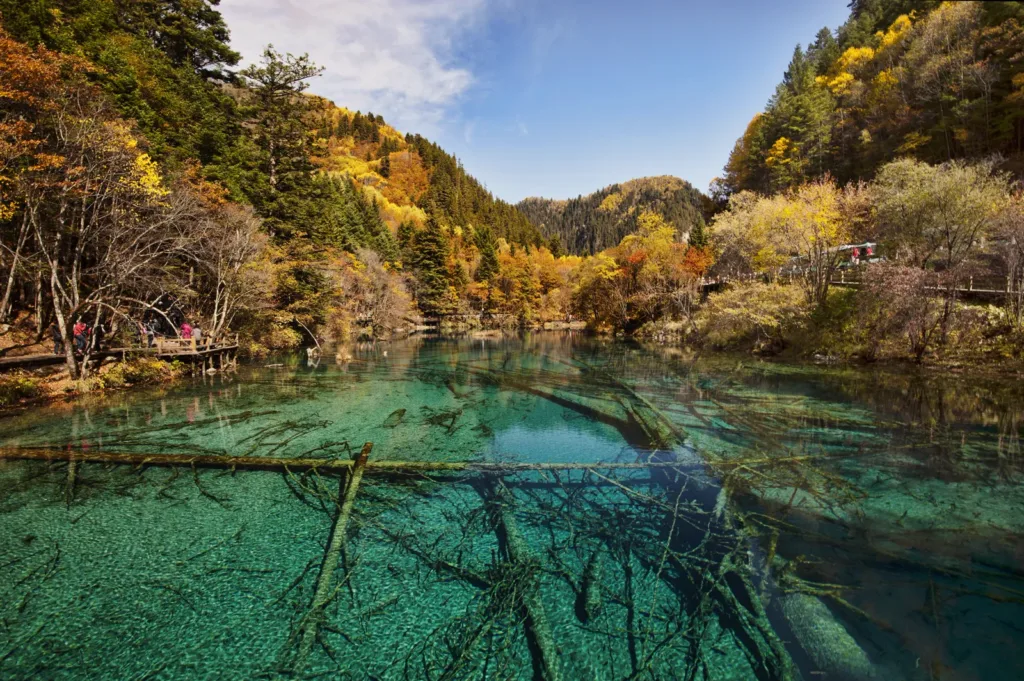
The strongest reason to come is the way the water keeps changing as you move. Mineral-rich lakes hold reflections of conifer slopes and snow peaks; submerged timber shows through clear water; shallow mineral banks divide one pool from the next; and waterfalls link the still surfaces into a continuous soundscape. UNESCO describes the wider 72,000-hectare heritage area as a set of forest ecosystems with narrow conic karst landforms, waterfalls and important wildlife habitat. A normal sightseeing visit should be treated as landscape observation, not as a panda-spotting excursion.
The valley’s cultural details are quiet rather than staged. You may see a village name, a white stupa or prayer flags among the forest and water. Observe from the signed visitor areas, ask before photographing residents, and do not treat homes or religious objects as props. Keep to managed paths, never feed wildlife or fish, and leave closed or protected areas alone.
How to read the three branches
The park is laid out as a Y. Shuzheng Valley forms the lower stem, while Rize Valley and Zechawa Valley branch above it. Rize is the branch for Five Flower Lake, Pearl Shoal and its waterfall, Mirror Lake and the upper forest-and-lake scenery. Zechawa is the more open high-valley branch, centred on Long Lake and Five-Colored Pond. Shuzheng brings together grouped lakes, cascades, Reed Lake, Bonsai Beach and Shuzheng Village.
Use the park’s sightseeing buses to cover the long transfers, then slow down on the designated boardwalks. A useful first visit is to compare one still lake with one moving-water site: look at how the submerged trunks, mineral edges and reflected trees change when the light or wind changes. The official route advice combines bus travel with walking, but it is an editorial visiting sequence rather than a promise that every stop or connection will operate unchanged on your date.
Tickets and current conditions
The administration announced that the whole scenic area reopened from 30 July 2026 after a local debris-flow response. Check the latest notice before travelling because weather, safety work and daily operating arrangements can change.
For the current seasonal bands, the official ticket page lists the peak season as 1 April–15 November, with an entrance ticket of CNY 190 and a sightseeing-vehicle ticket of CNY 90. From 16 November to 31 March, the listed prices are CNY 80 for entry and CNY 80 for the sightseeing vehicle. The park’s English visitor information lists opening hours of 07:30–18:00 in peak season and 08:30–18:00 in the off-season.
The ticket page says every visitor must make a real-name reservation and carry the original valid identity document for inspection. It does not spell out how a foreign passport is entered in the booking system. If you are travelling on a passport, confirm that the official booking channel accepts your document details before payment; do not assume that a domestic-ID workflow applies. Visitors must leave before 18:00, and overnight stays inside the scenic area are not allowed.
Getting there and getting back
The scenic area is in Zhangzha Town; the English operator page gives the park administration address as Zhang Zha Zhen, 623402, Aba, Sichuan. Do not use the county name alone when arranging the final transfer: Jiuzhaigou County and Jiuzhaigou Valley are different map targets.
By rail, use Huanglong-Jiuzhai Railway Station 黄龙九寨站 in Chuanzhusi Town, Songpan County, as a regional arrival point, not as the park gate. The scenic-area arrival page describes the station as about 93 km and roughly two hours from Jiuzhaigou Scenic Area, with direct scenic-area shuttle buses intended to connect the station and the valley. The station’s 2026 expansion is complete and the local government reports that rail and local transport agencies dynamically operate shuttle buses to Huanglong and Jiuzhaigou. The national railway authority identifies the station as part of the operating Zhenjiangguan–Huangshengguan section that connects the region to the rail network. Check the current departure, ticket and return arrangements before you commit to a same-day train connection.
By air, Jiuzhai Huanglong Airport 九寨黄龙机场 is in Chuanzhusi Town, Songpan County. The scenic-area page gives the journey to the Jiuzhaigou gate as about 88 km and around one and a half hours, and says airport passenger services run buses towards major scenic areas. Flight patterns and road transfers are weather-sensitive, so confirm the current service rather than relying on an old timetable.
By road, the operator describes a western approach from Chengdu through Wenchuan, Maoxian and Songpan, and an eastern approach from Mianyang through Jiangyou and Pingwu. These are route directions, not fixed departures. For either a coach or a private car, keep the Chinese destination 九寨沟景区游客中心/沟口 Jiǔzhàigōu Jǐngqū Yóukè Zhōngxīn / Gōukǒu ready and confirm where you will rejoin your return transport after leaving the park.
Combine your visit
Suggested order for the visit:
-
Rize Valley
Choose the open lake and waterfall stops on the assigned internal-bus route.
-
Zechawa Valley
Make a separate valley branch for the long-lake and coloured-pool landscape.
-
Shuzheng Valley
Use the return valley for grouped lakes and cascades.
This is an editorial sequence of named spaces or places. It does not imply a verified walking connection or promise opening, ticket availability or a journey time.
Find Jiuzhaigou Valley
九寨沟 · 九寨沟县
The pin marks the area, not the entrance.
More places nearby
Approximate straight-line distances between map pins, not travel distances.
Huanglong Scenic and Historic Interest Area 黄龙风景名胜区
51 km awayHuanglong is a mountain valley distinguished by a sequence of travertine pools, mineral formations and waterfalls. The pale terraces and colored water are part of a natural system, set among forests and high peaks rather than…
View guide →Songpan Ancient City 松潘古城
67 km awaySongpan’s old city is shaped by its fortified gates and the Min River running through the built-up area. Gusong Bridge gives a close view of the water and the houses along its banks, while the surrounding streets retain a busy…
View guide →Bao'en Temple, Pingwu 平武报恩寺
106 km awayBao’en Temple in Pingwu is arranged around a main axis, with galleries linking halls into enclosed courts. Its most distinctive objects are architectural in scale: a many-armed Guanyin carved from nanmu wood in Dabei Hall and an…
View guide →Sources & visit information
Sources checked on 24 October 2026. Hours, tickets, reservations and transport can change; confirm with the operator before you go.
Image credits & notes (1)
- Five Flower Lake in Rize Valley, Jiuzhaigou Valley National Park, Sichuan, photographed in autumn 2011. Photo: ChensiyuanPhoto: CC BY-SA 4.0