

Explore the region
What to see and how to explore
“Guanxian” recalls the historic county name: the name remained in use for 612 years before the county was abolished and Dujiangyan City established in 1988. The town is in Dujiangyan, a county-level city administered by Chengdu; it is within Chengdu Municipality, not a separate Sichuan destination.
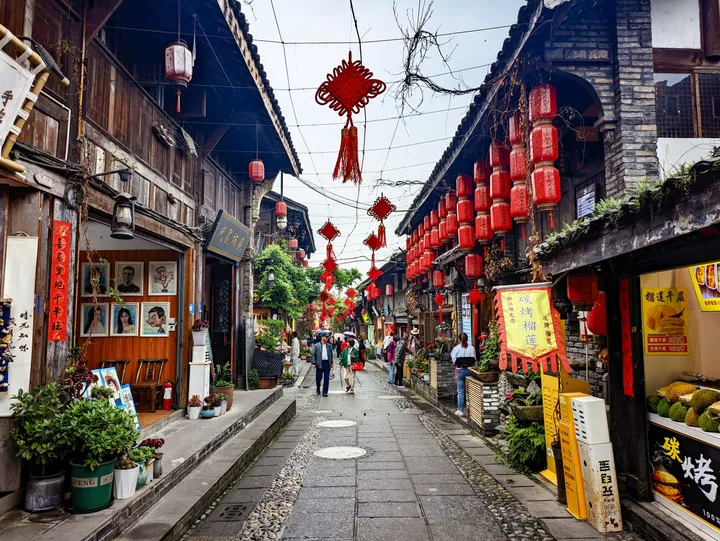
Treat Guanxian as an urban district and street walk rather than a single enclosed monument. Start at Xuanhua Gate (宣化门), then follow the commercial lanes along Xingfu Road (幸福路) toward West Street (西街). The street network includes everyday businesses as well as tourism-facing shops; the names of West Street, South Street and Xingfu Road recur in city visitor coverage. A current visitor listing also identifies South Bridge (南桥), the old-town lanes and nearby heritage landmarks as points of interest.
Walk slowly enough to notice where the street fabric opens toward the river and where newer shopfronts sit beside older-looking buildings. Continue to South Bridge for a close view of the crossing and the fast-changing river below; the bridge makes a natural link between the old-town walk and the larger water landscape, but the bridge and the Dujiangyan Irrigation System are distinct visits. The paid irrigation-area attractions, including their gates and operating arrangements, should not be assumed to be included in a walk through the town streets.
The old town is best explored on foot. A simple route is Xuanhua Gate → Xingfu Road → West Street and the smaller lanes → South Bridge. Turn back or pause for a meal when you find a street or shop that interests you; this is a route through a lived-in commercial district, not a timed performance or a fixed one-way tour.
Tickets, opening and reservations
A current third-party visitor listing describes the old-town district as free to enter and gives the address below. I could not confirm a current official notice stating ordinary-day entry, opening hours or reservation requirements. Treat the street network as a public-area visit, and check separately before entering any ticketed heritage building, attraction or business; shop and venue hours can differ.
Getting there
There is no Chengdu Metro station in the old-town district. From Chengdu, one rail option is Metro Line 2 to Xipu (犀浦), then a transfer to the Chengguan intercity railway toward Lidui Park (离堆公园), if a suitable train is available for your date. At Xipu, do not assume a same-platform transfer: a September 2024 report said metro-to-rail passengers had to leave the metro station and enter the railway station separately, following the posted railway direction at Exit A1. That report is dated, so follow current station signs and allow time for security and boarding.
From Lidui Park station, walk toward the old-town streets and enter at Xuanhua Gate; no station exit number or fixed walking time is asserted here. Check current China Railway 12306 services and return tickets before setting out, as this is an intercity railway connection rather than a metro ride to the town.
Bus: A 2026 city-transit report identifies local bus route 4 between Dujiangyan Railway Station and Finance Building (财经大厦) / Xuanhua Gate (宣化门), serving the old-town core. Its extended summer timetable ended on 31 August 2026, and a current October timetable was not available in the sources checked. Confirm the live stop and service before relying on this bus.
For a taxi or ride-hail, enter 灌县古城,成都市都江堰市幸福路3号. Xuanhua Gate is a practical pedestrian gateway, but do not request a drop-off inside the pedestrian streets: use only a legal roadside stopping or passenger-pickup point, then walk to the gate. The address is listed by the visitor directory; no specific curb or designated taxi bay was verified.
Combine your visit
Choose from these complementary stops when planning your visit.
-
Xuanhua Gate and old streets宣化门与古城街巷
Begin with the urban gateway and commercial lanes.
-
Yangliu River杨柳河
Slow down beside the smaller watercourse.
-
South Bridge南桥
Finish with the main river view.
This is a suggested combination, not a timed route; confirm the opening and transport arrangements for your date.
Find Guanxian Ancient Town
灌县古城 · 都江堰市
The pin marks the area, not the entrance.
More places nearby
Approximate straight-line distances between map pins, not travel distances.
Dujiangyan South Bridge 都江堰南桥
Less than 1 km awaySouth Bridge crosses the inner river below Dujiangyan’s diversion works. Its covered walkway, painted ceiling and carved timber create a close-up architectural experience above the fast-moving water. The bridge has been rebuilt…
View guide →Yulei Mountain Park 玉垒山公园
Less than 1 km awayYulei Mountain rises immediately above Dujiangyan’s old streets, combining wooded paths with gates and the City God Temple. The climb gives changing views of the town and the water-management landscape below. Temple…
View guide →Erwang Temple 二王庙
Less than 1 km awayErwang Temple commemorates Li Bing and his son within the Dujiangyan scenic area. Its halls contain river-related religious images and inscriptions connected with water management, linking worship with the irrigation landscape…
View guide →Sources & visit information
Sources checked on 21 October 2026. Hours, tickets, reservations and transport can change; confirm with the operator before you go.
- Sichuan Provincial Local Records Office, historical account of Guanxian and Dujiangyan place names ↗
- Chengdu Municipal People's Government, city overview and administrative divisions ↗
- Sichuan Online, visitor activity coverage naming Guanxian Ancient Town streets ↗
- Trip.com visitor listing, address, entry listing and points of interest ↗
- Sichuan Online, Xipu Metro and Chengguan Railway transfer report ↗
- Sina, 2026 Dujiangyan summer night-bus service report quoting city transit information ↗
Image credits & notes (1)
- West Street in Guanxian Ancient Town, Dujiangyan, decorated with red lanterns · 都江堰灌县古城西街,挂满红灯笼Photo: Kcx36 · CC BY-SA 4.0 · taken 2024-05-01Resized for the web; the photo itself has not been edited. Thumbnails may show a cropped view.
