

Explore the region
Tap any red Chinese text to hear it in Mandarin.
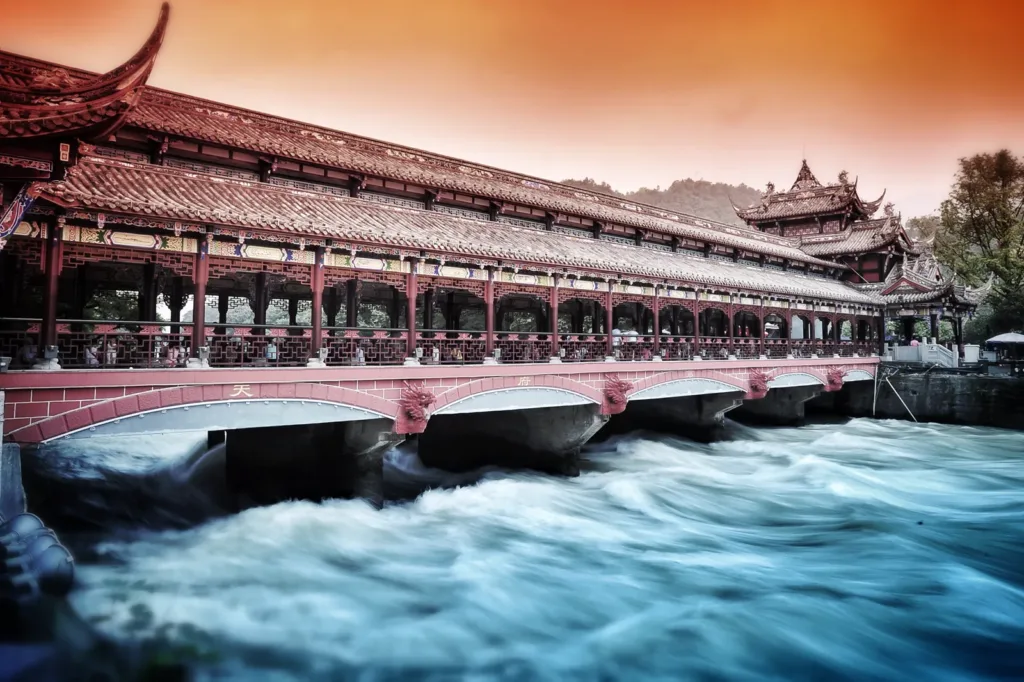
South Bridge is both a landmark and a working pedestrian crossing. It spans the Min River’s inner channel near Baopingkou, where the river’s water is routed into the irrigation system. From the bridge, notice the contrast between the fast current below and the ornate, sheltered walkway above. Painted ceilings, gilded woodwork, roof figures and calligraphic plaques make the bridge itself worth a slow crossing. It also gives a view back toward the waterworks and connects the Guanxian old-town streets with the entrance to the Dujiangyan Scenic Area.
The bridge has been rebuilt several times as floods and conflict damaged it. A timber bridge called Puji Bridge was built in 1878 after a major repair of the irrigation works; it was destroyed in a flood in 1898. After further losses, its timber piles were replaced with concrete piers in 1959, when it took the name South Bridge. A 1979 rebuilding established much of the present scenic form, and the bridge received a protective reconstruction after the 2008 Wenchuan earthquake. These layers explain why it is better understood as an evolving civic crossing than as an untouched ancient structure.
Walk across at an unhurried pace, pausing to look both upstream toward Baopingkou and down at the decorated bridge structure. Continue into Guanxian Old Town for its lanes and food shops, or return toward the scenic-area entrance to visit the irrigation works. The bridge and the ticketed irrigation-works attraction are adjacent but are not the same visit: current visitor listings classify South Bridge itself as free to enter and open all day, while a separate ticket is sold for the Dujiangyan Scenic Area. Check the official scenic-area booking channel for current admission and any access controls before entering the paid site; do not assume nearby businesses, riverside lighting or the ticketed area follow the bridge’s access terms.
The bridge is most revealing in daylight, when roof details and the river are easier to see. At night, illumination along the old-town riverfront has become a draw; the Ministry of Culture and Tourism has described the nearby Tianfu Yuan Covered Bridge and the blue-lit water below as the “Blue Tears” scene. Lighting and crowd conditions can change, so treat it as a possible evening view rather than a guaranteed show. The bridge is also part of the everyday public realm: a local report describes residents and visitors using it as a place to pause and cool down, alongside the busy flow of people moving between the old town and the scenic area. Give pedestrians room and avoid blocking the crossing for photographs.
Getting there
For the rail approach from Chengdu, take Chengdu Metro Line 2 or Line 6 to Xipu (犀浦), then connect to the Chengdu–Dujiangyan intercity railway for Lidui Park (离堆公园). The official Pidu District station guide lists Lidui Park as an operating stop. At Xipu, a same-platform metro-to-rail transfer passage was reported back in trial operation in October 2024, but it had conditions and could be interrupted; follow the current station signs and your rail-ticket instructions. The 2024 report said passengers without an eligible near-term train, or with oversized luggage, were directed to exit at A1 and enter the railway station separately. No numbered exit at Lidui Park has been reliably confirmed for South Bridge: from the station, follow pedestrian signs toward 离堆公园 / 都江堰景区 and the Guanxian Old Town; South Bridge stands beside the scenic-area entrance and joins the old-town side.
Local bus listings show routes 4, 9, 17, 101 and 739 serving the South Bridge area, with 离堆公园 Líduī Gōngyuán and 玉垒山公园 Yùlěi Shān Gōngyuán among the nearby stops. These are aggregator listings, not an official live timetable; confirm the route and direction on the day.
For a taxi or ride-hail, enter 都江堰南桥,成都市都江堰市团结巷146号 as the destination. The bridge is a pedestrian crossing, not a vehicle drop-off point. Ask to be let out only at a lawful signed passenger-loading point accessible to the driver, outside any pedestrian-control barrier, then walk to the bridge; do not ask the driver to stop on the bridge or enter a restricted old-town street.
Combine your visit
Choose from these complementary stops when planning your visit.
-
Bridge interior廊桥内部
Look up at the painted ceiling and timber details.
-
Riverbank viewpoint河岸观景点
View the bridge from beside the water.
-
Old-town meal古城用餐
Finish in the surrounding streets.
This is a suggested combination, not a timed route; confirm the opening and transport arrangements for your date.
Find Dujiangyan South Bridge
都江堰南桥 · 都江堰市
The pin marks the area, not the entrance.
More places nearby
Approximate straight-line distances between map pins, not travel distances.
Guanxian Ancient Town 灌县古城
Less than 1 km awayGuanxian Ancient Town is Dujiangyan’s historic urban core, adjoining the irrigation works. Xuanhua Gate, West Street and the Yangliu River lanes reveal different parts of the old town, while South Bridge connects the visit with…
View guide →Yulei Mountain Park 玉垒山公园
Less than 1 km awayYulei Mountain rises immediately above Dujiangyan’s old streets, combining wooded paths with gates and the City God Temple. The climb gives changing views of the town and the water-management landscape below. Temple…
View guide →Erwang Temple 二王庙
Less than 1 km awayErwang Temple commemorates Li Bing and his son within the Dujiangyan scenic area. Its halls contain river-related religious images and inscriptions connected with water management, linking worship with the irrigation landscape…
View guide →Sources & visit information
Sources checked on 21 October 2026. Hours, tickets, reservations and transport can change; confirm with the operator before you go.
- Huaxi Metropolis Daily, 在都江堰的这座桥,还能“躺平”吗? ↗
- Trip.com, South Bridge visitor guide ↗
- Ctrip, South Bridge visitor information ↗
- Qunar, Dujiangyan Scenic Area ticket listings ↗
- China Tourism News via Ministry of Culture and Tourism, 古城越“夜”越精彩 ↗
- Pidu District Government, 2026年成灌站点信息-快铁 ↗
- Sichuan Online via Sina, 犀浦站地铁动车无缝换乘通道恢复试运营,乘客2分钟完成换乘 ↗
- Moovit, buses and stops near South Bridge ↗
Image credits & notes (1)
- South Bridge spans the Min River inner channel at Dujiangyan, with its covered corridor above the fast water. Photo: 蒋亦炯 (EXIF copyright: CalvinJ)Photo: CC BY-SA 3.0