

Explore the region
A former rare-metal mine turned into a geological and industrial-heritage visit in Keketuohai Town, Fuyun County. The experience combines the scale of an open pit with a small exhibition hall where mineral specimens and mining photographs explain why this remote Altai town became known as a “merit mine.”
Why this place matters
Keketuohai World Geopark is in Fuyun County, Altay Prefecture, and its official site lists the No. 3 lode as one of the park’s five component areas. The lode is the reason this is more than a scenic overlook: it is a mine landscape tied to rare-metal extraction, geological study and the history of a working town.
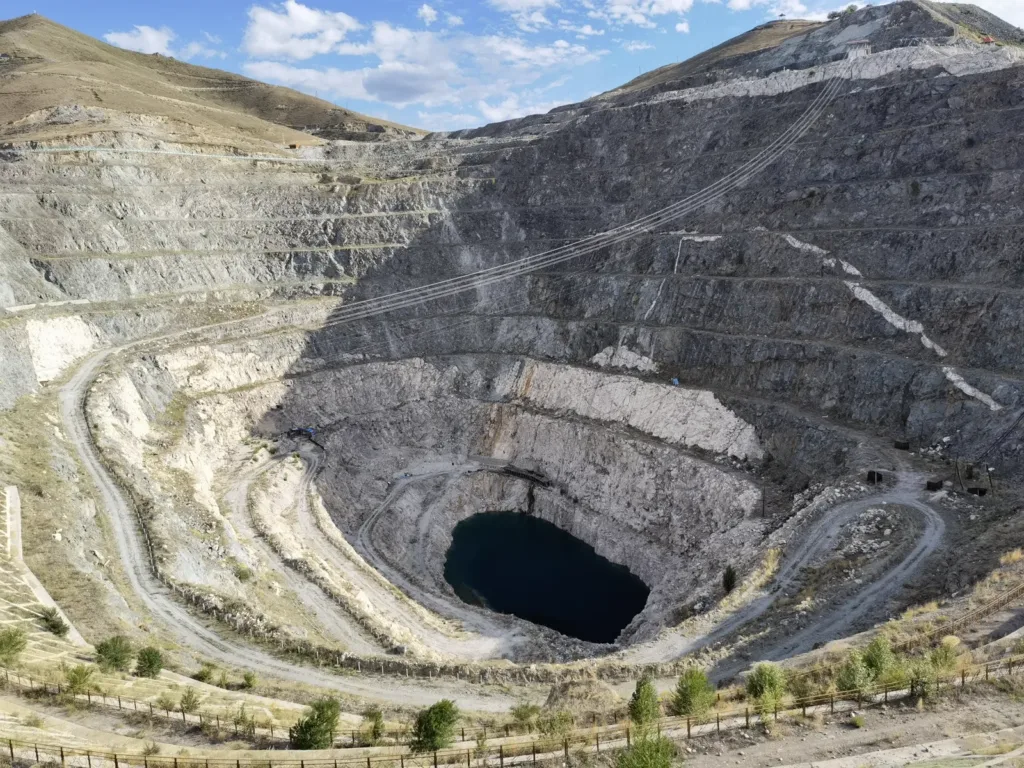
The pit supplied rare metals used by China’s aerospace and defence industries, and Xinhua describes more than 80 useful mineral types from the 170-plus types known in China. Its 2021 report gives a maximum diameter of about 350 metres and a depth of up to 142 metres. Published measurements are not consistent, however. A 2019 People’s Daily report describes a much larger 500-metre diameter and 350-metre depth, so do not treat any single figure as a current survey-grade measurement. The dependable visitor impression is the scale of the terraced open pit and the contrast between exposed rock, benches and the surrounding Altai hills.
What to look for
Start at a permitted viewpoint and read the mine as a working landscape rather than as a natural crater. Look for the stepped walls, changes in rock colour and the way the benches reveal successive extraction levels. Keep the railings and designated paths between you and the edge; do not enter closed workings or remove rock samples.
The geological exhibition hall adds the human and scientific layer. It was built in 1957 as the workers’ club of the mine and is described as a Russian-style building. Its displays include more than 400 geological specimens and other exhibits covering 94 mineral types, including the only known Irtysh stone, 额尔齐斯石, held in the hall. Old photographs are useful for noticing the labour behind the industrial story: drilling, dust, transport and the improvised conditions of earlier mining are more informative than a slogan alone.
Allow time to compare the specimens with the landscape outside. Labels can help you connect a mineral name to its colour, crystal form or industrial use. The official scenic-area site has also advertised guided storytelling and occasional “ore-finding” activities at the No. 3 lode, mine cave and exhibition hall, but that page describes a dated event rather than a daily programme. Ask about the day’s schedule instead of assuming an activity will be running.
Getting there and getting back
The destination is in Keketuohai Town, Fuyun County, rather than in Altay city proper. There is no verified metro or named urban-bus stop for the mine. A dated China.com route guide describes about 480 kilometres by road from Urumqi to Fuyun and nearly 58 kilometres from Fuyun to Keketuohai; these are useful orientation figures, not a live timetable or guaranteed present-day road measurement.
For the final leg, reach Keketuohai Town first, then use a local car or the entrance indicated by the scenic-area operator for “可可托海三号矿坑” or “可可托海稀有金属国家矿山公园.” I could not verify a current scheduled shuttle, a precise public transport stop, or an exact walking route to this combined mine-and-hall entry. Confirm the pin, which buildings are open, and where a car should wait with the official scenic-area hotline: 0906-8781188, 0906-8781155 or 0906-8781166.
Arrange the return before entering the site. If you hire a car from Fuyun or Keketuohai, agree that it will collect you after the visit and return you to the town or Fuyun; no current return timetable was found in the sources checked. Do not assume that a generic “geology museum” map result is the mine entrance, since the park contains several facilities.
Tickets and access checks
The official scenic-area homepage currently displays an adult scenic-area ticket of RMB116, but it does not state on that page whether the price covers this particular mine-and-exhibition combination. Its booking page says tickets can be reserved up to 30 days ahead, with same-day reservations allowed before 14:00. The same page instructs visitors to pass the gate with an identity card and contains an unrelated reference to Yading, suggesting that parts of the notice are a reused template.
Passport holders should contact the operator before travelling to confirm whether a passport can be used for online booking and on-site inspection, whether the No. 3 Mine Pit and the hall are open on the intended date, and whether an internal shuttle or separate fee applies. Treat opening hours, current admission scope and any seasonal closure as unconfirmed until the operator answers. Wear shoes with good grip, expect strong temperature changes between seasons, and follow the site’s marked route around the pit.
Find Keketuohai No. 3 Mine Pit and Geology Exhibition
可可托海三号矿坑与地质陈列 · 富蕴县
The pin marks the area, not the entrance.
Sources & visit information
Sources checked on 2 November 2026. Hours, tickets, reservations and transport can change; confirm with the operator before you go.
Image credits & notes (1)
- Terraced benches and the water-filled lower workings of Keketuohai No. 3 Mine Pit in Fuyun County, Xinjiang, China. Photo: Yanxutong1215Photo: CC BY-SA 4.0