

Explore the region
Tap any red Chinese text to hear it in Mandarin.
Why go
Dali Old Town is a public urban district rather than a single preserved palace. Its interest comes from reading several layers at once: the old north–south street grid, reconstructed gates, surviving courtyard patterns, small waterways and the everyday businesses that now occupy them. The town sits in the landscape of Cangshan and Erhai, but the old streets themselves are the experience; the lake, mountain and Three Pagodas are separate places to plan rather than parts of one ticket.
The place also carries a longer political history. The official Yunnan tourism portal connects the area with the Nanzhao capital of Yangxiemie City and dates the present walled city to 1382, during the Ming Hongwu period. It also records Dali as one of the first 24 national historical and cultural cities, designated in 1982. These dates explain the town’s importance, but they do not mean every façade is original. The most useful visit is one that notices what has been rebuilt as well as what remains legible in the plan.
What to see on foot
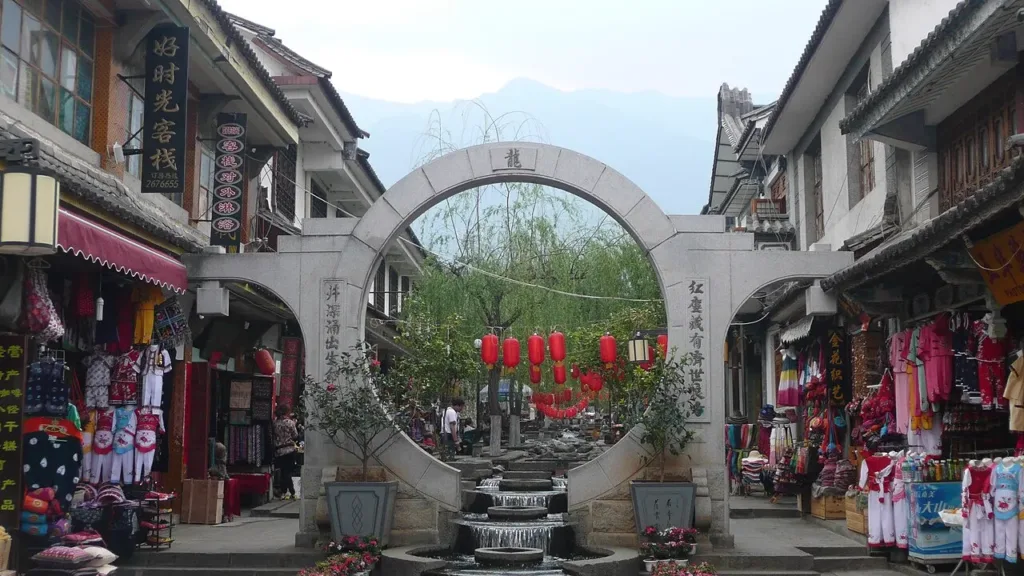
Start at the South Gate (南城门), then follow Fuxing Road (复兴路) north. The road links the gate areas and passes the central Wuhua Tower (五华楼), a useful landmark for understanding the town’s scale and its chessboard-like streets. Look for the contrast between the busy commercial spine and the narrower lanes: blue-grey tiled roofs, courtyard walls, planted interiors and channels carrying water through the town are more revealing than a quick photograph of a gate.
Use Huguo Road (护国路), often called Foreigner Street (洋人街), and Renmin Road (人民路) as side trips rather than assuming they are museum streets. They are commercial and social spaces with cafés, restaurants, tea houses, small shops and evening activity. Red Dragon Well (红龙井) is another short old-town lane whose Bai-style houses and water feature make it a good slower section. The official local tourism description presents these streets as parts of the town’s daily texture, not as separate out-of-town attractions.
If an indoor visit fits your day, choose one venue and check it separately. Dali Municipal Museum occupies the former Du Wenxiu Marshal’s Mansion, while the Bai Intangible Cultural Heritage Museum is housed in Jiang Gong Shrine. They add local history, material culture and exhibition space to the street walk, but their opening hours, entry arrangements and any identity check are not the same as public access to the old-town streets.
Entry, opening and reservations
The public street area is not a unified ticketed attraction. A visitor reference updated in 2026 lists public access as free and says that no general reservation is required for the public area; it gives a day-round planning window and a last-entry time of 23:30. Treat that as a planning reference, not a promise that every street, shop or inner venue will operate on the same schedule. Museums, towers, temples, performances, shuttles and other optional services can have their own tickets or controls.
Before leaving, check the same-day notice for the old town and the specific venue you want to enter. Carry your passport for any ticketed or ID-checked museum, tower or other venue, and ask whether foreign visitors need a separate booking route. The reviewed material does not establish one universal passport or reservation rule for every sub-site, so free street access should not be taken as proof of admission to every building.
Getting there and back
There is no metro station in the old town. Dali Railway Station (大理站) is in the modern Xiaguan area, not inside the historic district, so plan a separate last transfer.
From Dali Railway Station: a January 2025 page from the Dali tourism transport operator lists a Dali Station–Dali Old Town direct shuttle. It gives a listed fare of CNY 5 and about 40 minutes to Dali Old Town’s Huan’Erhai Service Centre (环洱海服务中心), with rolling departures tied to train arrivals. The page places the service point by the station’s commercial food area exit near the taxi waiting area and says passengers then cross the footbridge to board. Recheck the service desk, fare, departure condition and arrival point on the day of travel.
By city bus: older tourism guidance lists Bus 8 from Dali Railway Station into the old town, with town-side access around Erhai Gate (洱海门) or the east/west gate area. It also lists Bus 4 from Xiaguan toward the old town’s South and North Gates. These route names are useful starting points, but the checked guidance dates from 2020–2021; confirm the live destination board and current stop name before boarding.
By taxi or ride-hailing: show the driver 大理古城南门 Dàlǐ Gǔchéng Nánmén or 大理古城南门游客中心 Dàlǐ Gǔchéng Nánmén Yóukè Zhōngxīn. The government visitor guide uses the South Gate visitor centre as a road-arrival point and separates it from Dali Railway Station. Confirm where the vehicle can legally stop and arrange a return pickup point before entering the pedestrian streets.
For the return, use a confirmed departure from the Huan’Erhai Service Centre if you arrived by direct shuttle, or check the current reverse direction of Bus 8 toward Dali Railway Station or Bus 4 toward Xiaguan. Do not assume that public streets remaining open late means buses or shuttle services will still be running; settle the return connection before extending an evening walk.
A practical half-day sequence
Enter at the South Gate, walk Fuxing Road to Wuhua Tower, and then turn into one or two side streets such as Huguo Road, Renmin Road or Red Dragon Well. If a museum is open and its entry conditions suit you, add one rather than trying to treat every small building as a separate sight. Finish at the gate or service point that matches your confirmed return connection. Keep the Three Pagodas, Cangshan cableways and Erhai transport as separate plans: they are nearby Dali experiences, not sub-sections of the public old-town entry.
Combine your visit
Suggested order for the visit:
-
South Gate
Begin at the wall and gateway area.
-
Fuxing Road and Wuhua Tower
Follow the town’s main architectural axis.
-
A side street towards the west
Compare smaller streets with the busy central route.
This is an editorial sequence of named spaces or places. It does not imply a verified walking connection or promise opening, ticket availability or a journey time.
Find Dali Old Town
大理古城 · 大理市
The pin marks the area, not the entrance.
More places nearby
Approximate straight-line distances between map pins, not travel distances.
Three Pagodas 崇圣寺三塔
2 km awayThe Three Pagodas stand below Cangshan in a triangular arrangement. The tall central Qianxun Pagoda has a square plan and closely spaced eaves, while the two smaller companions are octagonal. Their different forms are easiest to…
View guide →Erhai Lake 洱海
8 km awayErhai stretches along the foot of Cangshan, with Bai settlements and farmland shaping much of its shore. Caicun, east of Dali Old Town, gives a practical introduction to the western bank; Shuanglang presents a different lakeside…
View guide →Xizhou 喜洲
18 km awayXizhou’s streets preserve Bai courtyard houses between the Cangshan mountains and Erhai Lake. Around Sifang Street, the Yan Family Courtyard shows decorated beams, painted surfaces and the relationship between rooms, screen…
View guide →Sources & visit information
Sources checked on 24 October 2026. Hours, tickets, reservations and transport can change; confirm with the operator before you go.
Image credits & notes (1)
- A street in Dali Old Town, with traditional-style shopfronts, a central water feature and Cangshan visible beyond, Dali, Yunnan, China. Photo: Brücke-Osteuropa (Wikimedia Commons author; file history uploader Dr. Bernd Gross)Photo: Public domain