

Explore the region
Why this place is different
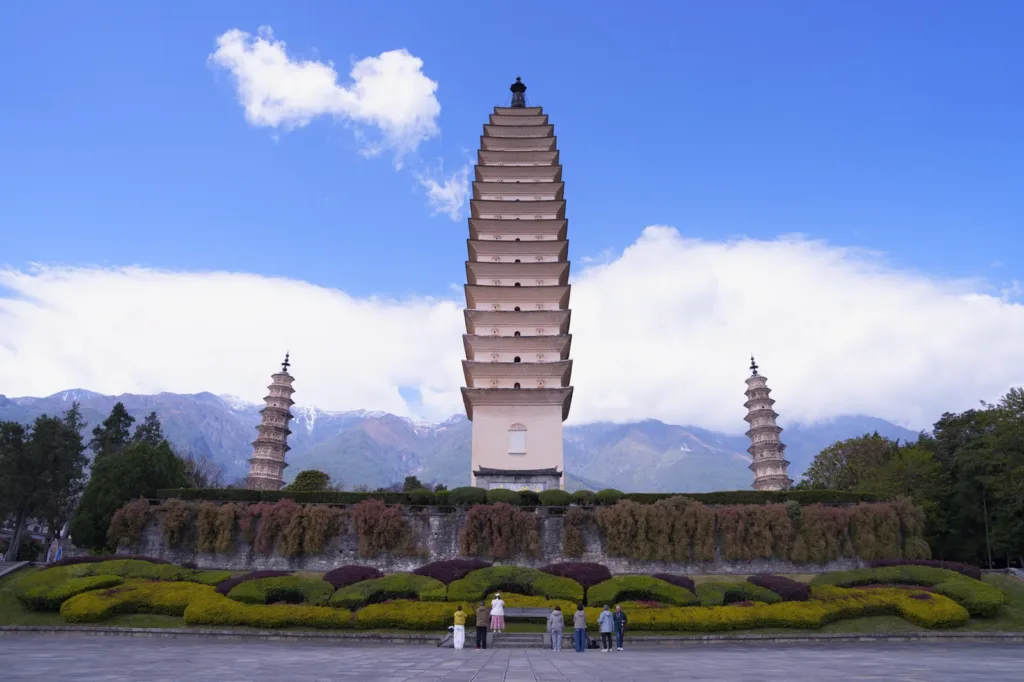
The Three Pagodas stand below Cangshan on the northern side of Dali’s old town area. They are the surviving core of a much larger Buddhist and royal-monastery landscape, and the operator describes them as a national-level protected cultural site since 1961. The setting matters: the towers are not an isolated monument in a city square, but a group framed by mountain slopes, open sky and the basin of old Dali.
The central Qianxun Pagoda (千寻塔) is the tall, square, closely tiered tower. The scenic-area overview gives it a height of 69.13 metres and 16 levels, dating its construction to 833–840 during the Nanzhao period. The two smaller towers are octagonal, ten-level brick towers, each 42.19 metres high; the same overview dates them to the Dali Kingdom period, 1108–1172. Their contrast is the point of the visit: compare the heavy, upright centre with the lighter, more ornamented companions rather than treating “the three pagodas” as three identical objects.
Conservation is part of the story you can see in the masonry. The operator’s account of the 1978–1981 repair and reinforcement describes scaffold holes discovered in the towers, while a Dali cultural-publication account records the recovery of hundreds of objects during that work. The towers have also endured repeated earthquakes and long periods of repair. Treat those accounts as an explanation of why the structures are protected, not as an invitation to climb or touch the fabric.
What to look for
Start in the front tower precinct and give yourself time to look from more than one angle. The inscription “永镇山川” (“may the mountains and rivers remain forever”) is on the screen wall before Qianxun Pagoda; the scenic-area account attributes the characters to Mu Shijie, a Ming-era descendant of Mu Ying.
Then walk to Juying Pond (聚影池), the reflection pool named for the way it gathers the towers, trees and sky in one view. Reflections depend on wind, light and water conditions, so the pool is a useful place to pause rather than a guaranteed photograph. If you continue beyond the front area, the large halls of the rebuilt Chongsheng Temple form a separate, later visitor layer behind the ancient towers. The operator’s own overview distinguishes the front area centred on the pagodas from this rebuilt rear area; do not assume that every hall has the same age or heritage status as the towers.
Plan a visit
Use the entrance for the Chongsheng Temple Three Pagodas Cultural Tourism Zone (崇圣寺三塔文化旅游区), outside Dali Old Town’s street grid. A local transport guide names the approach area as Sanwenbi Village by the north side of Dali Old Town; show the Chinese name to a driver and confirm that the vehicle is going to the visitor entrance, not an approximate map pin.
The operator’s homepage displayed the site as open when checked on 24 October 2026. A current booking listing showed 07:30–18:30 opening and 18:20 as the latest entry time, but that is a third-party listing rather than an official timetable; check the date-specific product or call the scenic area before setting out. The operator publishes the visitor hotline 0872-2666055.
Do not assume that a mainland-ID product works for a passport holder. A February 2026 notice for a limited annual pass said that it required the holder’s Chinese ID card and facial recognition, and that annual-pass sales ended on 30 June 2026; it does not establish a current foreign-passport booking route. For an ordinary visit, confirm passport booking, identity verification, ticket availability and any reservation requirement with the official channel or hotline before travelling. The normal admission price is not stated here because the current official page captured for this guide did not publish a stable price.
Getting there and back
A local guide dated 8 June 2022 listed the Three Pagodas special line (三塔专线车) from Dali Railway Station (大理站), Dali Ancient Town South Gate (大理古城南门) and Dali March Street (大理三月街). Its stop list includes North Gate Bridgehead (北门桥头) before Chongsheng Temple Three Pagodas (崇圣寺三塔). That guide records service hours of 06:30–19:30 and departures every 20 minutes, but those details are dated and should not be treated as a current timetable.
From Dali Railway Station, the special line or a taxi/ride-hail vehicle provides the final road leg; there is no need to invent a metro connection for this out-of-grid site. Before entering, confirm how you will return: check the reverse 三塔专线 service at the stop, or arrange a driver to collect you at the named visitor entrance. The older guide confirms the route toward the site but does not independently confirm a current evening return schedule, so do not rely on the last remembered bus.
Combine your visit
Suggested order for the visit:
-
Pagoda forecourt
Compare the three structures from ground level.
-
Reflection pond
Look for the grouped reflection when conditions allow.
-
Chongsheng Temple halls
Continue into the reconstructed temple complex.
This is an editorial sequence of named spaces or places. It does not imply a verified walking connection or promise opening, ticket availability or a journey time.
Find Three Pagodas
崇圣寺三塔 · 大理市
The pin marks the area, not the entrance.
More places nearby
Approximate straight-line distances between map pins, not travel distances.
Dali Old Town 大理古城
2 km awayDali Old Town sits between Cangshan and Erhai, with a street grid that makes its layout easy to read. Fuxing Road links the north and south gate areas, while side streets lead past shops, courtyards and local museum spaces…
View guide →Erhai Lake 洱海
7 km awayErhai stretches along the foot of Cangshan, with Bai settlements and farmland shaping much of its shore. Caicun, east of Dali Old Town, gives a practical introduction to the western bank; Shuanglang presents a different lakeside…
View guide →Xizhou 喜洲
16 km awayXizhou’s streets preserve Bai courtyard houses between the Cangshan mountains and Erhai Lake. Around Sifang Street, the Yan Family Courtyard shows decorated beams, painted surfaces and the relationship between rooms, screen…
View guide →Sources & visit information
Sources checked on 24 October 2026. Hours, tickets, reservations and transport can change; confirm with the operator before you go.
Image credits & notes (1)
- The Three Pagodas of Chongsheng Temple seen from the front precinct, with Cangshan behind them. Photo: Jackiejackie123123Photo: CC BY-SA 4.0