

Explore the region
Tap any red Chinese text to hear it in Mandarin.
Why come
Xizhou is worth visiting for the way Bai architecture remains part of a working town. The settlement lies in Dali City, between the western shore of Erhai Lake and the foothills of the Cangshan range. Its historic core is not a reconstructed museum street: houses, shops, small workshops and protected compounds share the same lanes, so the most revealing views often come from looking carefully at a doorway, screen wall or roofline between everyday errands.
The town’s prosperity was closely tied to Bai merchant families and long-distance trade. The local heritage account describes the large residences built by the Dong, Yan, Yang and Yin families, and the building forms that became associated with Xizhou: san fang yi zhao bi (three wings and one screen wall), si he wu tian jing (four buildings around five courtyards), and liu he tong chun (six sides opening to one shared spring). Xizhou Bai Ancient Architecture Complex was placed on China’s fifth batch of National Key Cultural Relics Protection Units in 2001.
Read the town through its courtyards
Start around Sifang Street, the town’s public centre, then compare the open square with the quieter lanes leading away from it. The Yan Family Courtyard stands beside the square. If its museum rooms are open, it gives a concentrated introduction to Xizhou’s domestic architecture: linked courtyards, screen walls, carved timber, stone and marble work, clay decoration and painted surfaces. The compound is a specific heritage residence, not a synonym for the whole ancient town.
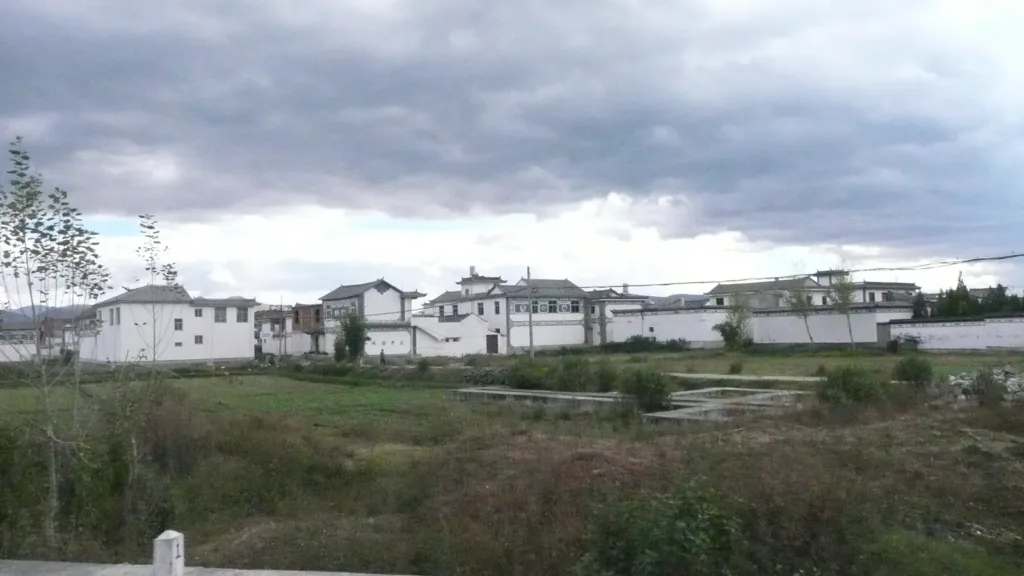
Look upward as well as inward. Whitewashed walls, grey tile roofs, projecting eaves, carved doors and painted screen walls show how decoration, family identity and climate were combined in a practical home. A courtyard that is open to visitors can be studied from its thresholds and courts; a closed or lived-in house should remain an exterior view. Do not enter private homes or photograph residents without permission.
Beyond the showcase courtyard, walk slowly through the lanes and, where public paths allow, toward the fields at the edge of the settlement. The relationship between houses, irrigation land and the mountain–lake basin is part of Xizhou’s character; it is more useful than trying to collect every named “photo spot.” The local tourism account also records craft and cultural venues around the town, including a folk-art centre, clay work and tea-related experiences. These are separate venues, not a guaranteed all-in-one route, so check each one before setting out.
Plan a practical visit
The public lanes and square do not have one confirmed town-wide ticket or one universal opening time. A media report dated 9 October 2026, summarising a Dali Tourism Group summer notice, described the central Xizhou street area as free and without advance reservation. Treat that as a seasonal service notice, not a permanent promise for every indoor courtyard, museum or viewing platform. Check the specific venue on the day, especially if you need an accessible interior or want to use a paid admission.
For a road arrival, search 喜洲古镇 Xǐzhōu Gǔzhèn or 喜洲古镇四方街 Xǐzhōu Gǔzhèn Sìfāng Jiē in Amap or Apple Maps and ask the driver for the public town centre rather than a private courtyard. There is no useful metro connection to Xizhou. A January 2026 report described a “Dali Ancient Town–Shaxi Ancient Town” station bus departing from Dali Bus Passenger Station and calling at Xizhou Ancient Town, with the reverse direction available as part of the same route; it reported eight round trips a day when the service launched. Confirm the current departure board and operating days before relying on it, because the report does not establish a permanent timetable.
An older English transport guide names the local minibus departure point in Dali Old Town as Cangshan Gate, No. 5 Yuer Road(苍山门,玉洱路5号), but that information is from 2018 and its fare and timetable should not be reused. If you take a taxi or ride-hailing car, keep the Chinese destination on your phone. For the return, arrange a pickup or confirm the reverse bus before leaving the lanes; do not assume that a late roadside minibus will still be running.
Allow more time than a quick square-and-photo stop if you want to see the architectural relationship between the public centre, courtyards and fields. For passport holders, the open town streets have no separately verified passport-ticket procedure in the sources reviewed. A separately ticketed courtyard, museum or workshop may have its own ticketing, identification and reservation rules; confirm those directly rather than assuming that entry to the public town guarantees admission.
Combine your visit
Suggested order for the visit:
-
Sifang Street
Begin with the square and inscribed arch.
-
Yan Family Courtyard
Observe the decorated rooms and courts.
-
Old-town lanes
Compare the courtyard with surrounding domestic facades.
This is an editorial sequence of named spaces or places. It does not imply a verified walking connection or promise opening, ticket availability or a journey time.
Find Xizhou Ancient Town
喜洲 · 大理市
The pin marks the area, not the entrance.
More places nearby
Approximate straight-line distances between map pins, not travel distances.
Erhai Lake 洱海
12 km awayErhai stretches along the foot of Cangshan, with Bai settlements and farmland shaping much of its shore. Caicun, east of Dali Old Town, gives a practical introduction to the western bank; Shuanglang presents a different lakeside…
View guide →Three Pagodas 崇圣寺三塔
16 km awayThe Three Pagodas stand below Cangshan in a triangular arrangement. The tall central Qianxun Pagoda has a square plan and closely spaced eaves, while the two smaller companions are octagonal. Their different forms are easiest to…
View guide →Dali Old Town 大理古城
18 km awayDali Old Town sits between Cangshan and Erhai, with a street grid that makes its layout easy to read. Fuxing Road links the north and south gate areas, while side streets lead past shops, courtyards and local museum spaces…
View guide →Sources & visit information
Sources checked on 24 October 2026. Hours, tickets, reservations and transport can change; confirm with the operator before you go.
Image credits & notes (1)
- Xizhou town, Dali, seen beyond cultivated ground and drainage channels, with whitewashed Bai-style courtyard walls and tiled roofs. Photo: Brücke-Osteuropa (Wikimedia Commons author; file history uploader Dr. Bernd Gross)Photo: Public domain