

Explore the region
Why this place is special
This is one visitor stop with two different purposes. Manting Park is a paid public garden on Manting Road; Zongfo Temple is a neighbouring religious complex on Baji Road. They are close enough to combine, but do not treat the temple as simply another pavilion inside the park. A current visitor listing gives the temple its own address and free-entry listing, while a local account describes a connection on the park’s southern side; the gate arrangement and re-entry rules should still be confirmed on the day.
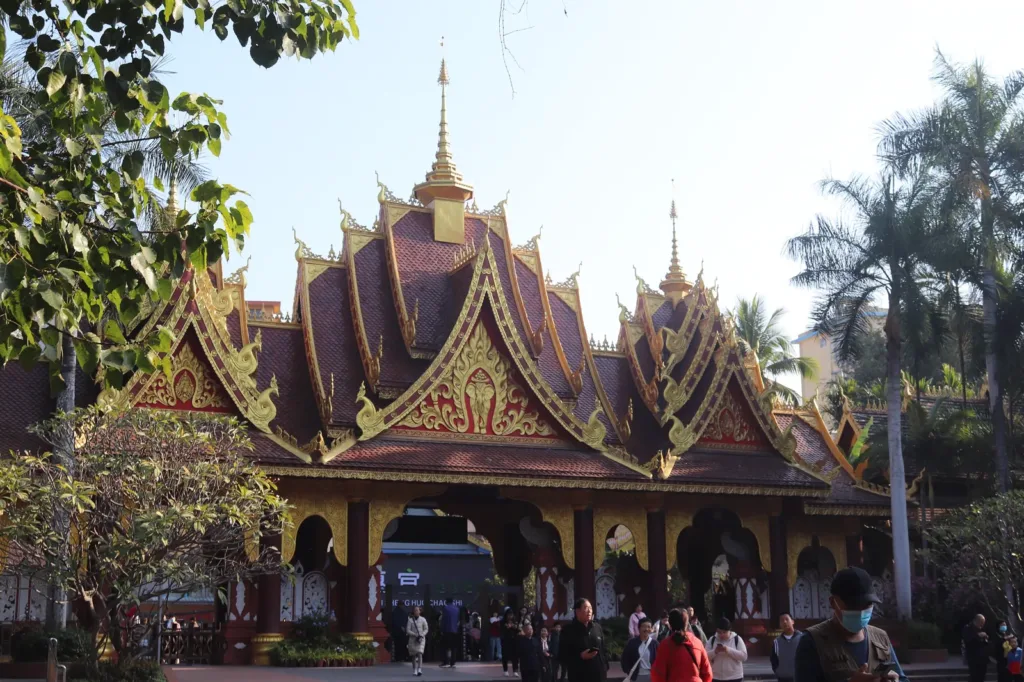
The park’s identity comes from its former role as a Dai royal garden. A Yunnan cultural-location guide describes a history of more than 1,300 years and an area of about 27 hectares, with a royal-garden culture zone, folk-culture zone, ironwood grove, ethnic-culture square and performance area. It specifically names the royal-palace building, Zhangha Pavilion and octagonal covered bridge as Dai-style visual anchors in the present garden.
Zongfo Temple, called “Wat Pajie” or “Waba Jie” in Dai, is more than a decorative temple stop. The National Ethnic Affairs Commission describes it as one of Xishuangbanna’s earliest Theravada Buddhist temples, traditionally founded by two monks from Myanmar in the mid-seventh century. It was recognised as the prefecture’s highest-ranking Buddhist temple about 700 years ago and now accommodates the Xishuangbanna and Jinghong Buddhist associations and the Xishuangbanna branch of Yunnan Buddhist College.
What to look for
Start in the park with the built details rather than trying to cover every landscaped corner. Compare the royal-palace building with the smaller Zhangha Pavilion, then look for the octagonal covered bridge and the shade of the ironwood grove. The sequence shows how a contemporary public garden uses royal and Dai architectural references without pretending that every present-day structure is an untouched palace building.
Then give the temple its own quieter visit. Look at the main worship buildings, roof ornaments and bell-and-drum spaces from the public route, but remember that this is also a functioning religious and educational institution. The temple’s importance lies in its continuing role for Buddhist associations, worshippers and monastic education as much as in its architecture. Do not enter teaching, residential or closed ritual areas, and ask before photographing monks or worshippers.
The park also hosts changing cultural programming. A 2025 Yunnan tourism report recorded a revival of the Dai story performance Zha Shutun and Nanmunuona and hands-on experiences linked to Dai writing and other intangible cultural heritage. Those were reported programme offerings rather than a permanent daily timetable, so treat them as optional additions and check the current notice before planning around a show.
Visiting and getting there
The park’s visitor address is 35 Manting Road, Jinghong City. A current ticket listing read on 24 October 2026 shows daytime opening from 08:00 to 18:00, with ticket sales and entry stopping at 17:00; another current listing gives the same window. Opening hours, ticket price, reservation channel and bundled evening performances can change, so confirm the date-specific notice or official booking channel before setting out.
For the temple, use 18 Baji Road, Jinghong City as the separate Chinese destination. The current listing read on 24 October 2026 shows free entry and 08:00–18:00 opening, but a working temple may close or restrict areas for religious activity. Domestic online ticket instructions should not be assumed to cover a foreign passport; ask the venue or gate staff about the current entry process.
For public transport, an English Jinghong transport guide updated in August 2025 lists Bus No. 3 as a ring route running from the North Jinghong Road–North Galan Road junction to Manting Park, passing the Jinghong Long-distance Bus Station and Xishuangbanna Bus Station. Route names, stops and service periods can change, so confirm that the bus display still shows the Manting Park direction before boarding. There is no verified metro route for this stop in the sources reviewed.
A taxi or ride-hailing car is the least ambiguous option: show 曼听公园,景洪市曼听路35号 for the park, or 西双版纳总佛寺,景洪市坝吉路18号 for the temple. Keep the two names separate when booking the return. If you enter the temple from the park side, ask whether you may cross back through the same gate; otherwise leave by the road-side gate and request a new car from the Chinese destination name.
Combine your visit
Suggested order for the visit:
-
Royal-palace building area
Begin with the main architectural focus.
-
Zhangha Pavilion and covered bridge
Compare the smaller garden structures.
-
Ironwood grove
Finish in the shaded planted area.
This is an editorial sequence of named spaces or places. It does not imply a verified walking connection or promise opening, ticket availability or a journey time.
Find Manting Park and Zongfo Temple
曼听公园 · 景洪市
The pin marks the area, not the entrance.
More places nearby
Approximate straight-line distances between map pins, not travel distances.
Wild Elephant Valley 野象谷
21 km awayWild Elephant Valley occupies the Sanchahe forest area north of Jinghong. Elevated viewing walkways provide a way to observe the valley without entering elephant habitat, while the Asian Elephant Museum explains the animals’…
View guide →Xishuangbanna Tropical Botanical Garden 西双版纳热带植物园
47 km awayThe Xishuangbanna Tropical Botanical Garden is in Menglun, outside Jinghong. Its western visitor area arranges living collections into distinct gardens, including palms, aquatic plants and banyans. This makes it possible to…
View guide →Sources & visit information
Sources checked on 24 October 2026. Hours, tickets, reservations and transport can change; confirm with the operator before you go.
Image credits & notes (1)
- Entrance building at Manting Park in Jinghong, photographed on 13 January 2025. Photo: LiuxingyPhoto: CC BY-SA 4.0