

Explore the region
Tap any red Chinese text to hear it in Mandarin.
Why come
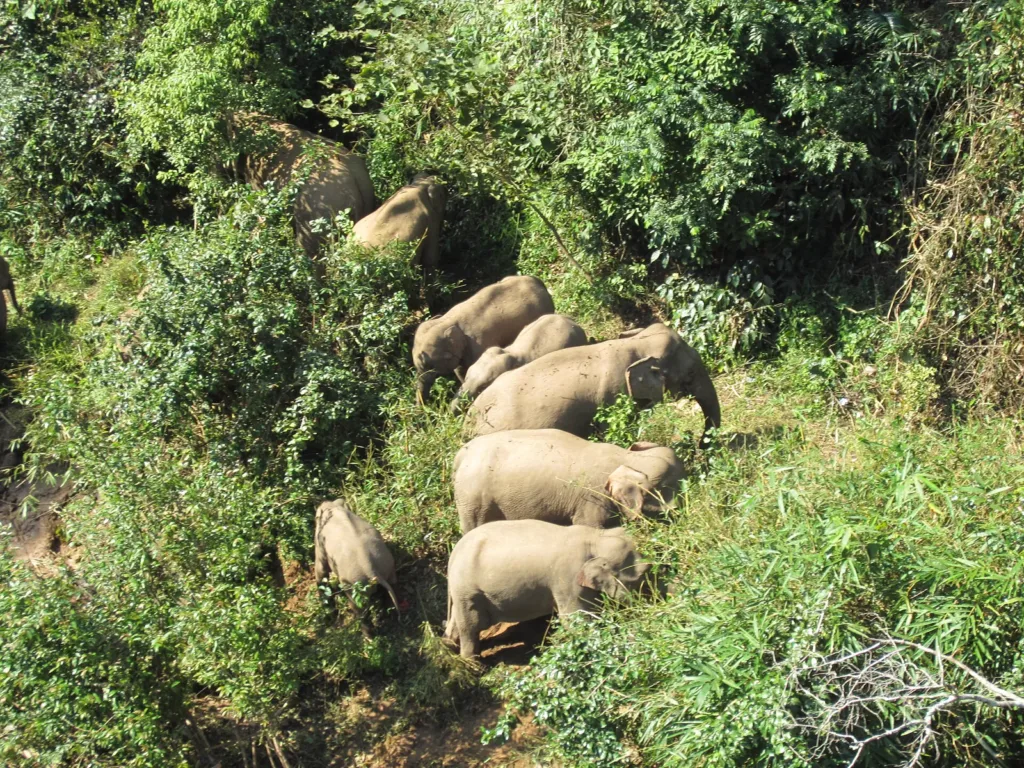
In Sanchahe, Mengyang Town, Wild Elephant Valley sits beside the G213 corridor within the Xishuangbanna National Nature Reserve. The valley is a low, wooded landscape of streams and tropical forest, and the scenic area is part of a managed model that links public access with protection of the reserve. The site was established in 1990 and became a national 4A tourist attraction in 2005.
The experience is best understood as a careful look into elephant habitat rather than a search for a captive display. Elevated observation routes let visitors look down into the forest while keeping people out of the animals’ space. The Asian Elephant Museum adds the missing context: its renewed exhibition uses specimens, moving screens and a 3D animation theatre to explain elephant ecology, the risks the animals face and the people who work to protect them.
The scenic area also contains the Xishuangbanna Asian Elephant Rescue and Breeding Centre. Its work includes caring for injured or displaced elephants, rehabilitation, breeding research and public education. It is a reminder that the forest view is connected to long-term conservation work, not just sightseeing.
What to look for
Start with the Asian Elephant Museum if you want the background before entering the forest routes. Look for the way the exhibition connects anatomy and behaviour with habitat loss, rescue and coexistence. Then use the designated elevated walkway to read the valley as a habitat: streams, forest edges and open patches matter as much as the possibility of seeing an elephant.
If the rainforest cableway and the route it serves are operating on your date, treat them as optional paid components rather than assuming they are included in admission. A published visitor overview describes a forest cableway and elevated observation walkway linking the visitor zones, but route sections, operating hours and fees can change. Do not approach elephants, call them closer, feed them or leave the managed route. A sighting is a bonus; the animals move on their own schedule, and staff instructions take priority when movement changes a route.
January to April has historically produced more frequent elephant activity around the scenic area in the reserve operator’s long-term account, but that record is not a forecast for a particular day. Carry water, sun protection and insect repellent, and allow for humid forest conditions and uneven walking surfaces.
Getting there and returning
The visitor destination is 野象谷景区,景洪市勐养镇三岔河 Yěxiàng Gǔ Jǐngqū, Jǐnghóng Shì Měngyǎng Zhèn Sānchàhé, beside the G213 corridor. The official reserve-management account places it near G213 and distinguishes the site from the wider protected area. Use the named scenic-area visitor entrance shown by the operator or your map app; do not try to enter elephant habitat from an informal roadside path.
From Jinghong, a taxi or pre-arranged private transfer to 野象谷景区游客入口 Yěxiàng Gǔ Jǐngqū Yóukè Rùkǒu is the most straightforward option when you need a reliable return. The scenic area is outside the urban core, so agree where and how you will be collected before entering. No current official source reviewed for this guide established a regular bus route, stop name or return timetable that can safely be printed here.
If you arrive by train, 西双版纳站 (Xishuangbanna Railway Station) is in Gasa Town, Jinghong, and is a transport gateway rather than an entrance to Wild Elephant Valley. Continue from the station by taxi or pre-arranged transfer to the scenic-area entrance; the railway operator’s page confirms the station’s location but does not provide a Wild Elephant Valley connection.
Check the operator’s current notice before travel for opening hours, admission, reservation or identity requirements, the status of the cableway and observation routes, and any temporary wildlife-safety closure. Third-party booking pages can display different date-specific products and should not replace that notice. Passport-holder ticketing and real-name reservation arrangements were not confirmed by the sources reviewed here, so ask the operator specifically rather than assuming a domestic-ID process applies.
Combine your visit
Suggested order for the visit:
-
Asian Elephant Museum
Start with the animals’ biology and conservation story.
-
Elevated forest walkway
Observe the valley from the designated route.
-
Open rainforest visitor path
Complete the circuit only where staff permit.
This is an editorial sequence of named spaces or places. It does not imply a verified walking connection or promise opening, ticket availability or a journey time.
Find Wild Elephant Valley
野象谷 · 景洪市
The pin marks the area, not the entrance.
More places nearby
Approximate straight-line distances between map pins, not travel distances.
Manting Park 曼听公园
21 km awayManting Garden places Dai-style visitor architecture among shaded planting and water in Jinghong. The royal-palace building, Zhangha Pavilion and octagonal covered bridge give the grounds distinct architectural landmarks, while…
View guide →Xishuangbanna Tropical Botanical Garden 西双版纳热带植物园
49 km awayThe Xishuangbanna Tropical Botanical Garden is in Menglun, outside Jinghong. Its western visitor area arranges living collections into distinct gardens, including palms, aquatic plants and banyans. This makes it possible to…
View guide →Sources & visit information
Sources checked on 24 October 2026. Hours, tickets, reservations and transport can change; confirm with the operator before you go.
Image credits & notes (1)
- A group of Asian elephants moving through forest in Xishuangbanna Wild Elephant Valley. Photo: Hanno BöckPhoto: CC0 1.0