

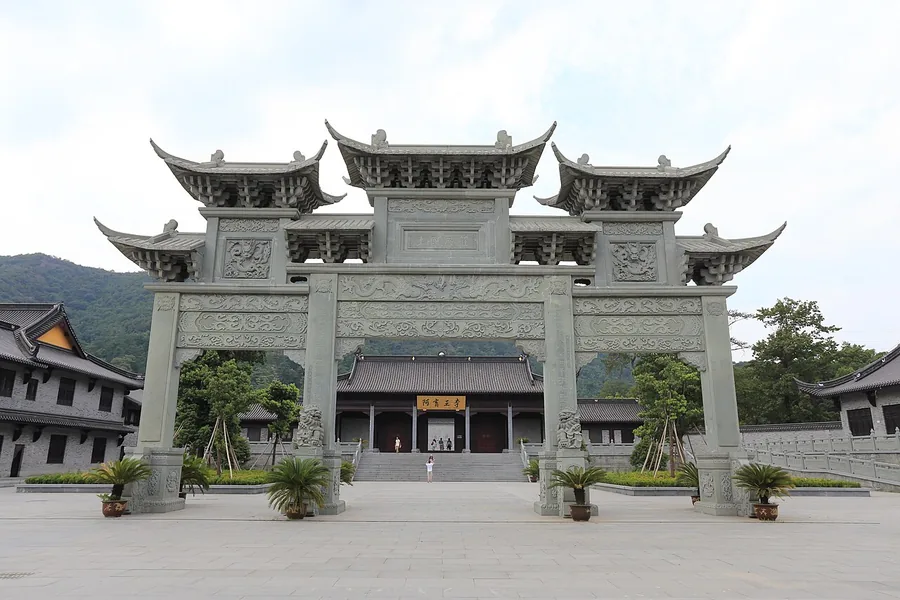
Photo adjustments
Proportionally resized and converted to WebP without cropping, retouching or changing the photographed subject.
Explore the region
About Ashoka Temple
The main axis moves past a release-life pond and the Heavenly Kings Hall toward the Mahavira Hall and Hall of Sarira. The latter explains the temple’s distinctive religious identity, while the main hall contains three principal Buddha images and surrounding attendants. Treat accounts of the relic’s discovery as religious tradition, and follow the monastery’s rules for viewing rather than assuming that sacred objects are always displayed.
The monastery was founded in 282 by the monk Huida (慧达) and received its present name in 522. Its buildings have been repeatedly enlarged and reconstructed, with surviving structures originating mainly in the Yuan, Ming and Qing periods. Extensive repairs carried out between 1978 and 1981 addressed the principal halls and other parts of the complex.
The West Pagoda (西塔), rebuilt in 1364, has seven storeys and six sides, with an internal brick stair. The temple also preserves more than fifty stone inscriptions dating from the Tang dynasty onward and collections of Buddhist scriptures. It became a Major Historical and Cultural Site Protected at the National Level (全国重点文物保护单位) in 2006.
What to look for
- The Hall of Sarira gives the monastery its distinctive relic-veneration focus.
- The release-life pond and successive halls organize the long central approach.
The surrounding area
A coastal city chapter centered on maritime food, Tianyi Pavilion and Moon Lake.
Location & getting there
Getting to Ashoka Temple
Baozhuang metro station is the documented public-transport approach to Ashoka Temple in Ningbo’s Yinzhou district; complete the remaining road connection to the monastery entrance.
Combine your visit
A suggested sequence linking the specific features of this visit.
-
Pond and Heavenly Kings Hall
Begin with the monastery’s central approach.
-
Mahavira Hall
Examine the three principal Buddha images and their setting.
-
Hall of Sarira
Finish with the religious focus associated with the temple’s name and tradition.
This order is editorial. Confirm access and any transfers between stops; it does not establish a walking route, same-day connection or common admission ticket.
Find Ashoka Temple
阿育王寺 · 宁波市
The pin marks the area, not the entrance.
More places nearby
Approximate straight-line distances between map pins, not travel distances.
Tiantong Temple 天童寺
7 km awayTiantong Temple occupies a wooded setting below Taibai Peak east of Ningbo. Its rebuilt Ming-and-Qing-style ensemble runs through the mountain gate and Heavenly Kings Hall toward the Mahavira Hall, with bell and drum towers to…
View guide →China Port Museum 中国港口博物馆
18 km awayThe China Port Museum in Beilun connects maritime history with the machinery and organization of modern harbours. Its paired, shell-like forms and sail-like glass-and-steel roof make the building part of the subject. Inside…
View guide →Moon Lake (Ningbo) 月湖
20 km awayMoon Lake forms a historic water landscape in Ningbo’s Haishu old city. Its stone-arched Central Lake East Bridge and the water-level stele near Pingqiao River connect scenic design with practical water management. Shrines and…
View guide →Sources & visit information
The sources below support the place-specific description and arrival information. Suggested combinations are editorial planning ideas; confirm current opening, entry arrangements and transport services for your date.
Visitor information adapted and edited from Wikipedia contributors, “Temple of King Ashoka” · CC BY-SA 4.0. Source revision 1367476781.
Visitor information adapted and edited from Wikivoyage contributors, listing “Ayuwang (Ashoka) Temple” · CC BY-SA 4.0.
Background paragraphs translated and condensed from Wikipedia contributors, "阿育王寺", Chinese Wikipedia · CC BY-SA 4.0. Source revision 87028799.