


Get to know Yinzhou District
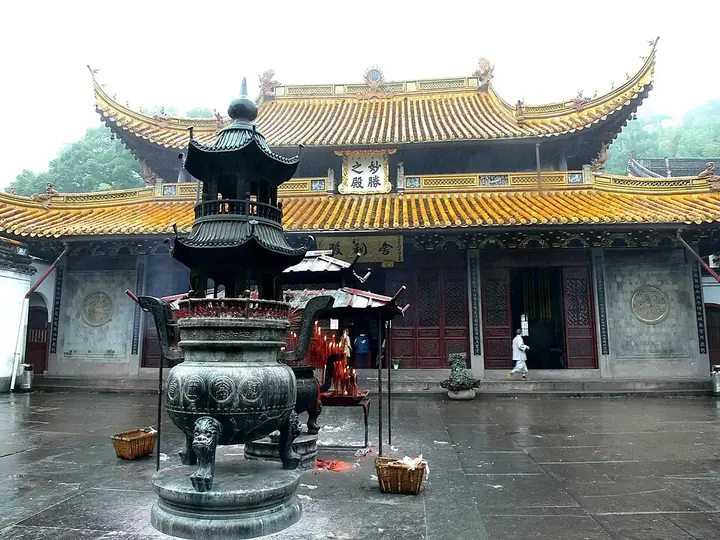
Photo adjustments
Full frame retained; resized proportionally to a maximum dimension of 960 pixels and converted to WebP quality 88. No crop, retouch, generated elements, or subject alteration. Final website rendition: full frame retained, proportionally resized to at most 720 pixels and converted to WebP. No additional retouching or subject alteration. Card displays may crop the view.
- Administrative area
- District · 市辖区
- Part of
- Ningbo
- Chinese name
- 鄞州区
- Local areas
- District guide
Area & population
- Area in the source
- 801.59 km²
- Population · 2016
- 1,257,000
Source: cited geographic source, as of the dates shown.
History
Yin (鄞) is one of the few place names in mainland China still in use since the Qin. A Yin prefecture (鄞州) was created from the old Gouzhang County (句章县) in 621 and abolished in 625. Until 1949 urban Ningbo was the seat of Yin County; after that the city was separated from it. The county became Yinzhou District in February 2002; in 2016 its land west of the Fenghua River went to Haishu and the rest merged with Jiangdong District (江东区) to form the present district.
What to see
Tiantong Temple (天童寺), at the foot of Taibai Mountain, is said to have been founded in 300 by the wandering monk Yixing (义兴). A Chan (Zen) monastery, it ranked third of the Five Mountains in the Southern Song. In 1225 the Japanese monk Dōgen (道元) studied here under the abbot Rujing (如净) and went home to found Japan's Sōtō school. Its oldest standing building is a Buddha hall of 1631. Taibai Mountain also holds the Tiantong Forest Park (天童森林公园).
The Ashoka Temple (阿育王寺), on the western foot of Mount Mao (鄮山) at Baochuang (宝幢) in Wuxiang (五乡镇), is named after the Indian emperor Ashoka and is said to keep a skull relic of the Buddha. It ranked fifth of the Five Mountains in the Southern Song, and the monk Jianzhen (鉴真) stayed here in 743 after his third failed voyage to Japan. Both temples became national key protected sites in 2006.
Dongqian Lake, in Dongqianhu town (东钱湖镇), is 8.5 kilometres long and 4.5 wide with 19.14 square kilometres of water. It is a lagoon formed by ancient geological movement and a main source of drinking and irrigation water for urban Ningbo. In the Northern Song, Wang Anshi (王安石), then magistrate of Yin County, overhauled its waterworks. The Ningbo Museum (宁波博物馆), also called the Yinzhou Museum, opened in 2008.
Crafts and performing arts
Ningbo gold and silver embroidery (宁波金银彩绣), stitched on silk with gold and silver thread alongside coloured silks, is found mainly in Yinzhou and entered the national intangible-heritage list in 2011. Ningbo zoushu (宁波走书), a sung storytelling form (quyi) that arose in the Tongzhi and Guangxu reigns of the Qing accompanied mainly by the four-string huqin, was listed in 2008.
Getting oriented
Ningbo Metro Line 1, the city's first, opened on 30 May 2014. The southern Ningbo higher-education park lies in Yinzhou, with Zhejiang Wanli University and the University of Nottingham Ningbo China.
Highlights
- Tiantong Temple 天童寺: Chan monastery where Dōgen studied before founding Japan's Sōtō school; national key protected site.
- Ashoka Temple 阿育王寺: Named after Ashoka and said to keep a skull relic of the Buddha; Jianzhen stayed here in 743.
- Dongqian Lake 东钱湖: Lagoon lake of 19.14 square kilometres whose waterworks Wang Anshi overhauled.
- Ningbo Museum 宁波博物馆: Opened in 2008, also called the Yinzhou Museum.
Sources for this guide
鄞州区 - 维基百科 · Wikipedia (Chinese) · CC BY-SA 4.0
天童寺 - 维基百科 · Wikipedia (Chinese) · CC BY-SA 4.0
阿育王寺 - 维基百科 · Wikipedia (Chinese) · CC BY-SA 4.0
东钱湖 - 维基百科 · Wikipedia (Chinese) · CC BY-SA 4.0
宁波金银彩绣 · China Intangible Cultural Heritage Network (Chinese National Academy of Arts)
宁波走书 · China Intangible Cultural Heritage Network (Chinese National Academy of Arts)
Original English written from the listed sources and checked sentence by sentence against quoted extracts by a separate reviewer. Updated 2026-09-25.
Explore Yinzhou District
Core places to explore, with English and Chinese names.
Places to explore around Yinzhou District
 The Buddha Hall and courtyard at Tiantong Temple, Ningbo; 28 July 2013.
Tiantong Temple天童寺
Tiantong Temple occupies a wooded setting below Taibai Peak east of Ningbo. Its rebuilt Ming-and-Qing-style ensemble runs through the mountain gate and Heavenly Kings Hall toward the Mahavira Hall, with bell and drum towers to…
Read the place guide →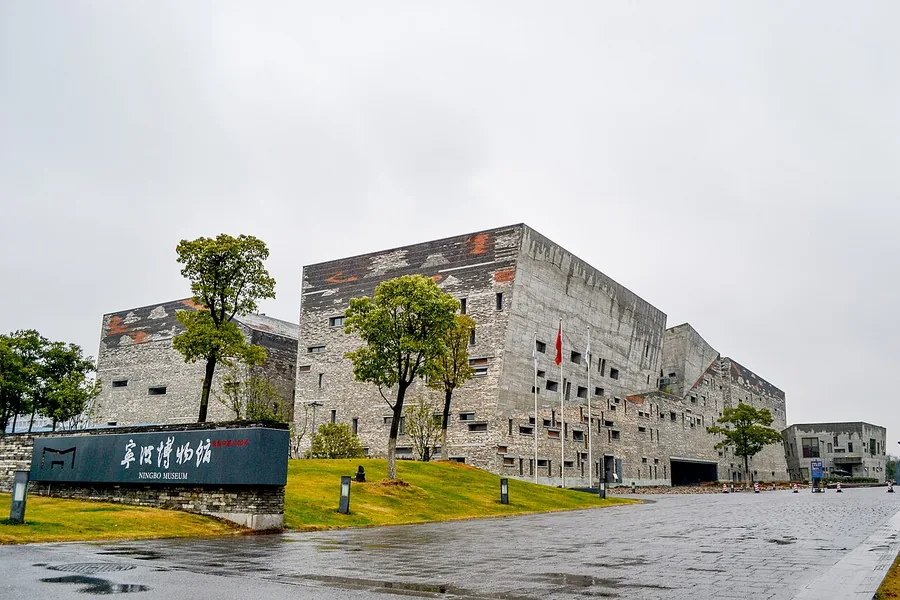 The south entrance and angular exterior of Ningbo Museum, Zhejiang; 15 January 2012.
Ningbo Museum宁波博物院
Ningbo Museum turns salvaged bricks and tiles into a rugged building recalling mountains and a village roofscape. Wang Shu’s design contrasts patched masonry with bamboo-imprinted concrete, while courts and openings break up the…
Read the place guide →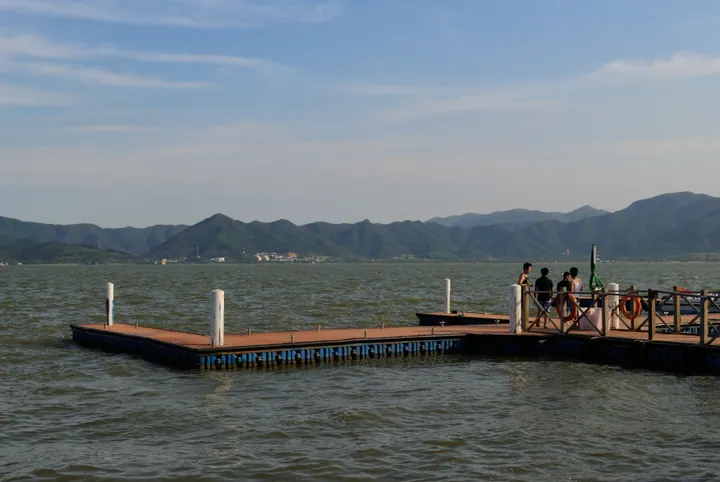 A small dock on Dong Qian Hu (Dongqian Lake) in Yinzhou District, Ningbo · 宁波市鄞州区东钱湖边小码头 Source-recorded photograph date: 2012-08-26 01:27:14.
Dongqian Lake东钱湖
Dongqian Lake is a large freshwater lake in Ningbo's Yinzhou area, surrounded by villages, cultural sites and recreational shorelines.
Read the place guide →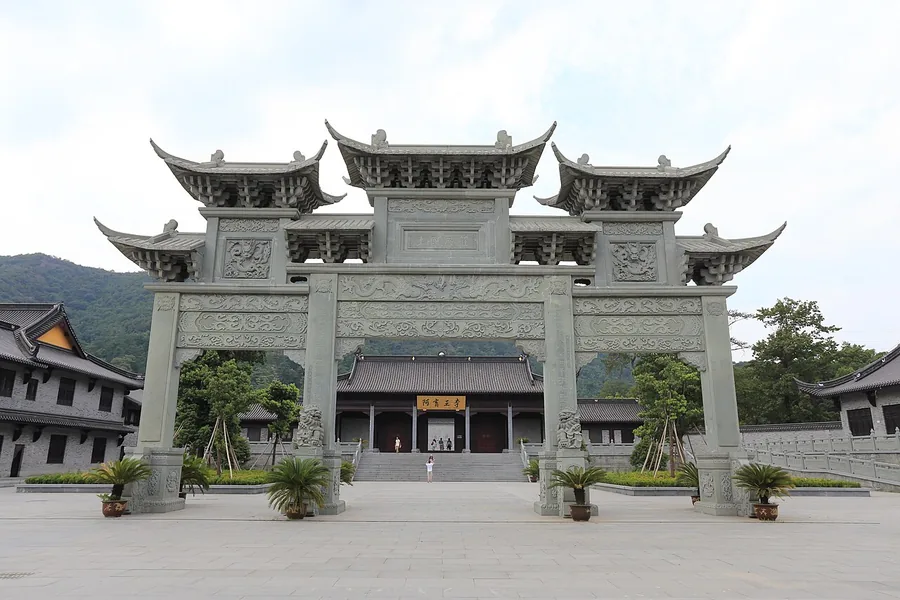 The modern entrance archway at the Temple of King Ashoka in Ningbo, July 2013.
Ashoka Temple阿育王寺
Ningbo’s Temple of King Ashoka centres on the veneration of a relic traditionally associated with the Buddha. The main axis moves past a release-life pond and the Heavenly Kings Hall toward the Mahavira Hall and Hall of Sarira…
Read the place guide →Plan your visit
Getting there
Yinzhou District is about 9 km in a straight line from central Ningbo. Search for 鄞州区 in a map app to find stations and your accommodation.
Where to stay →Build your route
Tiantong Temple and Ningbo Museum are about 25 km apart in a straight line. The linked place guides have entrance and visit details.
Continue with Ningbo →More in Ningbo
Sources & geographic information
Administrative names and parent areas: Official geographic directory · Reference date 2026-09-06.
Some facts checked against 鄞州区 — Wikipedia contributors, CC BY-SA 4.0.
Some facts checked against 天童寺 — Wikipedia contributors, CC BY-SA 4.0.
Some facts checked against 阿育王寺 — Wikipedia contributors, CC BY-SA 4.0.
Some facts checked against 东钱湖 — Wikipedia contributors, CC BY-SA 4.0.
Photo: Tiantong Temple · Zhangzhugang · CC BY-SA 3.0. Proportionally resized and converted to WebP without cropping, retouching or changing the photographed subject.

Photo: Ningbo Museum · Siyuwj · CC BY-SA 3.0. Proportionally resized and converted to WebP without cropping, retouching or changing the photographed subject.

Photo: Dongqian Lake · Siyuwj · CC BY-SA 3.0. Full frame retained; proportionally resized and converted to WebP. No retouching or changes to the photographed subject. Card displays may crop the view.

Photo: Ashoka Temple · Zhangzhugang · CC BY-SA 3.0. Proportionally resized and converted to WebP without cropping, retouching or changing the photographed subject.

Map data © OpenStreetMap contributors. Pins mark approximate centres, not entrances or boundaries.