

Explore the region
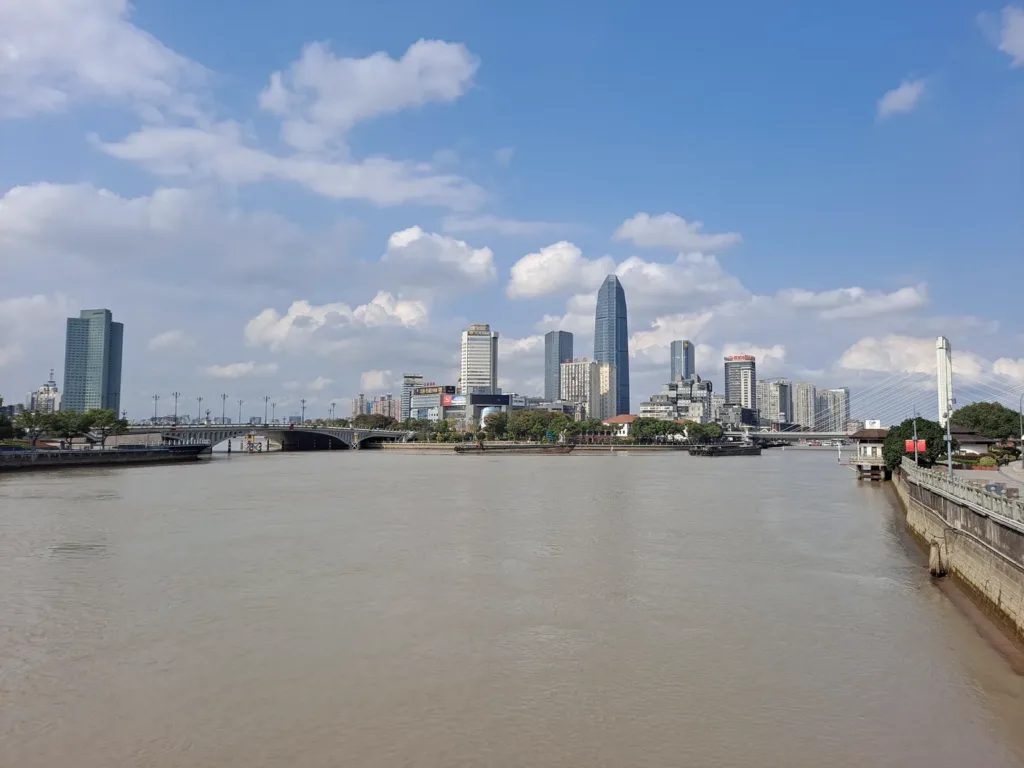
Ningbo is easiest to understand through water. At Sanjiangkou, the Yong, Yao and Fenghua rivers meet; this junction connected inland waterways with the sea and helped make Ningbo a trading port on routes reaching across East Asia. The modern Ningbo–Zhoushan Port belongs to the same outward-facing story, but the city’s maritime character is also visible at riverfront streets, old commercial buildings and the changing light on the embankments.
In the old centre, Tianyi Ge gives that history a quiet, enclosed form: Fan Qin built its library in 1561, with a pond and garden shaping the setting around the books. Moon Lake is the more open counterpart, a public water landscape where paths, bridges and historic buildings make the city’s scholarly life easier to encounter on foot. Sanjiangkou is a separate riverside connection rather than the end of the same compact garden visit.
The everyday side of Ningbo is equally specific. Local cooking is strongly tied to the coast and to preservation: yellow croaker with pickled mustard greens, rice cakes, tangyuan and seafood all appear in the city’s food culture. Brined crab is a traditional local taste, but it is raw or partly preserved seafood; salt, rice wine or time in a brine do not make it risk-free. Choose it only if that kind of food suits you, and otherwise stay with fully cooked dishes.
How to plan Ningbo
Use the old centre as a compact first cluster: Tianyi Ge, Moon Lake, the Drum Tower area and the central riverfront can be understood together, while the port-facing districts and farther heritage or mountain sites need their own connections. Xikou and the Fenghua hills, Hemudu and Yuyao, Cixi’s kiln and old-town landscapes, and the coastal sites around Xiangshan are not extensions of one walk. The city-wide introduction is therefore a starting map, not a promise that every listed place shares one ticket, entrance or return journey.
Arrival and getting around
Ningbo Lishe International Airport (宁波栎社国际机场, NGB) is the city’s air gateway. Metro Line 2 runs from 栎社国际机场站 (Lishe International Airport) toward 红联站 (Honglian); along the central section it serves 宁波火车站 (Ningbo Railway Station), 城隍庙站 (Chenghuangmiao) and 鼓楼站 (Gulou). From the airport, use the Honglian direction; for the return, follow trains toward Lishe International Airport. Check the operator’s current service and last-train information on the day.
For rail arrivals, use 宁波站 (Ningbo Railway Station), at 19 Nanzhan East Road, Haishu District. Lines 2 and 4 serve the station. Line 4’s end stations are 慈城站 (Cicheng) and 东钱湖站 (Dongqian Lake), making it useful for two different outer-city directions, not a substitute for a central walking route.
宁波汽车南站 (Ningbo South Bus Station) is beside the west side of Ningbo Railway Station’s south square. It can be useful for regional coach journeys, but county and county-level-city services change; confirm the current destination, departure point and return ticket before setting out. Keep the exact Chinese name of each venue and its visitor entrance for taxi or ride-hailing, since “Ningbo city centre” is too broad a destination.
Combine your visit
A suggested sequence linking the specific features of this visit.
-
Tianyi Ge天一阁
Begin with the library and garden setting.
-
Moon Lake月湖
Compare the enclosed scholarly compound with public lakeside space.
-
Sanjiangkou
Add the river confluence after a separate local connection.
This order is editorial. Confirm access and any transfers between stops; it does not establish a walking route, same-day connection or common admission ticket.
Find Ningbo overview
宁波 · 宁波市
The pin marks the area, not the entrance.
More places nearby
Approximate straight-line distances between map pins, not travel distances.
Tianyi Ge 天一阁
9 km awayTianyi Ge combines Fan Qin’s historic private library with a Jiangnan garden and other traditional buildings. The two-storey library faces a pond intended to help protect the books from fire, giving the water both practical and…
View guide →Ningbo Museum 宁波博物院
9 km awayNingbo Museum turns salvaged bricks and tiles into a rugged building recalling mountains and a village roofscape. Wang Shu’s design contrasts patched masonry with bamboo-imprinted concrete, while courts and openings break up the…
View guide →Ashoka Temple 阿育王寺
12 km awayNingbo’s Temple of King Ashoka centres on the veneration of a relic traditionally associated with the Buddha. The main axis moves past a release-life pond and the Heavenly Kings Hall toward the Mahavira Hall and Hall of Sarira…
View guide →Sources & visit information
Sources checked on 24 October 2026. Hours, tickets, reservations and transport can change; confirm with the operator before you go.
Image credits & notes (1)
- Sanjiangkou waterfront in Ningbo, with the riverfront bridges and urban skyline. Photo: 钉钉Photo: CC BY-SA 4.0