

Getting Medical Care in China: A Practical Travel Guide
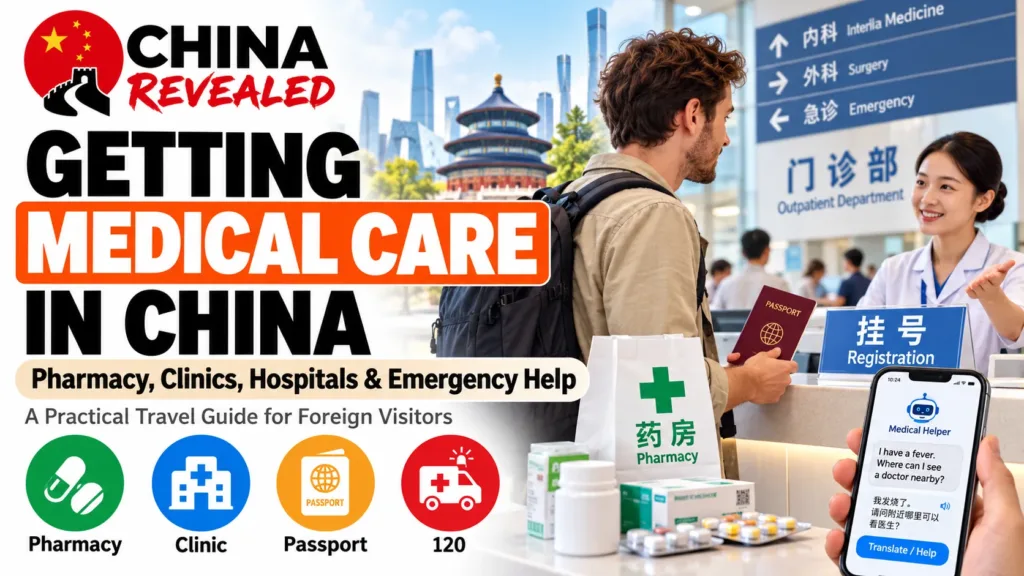
Medical care in China for tourists is easier when you choose the right place. For a mild cold or a small stomach upset, I would start with a neighborhood pharmacy or local clinic—not spend the morning queuing at a famous hospital. Take your passport when you need a doctor, use Chinese AI apps to help with the language, and keep the paperwork for your travel insurance.
Quick takeaways
- Start small for minor problems: a pharmacy for over-the-counter advice; a clinic or community health center for a doctor.
- For your first visit, use the staffed desk. Your passport and a short Chinese explanation are more useful than struggling with a hospital app.
- Use DeepSeek or Doubao in English to understand local terms, prepare questions and explain the next step.
- For ordinary outpatient care, plan to pay first and keep the receipts. Call your insurer before planned treatment to arrange the right provider and any authorization.
- For a serious emergency, call 120. Get help first; sort out insurance once treatment is underway.
In this guide
- Pharmacy, small clinic or big hospital?
- Use DeepSeek or Doubao as your local-language helper
- Walk in and register with your passport
- See the doctor, do the tests and collect medicine
- Call 120 for a serious emergency
- Pay, keep the documents and claim on insurance
- Chinese phrases to save on your phone
Pharmacy, small clinic or big hospital?
A pharmacy: the easiest stop for a minor problem
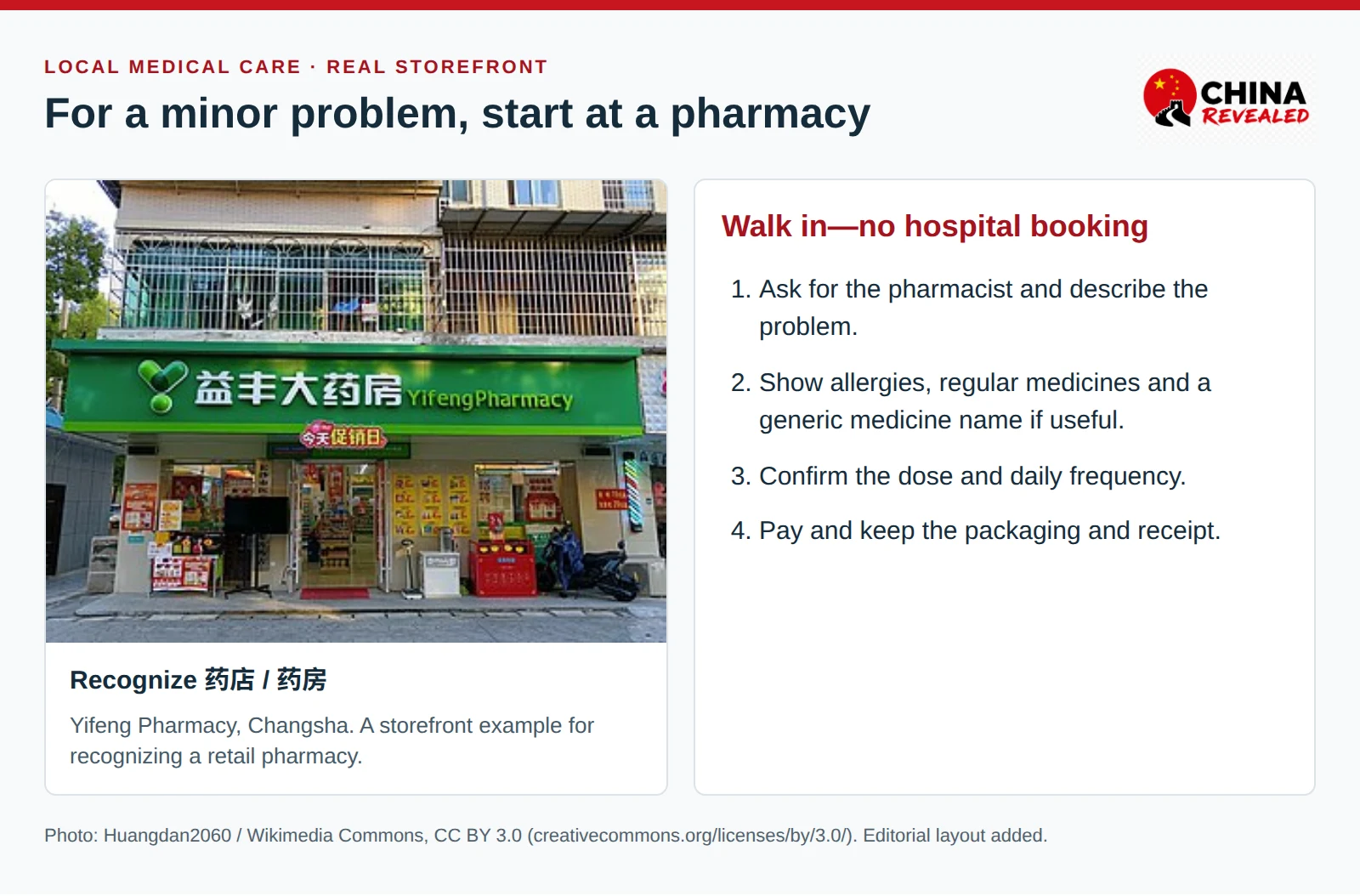
Look for 药店 or 药房 on the storefront, or search 药店 in your map app. At a retail pharmacy, you can walk in and speak to the pharmacist without booking a hospital appointment. A recognizable chain is a straightforward starting point.
For a mild cold, ask about over-the-counter symptom relief. For mild diarrhea, ask about oral rehydration sachets and describe how long you have been unwell. Tell the pharmacist your allergies and the medicines you already take. Ask them to write the dose and daily frequency, then keep the box and receipt. You do not need to recognize a Chinese brand: bring the generic name or a photo of the medicine you use at home.
If symptoms are worsening, you cannot keep fluids down, you have blood in your stool, or a high fever persists, see a clinician rather than making another pharmacy purchase.

A small clinic or community health center: my first choice for an ordinary consultation
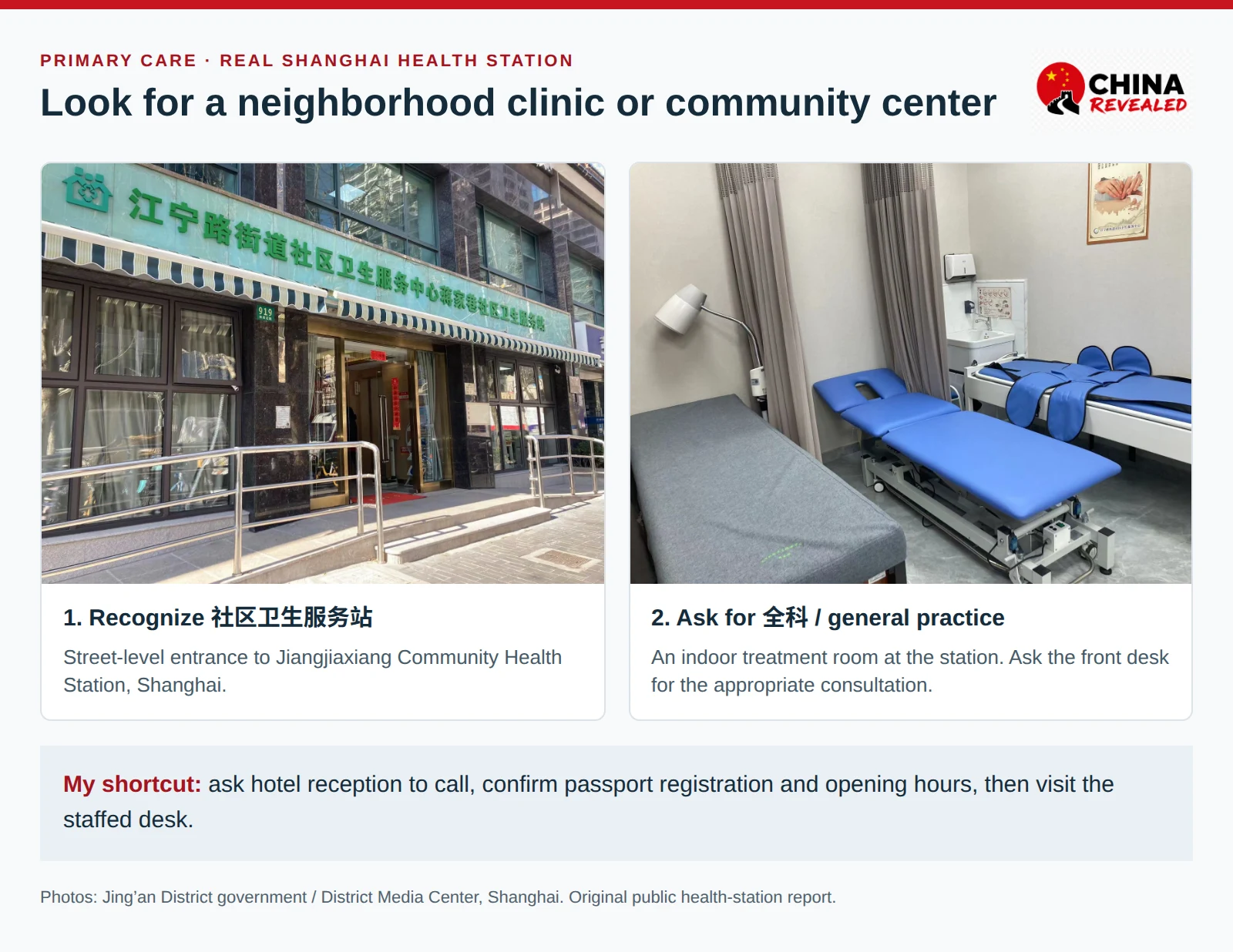
If you want a doctor to examine you, look for 诊所 (clinic), 社区卫生服务中心 (community health center) or 社区卫生服务站 (community health station). These neighborhood facilities handle everyday illnesses and basic care, with a much simpler route than a major teaching hospital.
I would ask hotel reception to call a nearby licensed clinic or community center, confirm its opening hours and check that it can register a foreign passport. Then take your passport and visit the front desk. Smaller facilities are often less crowded, though there may still be a short queue. Ask for 全科, the general-practice service, rather than choosing a specialist yourself.
English is less common here than at an international clinic. A translated symptom note is useful: say what is wrong, when it began and what medicine you have taken. If you need tests or treatment the clinic cannot provide, the doctor can direct you to a suitable hospital.
What do China’s hospital levels mean?
Chinese hospitals are grouped into Level I, II and III. Level I is local basic care; Level II provides broader regional services; Level III includes the large referral hospitals for specialist, serious and complicated cases. Neighborhood clinics and community centers are the frontline primary-care options around that system.
You will often hear 三甲—short for 三级甲等, or Level III Grade A. These are top-tier hospitals with extensive specialist resources. They also attract patients from a wide area, so popular outpatient clinics can involve long queues and hard-to-get appointments. I would use one for a complex problem or when a doctor recommends it, not simply because it is the most famous name on the map.
For an ordinary problem needing more investigation, a nearby district or Level II general hospital is often a sensible next step. If English service is your priority, choose an international clinic or a hospital’s 国际部 (international department), and ask for the consultation price when booking.
Use DeepSeek or Doubao as your local-language helper
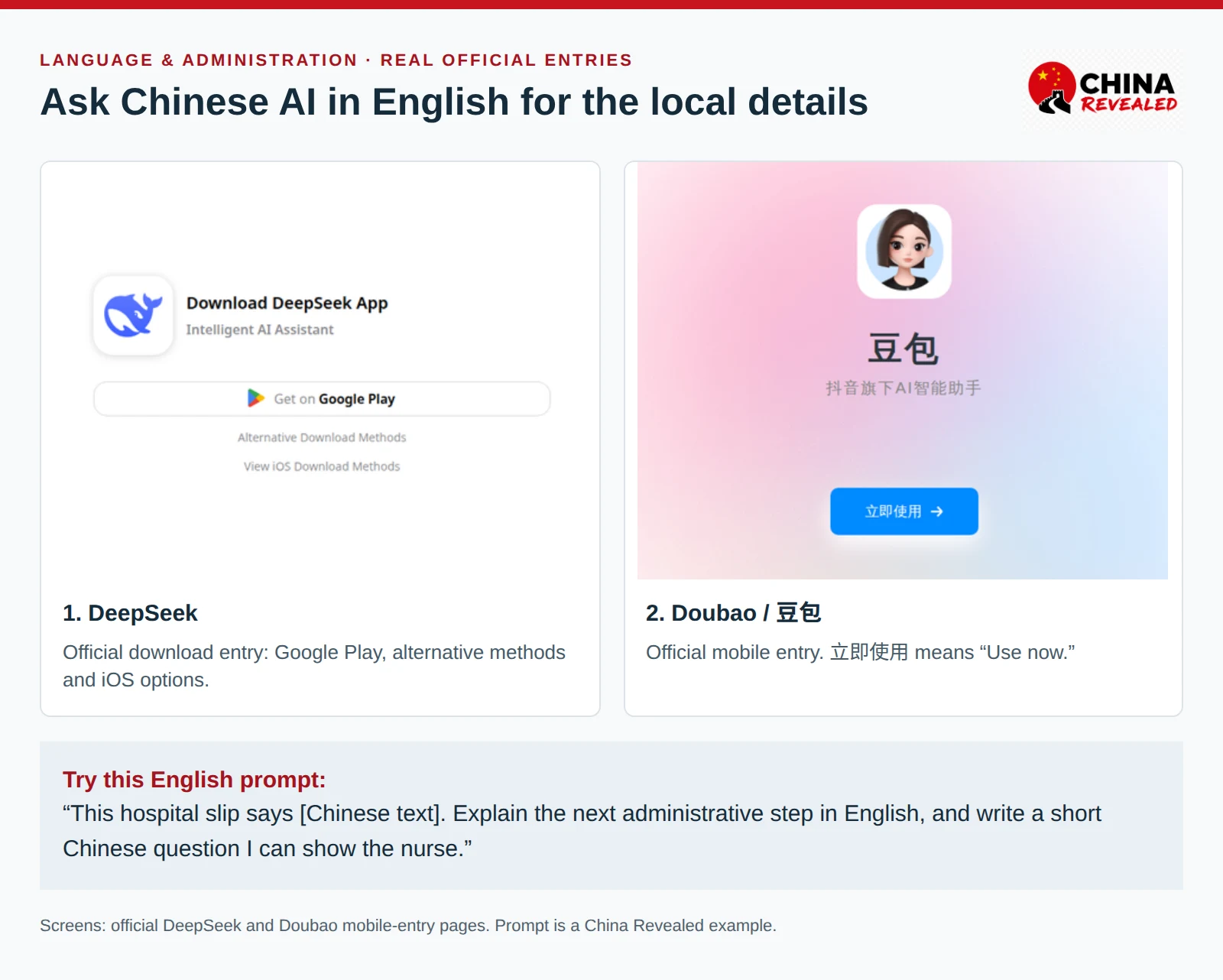
I recommend having a Chinese AI assistant ready before you need it: DeepSeek or Doubao / 豆包. Download through the official link and complete the app’s sign-in steps before your trip. You can type your question in English and ask for an English answer, with the Chinese wording to show staff.
These tools are particularly handy for the local details: the meaning of a clinic sign, what 挂号 means, where a payment slip tells you to go, and how to ask for a medical receipt. Here are prompts I would use:
Finding the right desk: “I am a tourist in [city], near [hotel or landmark]. Help me look for a licensed community clinic. Give me its Chinese name and questions to ask about passport registration, opening hours and general-practice appointments.”
At the hospital: “This slip says [paste the Chinese text]. Explain the next administrative step in English, and write a short Chinese question I can show the nurse.”
Explaining symptoms: “Translate this accurately into simple Chinese for a doctor: [symptoms, when they started, allergies and current medicines]. Keep the facts unchanged.”
Ask the clinic to confirm its hours and registration arrangements. Use AI for language and practical questions; the clinician diagnoses the problem and the pharmacist confirms medicine instructions. If sharing a photo of a slip, cover your passport number and patient identifiers first.
Walk in and register with your passport
For a foreign visitor’s first appointment, I recommend the staffed registration desk. Chinese residents often book on WeChat or hospital apps, but passport fields, local-phone verification and patient accounts can make that route unnecessarily awkward for a short trip.
At a small clinic or community center, ask about a same-day general consultation. For a popular large hospital or a particular specialist, have hotel reception or the hospital’s international desk arrange the appointment first, then use the staffed desk when you arrive.
The front-desk sequence
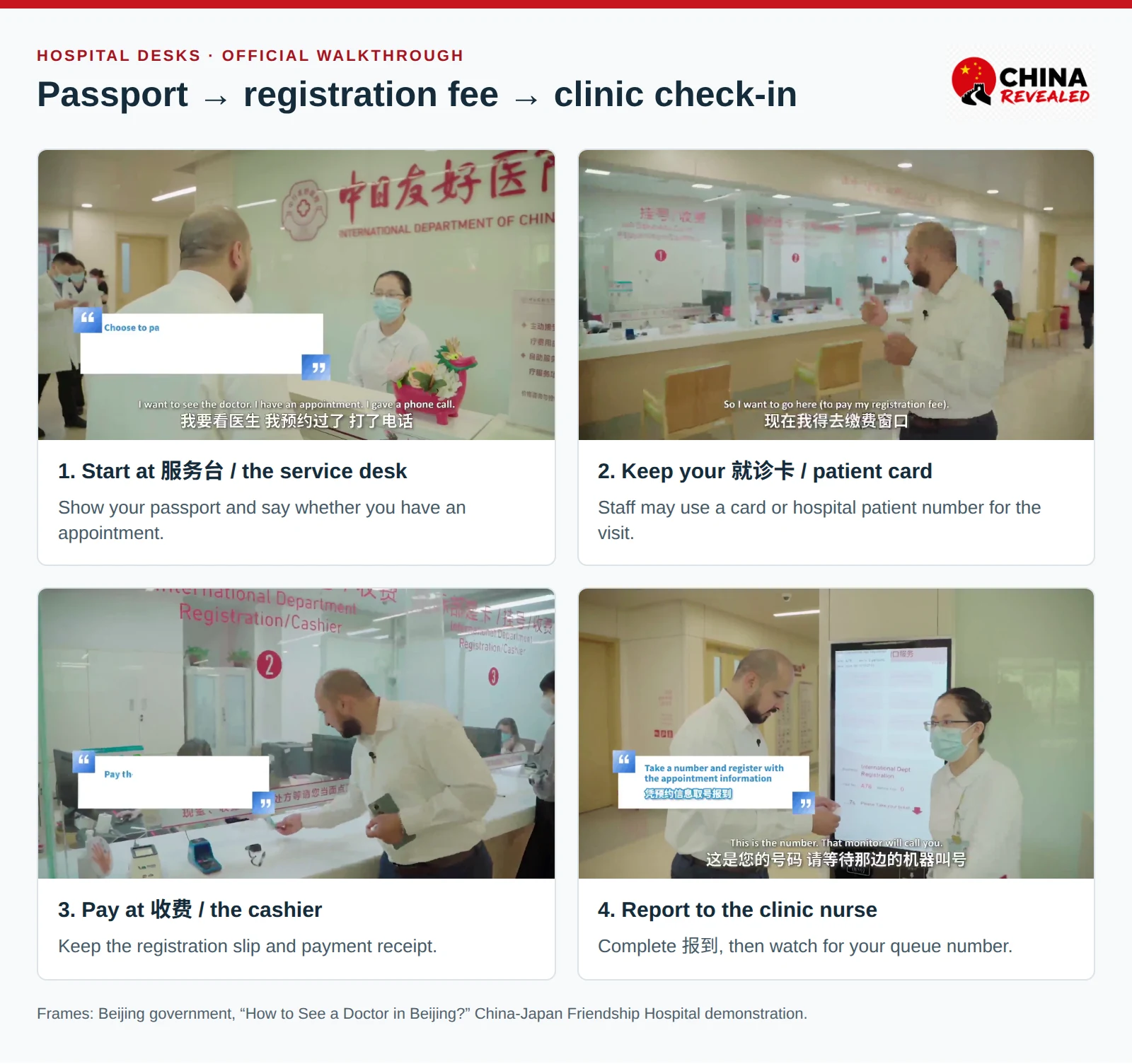
- Show your original passport at 服务台 or 挂号. Staff create your patient record and direct you to the right clinic. Tell them if you already booked.
- Pay the registration or consultation fee at 收费. Keep the slip. You may also receive a patient card, 就诊卡, or patient number; use it for the rest of the visit. If the card holds a prepaid balance, ask about the unused-balance refund when you finish.
- Go to the clinic and report to 分诊台 or 护士站. Show the registration slip to the nurse, complete 报到 (check-in) and wait for your number on the 叫号屏.
That is the practical order: passport → registration fee → clinic desk → your turn. Even after an online booking, go through the clinic’s arrival check-in.
Bring your phone, an allergy and medication list, and RMB cash as a backup to mobile payments or your card. For payment setup, see our Alipay guide for foreigners. If a hospital payment fails, go to the cashier rather than repeatedly trying the same mini-program.
Want to book online anyway?
Use the hospital’s official website, app or WeChat mini-program and look for 预约挂号. Select 护照 / Passport, then check the hospital campus, department, date and paid booking record. In Beijing, 京通 / International Service Beijing has an En option and a Beijing 114 appointment service through WeChat or Alipay.
If the form gets stuck on a Chinese ID number or SMS, switch to telephone or staffed registration. I would not spend a sick morning troubleshooting it.
See the doctor, do the tests and collect medicine
Explain the symptoms and when they started. Show your prepared Chinese note and say what you have already taken. Ask staff for language help with treatment instructions if needed.
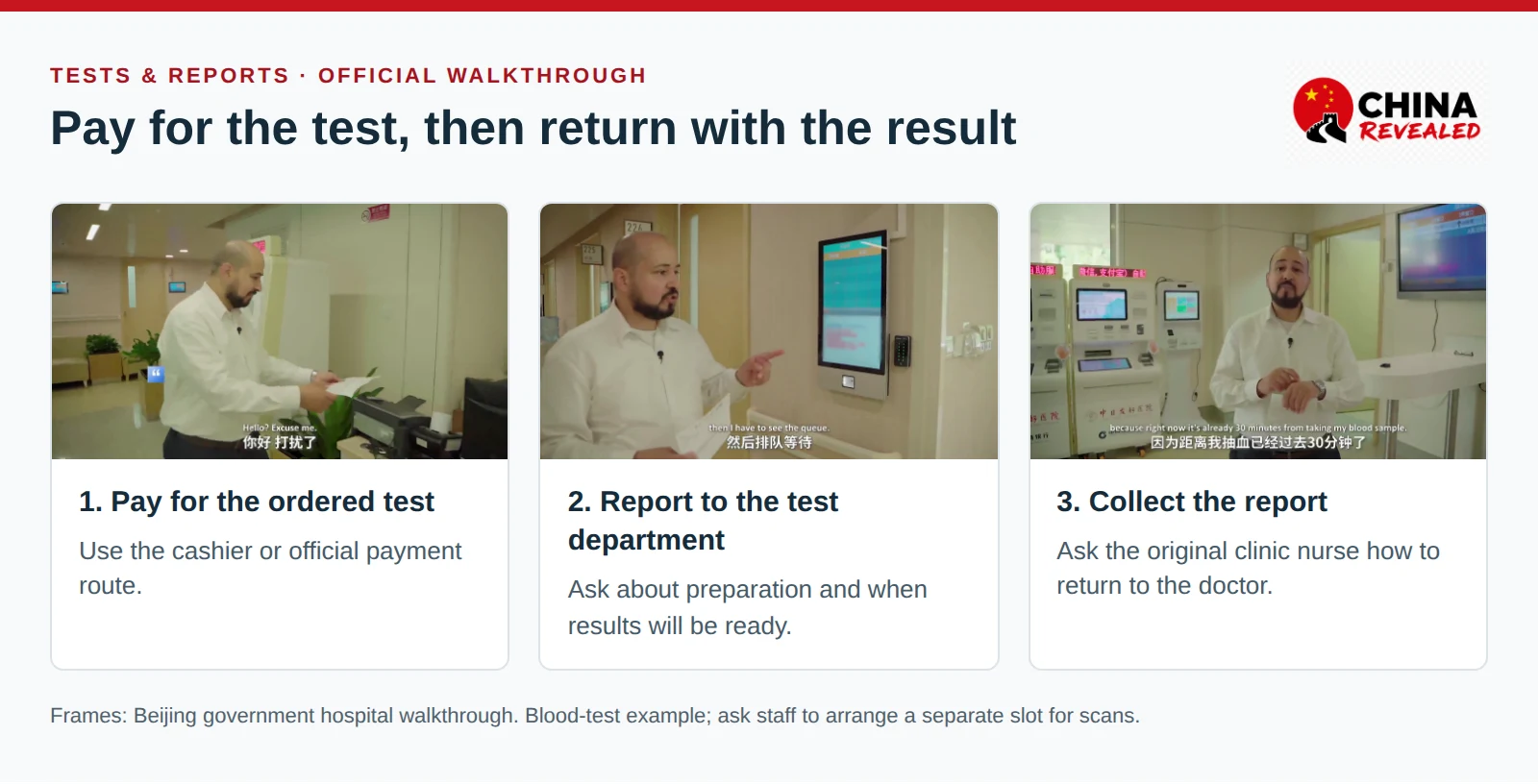
If the doctor orders tests, the next steps are usually pay for the test → report to its department → collect the result → return to the doctor. The test order or 导诊单 tells you where to go. Ask the test desk about preparation and when the report will be ready. For a scan, ask them to arrange the examination slot and its check-in.
Before leaving the consulting room, ask: “Do I return today, and where do I check in?” For same-day results, the original nurse can tell you how to rejoin the doctor’s queue. If the review will be another day, ask them to arrange the follow-up and confirm whether you need a new registration.
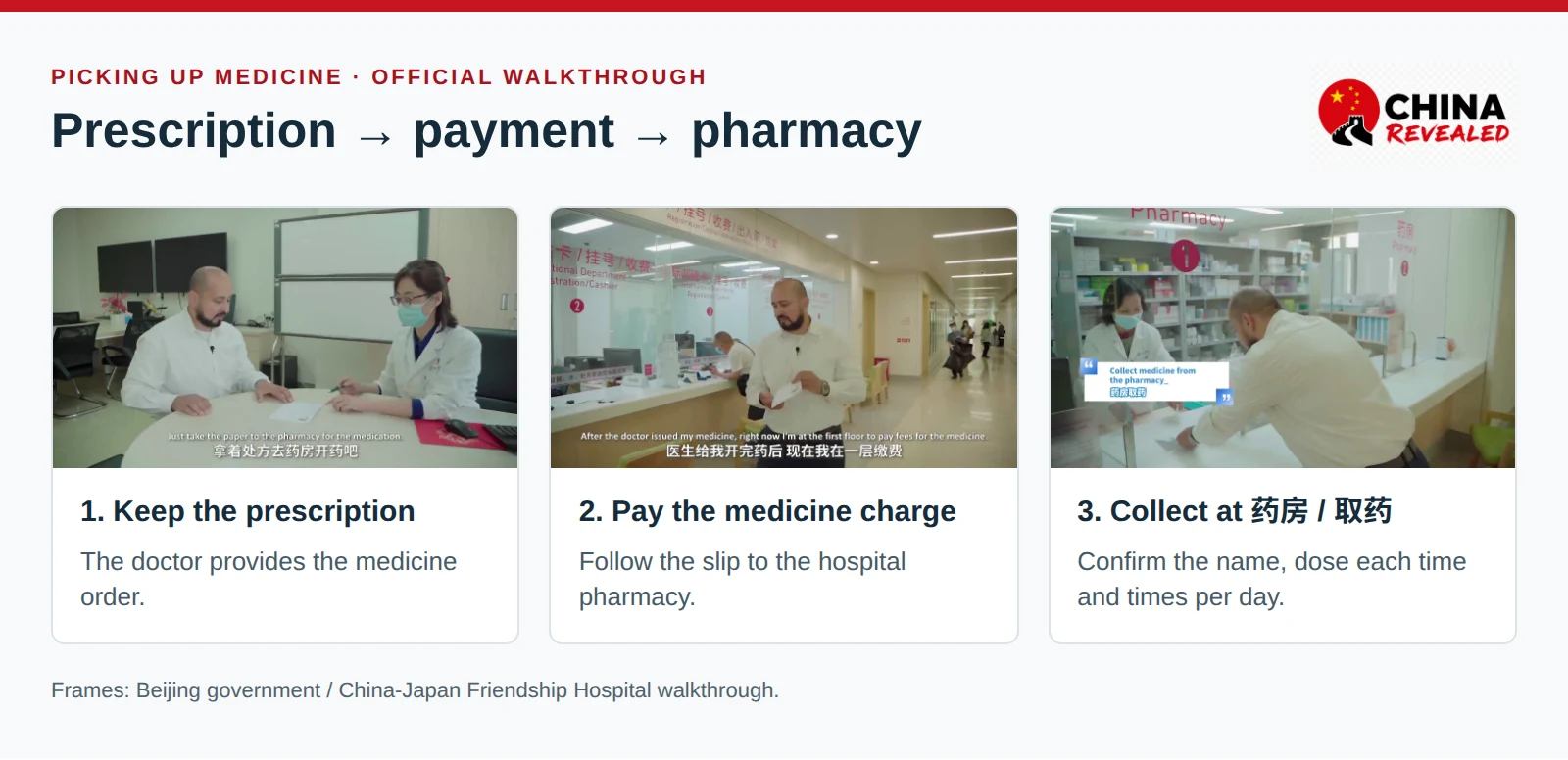
After the doctor writes a prescription, pay the medicine charge and go to the 医院药房 (hospital pharmacy) shown on the slip. Watch the pickup screen and have your patient card or prescription ready.
At the window, check the medicine name, strength, quantity, dose each time and times per day. Ask the pharmacist to write the instructions in English or explain them clearly through an interpreter. Keep the labeled packaging, prescription and pharmacy receipt.
Call 120 for a serious emergency
For severe breathing difficulty, chest pain with serious illness, collapse, a sudden severe abdominal pain or a serious injury, call 120. If already at a hospital, go to 急诊 (Emergency). Tell the dispatcher your exact Chinese address, entrance and room number. Hotel staff or a companion can help with the call.
A short city ambulance trip can cost just a few hundred yuan. For example, Beijing’s published charges put a 10-km trip plus basic pre-hospital emergency care at RMB 199, before medicines, tests or additional treatment. That is a useful sense of scale when deciding to call for help.
Get treatment first. Once help is underway, ask your companion or the hospital to contact your insurer’s medical-assistance team. Emergency departments assess urgency and treat the most serious patients first.
Book hotels, flights, train tickets, attractions and other travel services on Trip.com.
Pay, keep the documents and claim on insurance
Before a planned appointment: one call to your insurer
Use the 24-hour medical-assistance contact on your own policy. Tell them your symptoms, city and intended clinic. Ask which provider to use, whether pre-authorization is needed, whether they can arrange direct billing or translation, and who handles a hospital deposit. Save the assistance case number and their written reply.
For a small outpatient visit, the common route is pay the clinic or hospital, collect the documents, then submit a claim. Check your policy’s excess or deductible and rules for pharmacy purchases before spending time filing a small claim.
If admitted: let the insurer and hospital coordinate
Ask your insurer to send the hospital a Guarantee of Payment / GOP for direct billing, and ask the billing desk to confirm its arrival and your share of the cost. If the hospital takes a 住院押金 / 预交金 (deposit or prepayment), keep every receipt. At discharge, collect the final settlement showing how the deposit was applied and any refund.
Before you leave: collect the claim folder
I would collect these while still at the desk, not after flying home:
- Bills and payment proof: registration, consultation, treatment, tests and pharmacy receipts; the itemized 费用明细; and card or Alipay/WeChat payment records.
- Medical records: Chinese 门诊病历, diagnosis, test reports and prescriptions. For a pharmacy-only purchase, keep the medicine receipt and any supporting prescription.
- For a hospital stay: deposit receipts, final bill, settlement, refunds and 出院记录 / 出院小结 (discharge record or summary).
- Insurance communication: policy and assistance numbers, authorization or GOP, and the messages about your treatment and payments.
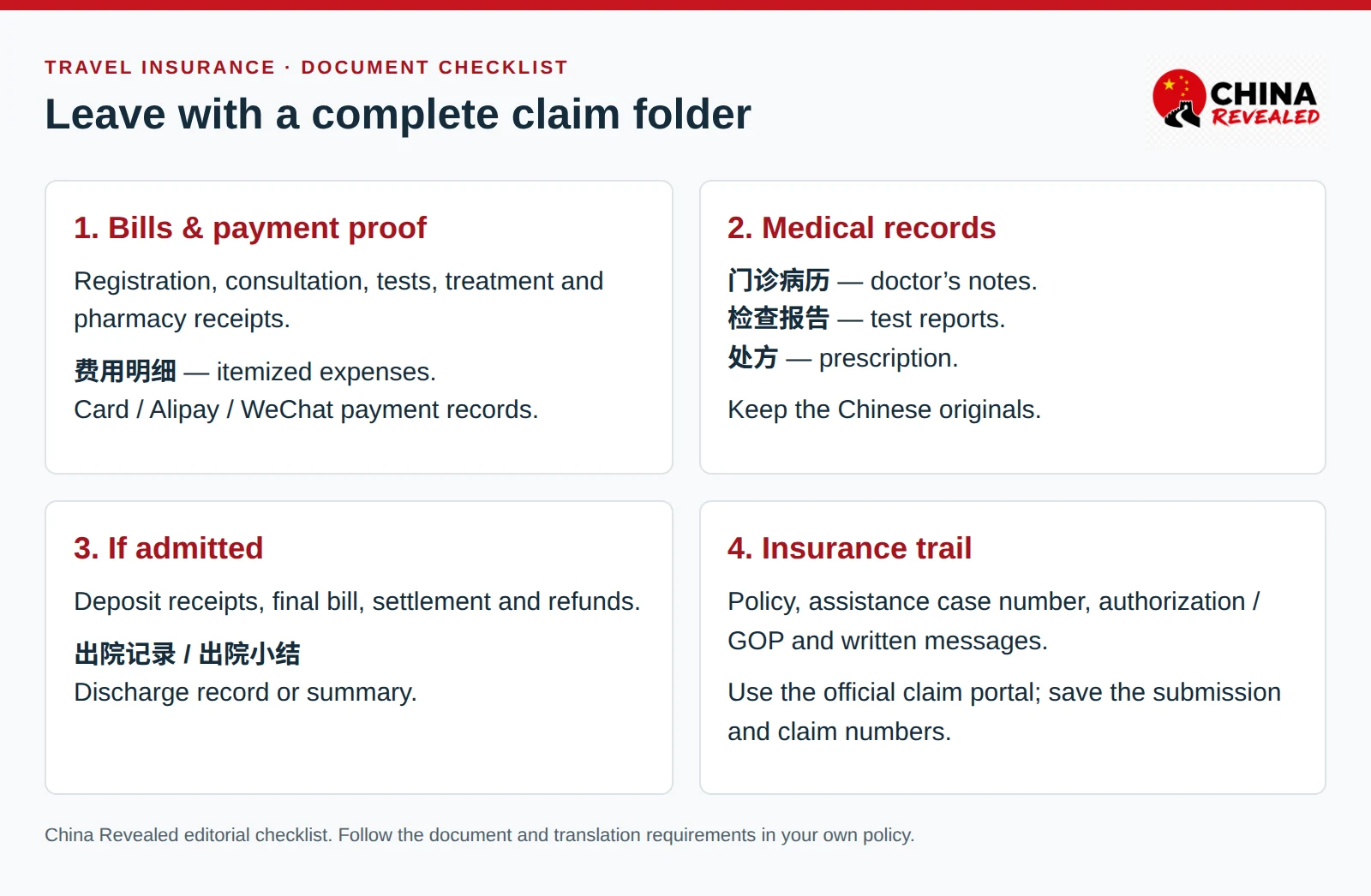
Upload the documents through the insurer’s official claims site or app, using the dates, amounts and currency shown on the bills. Keep the Chinese originals; ask which translations and original documents the claim requires. Report any refunds, keep the submission and claim numbers, and follow the policy’s reporting deadlines. The policy’s benefits and excess determine the reimbursement.
Chinese phrases to save on your phone
Can you help me find a nearby licensed clinic that registers foreign passports?
请帮我找一家附近可以用外国护照登记的正规诊所。I would like a general-practice appointment using my passport.
我想用护照挂全科门诊。Where do I pay, and where do I check in for this test?
请问在哪里缴费?这项检查在哪里报到?How much should I take each time, and how many times a day?
每次用多少?每天用几次?Please give me the itemized bill, medical record and reports for my insurance claim.
我需要保险理赔,请给我费用明细、病历和检查报告。
About China Revealed
China Revealed is an independent English-language travel guide dedicated to China.
We bring together China travel guides, destination information, local insights and practical travel resources in one place.
Our travel database covers China's provinces, cities, famous attractions, hidden gems, local cuisine, transportation, accommodation, visa requirements, digital payments, mobile connectivity and the other practical details travelers need to explore China.
We focus on depth, careful research and accuracy. Our guides combine official sources, detailed destination data, local knowledge and regularly updated information to give reliable, practical travel advice.
Whether you're visiting China for the first time or exploring beyond the popular destinations, China Revealed is an all-in-one resource for discovering the real China.
China Revealed — Your practical guide to China.
Some links on China Revealed, such as Trip.com booking links, are affiliate links. If you book through them, we may earn a commission at no extra cost to you. This does not change what we recommend.