

Is China Safe for Tourists? Yes—Travel With Confidence
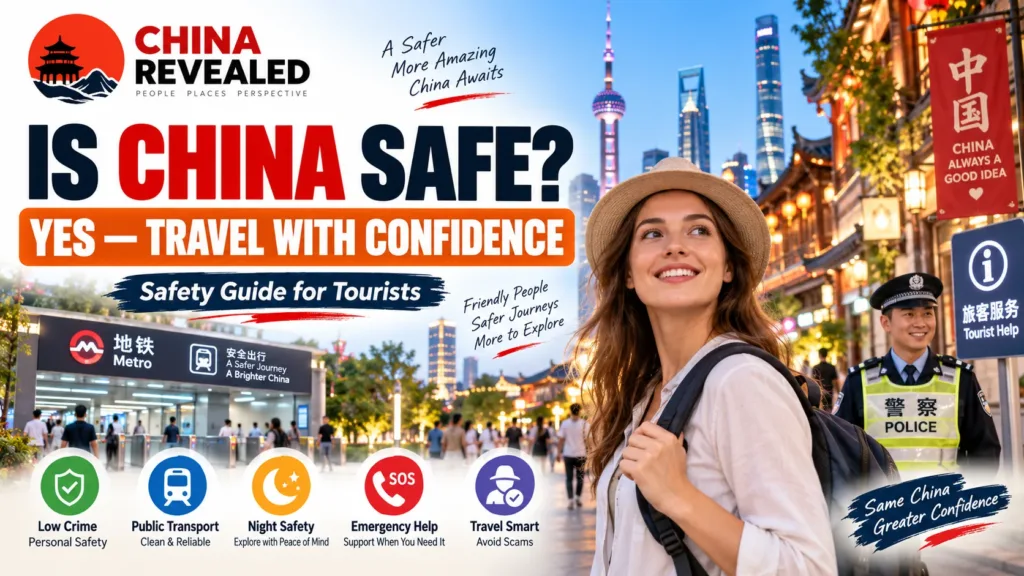
Yes. China is very safe for ordinary tourism, and personal safety should not be a major worry on your trip. You do not need to spend your holiday expecting someone to rob you, snatch your phone or attack you on the way back to your hotel. For established sightseeing routes, serious street crime is an uncommon concern—not something to organize your whole day around.
Visit the sights, use public transport, go out for dinner and enjoy the evening. Keep your belongings with you as you would anywhere, but there is no need to turn a China holiday into a constant exercise in watching for thieves. A working phone, the right hotel address and a little preparation for local payments are far more useful things to focus on.
That reassurance is supported by independent safety surveys, low homicide figures and foreign governments’ own descriptions of crime against visitors. This guide explains the evidence and the security measures you will notice in mainland China.
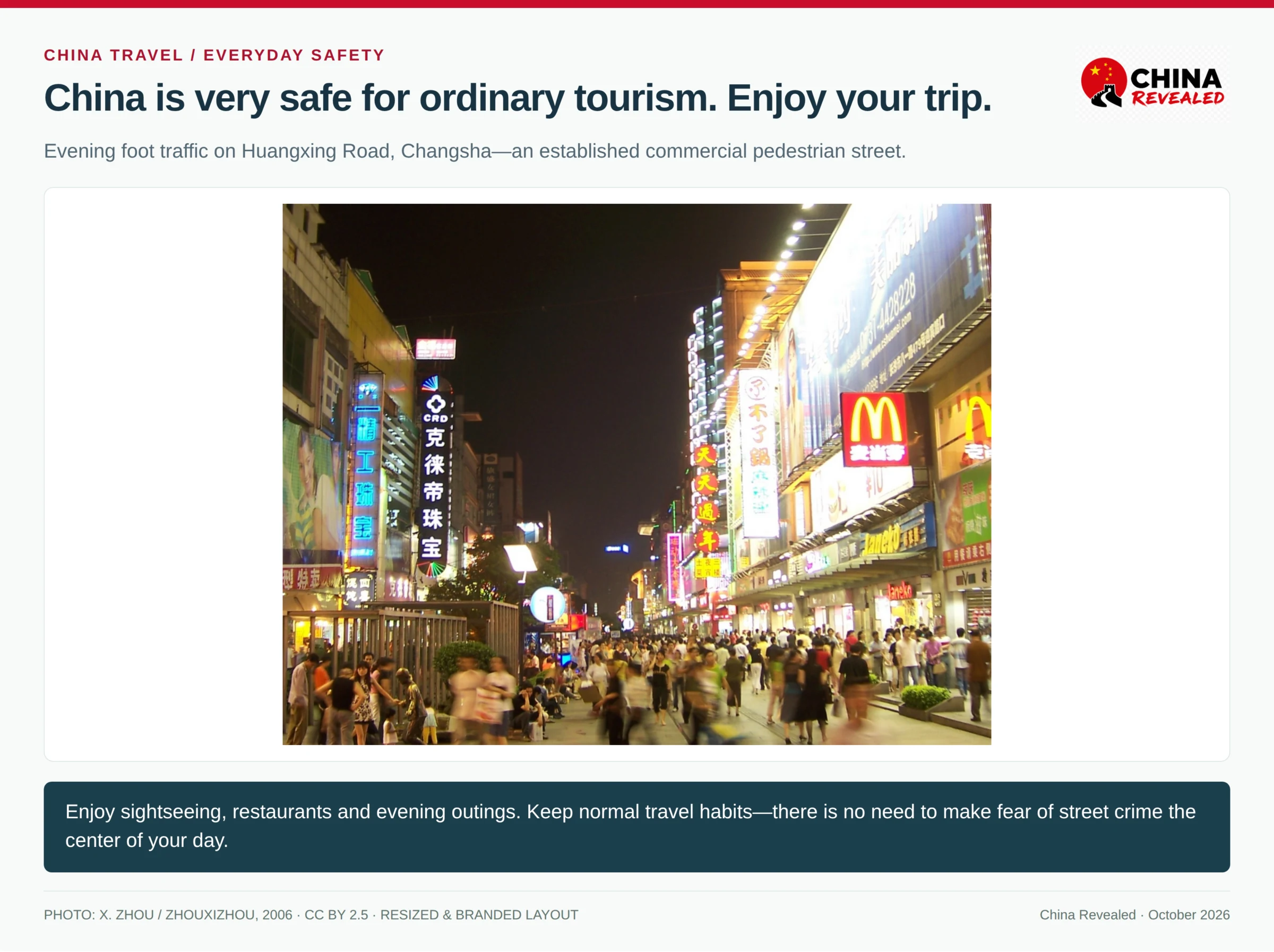

You can relax about everyday personal safety
Do I need to keep worrying about being robbed?
No. Fear of mugging or violent street crime does not need to dominate an ordinary China itinerary. British government travel advice describes serious crime against foreign nationals as “relatively rare”; Canadian advice uses the same description. That is a reassuring assessment from governments whose job is to warn their citizens about travel risks.
Theft is a separate question: it can still occur in crowded places. Keep your passport secure and take your phone and bag with you when leaving a table. You do not need to interpret everyone nearby as a potential thief, but a low-crime destination is not a reason to leave valuables unattended.
If a previous trip to a busy European tourist hotspot left you feeling constantly on guard, do not assume your China trip will be the same. Approach China on its own evidence: low serious crime and high confidence in everyday safety. Keep your belongings close as an ordinary habit, not as a source of constant anxiety.
Is it safe to go out at night?
An evening meal, a walk around an established shopping district or a return to your hotel is not something to rule out simply because it is dark. China’s night-time safety figures are particularly reassuring: in Gallup’s 2024 survey, 94% of adults in China said they felt safe walking alone at night where they lived.
Choose a sensible route, know how to get back and use a licensed taxi or verified app ride (see our DiDi guide) if you are tired or the route is isolated. Those are ordinary travel habits, not a recommendation to stay inside after sunset.
What about solo travelers and women?
China’s low serious-crime picture is reassuring for independent travel. A hotel with reliable reception, saved directions and a working phone is a good starting point. You can plan sightseeing, restaurants and evening outings without assuming that traveling alone makes them unsafe.
Use the usual precautions in bars, keep control of your drink and avoid going to an unfamiliar private venue chosen by a stranger. For a late return, match the car’s full plate to your ride order. Save your hotel’s Chinese name, address and phone number using our Amap guide.
The data behind that reassurance
94% felt safe walking alone at night
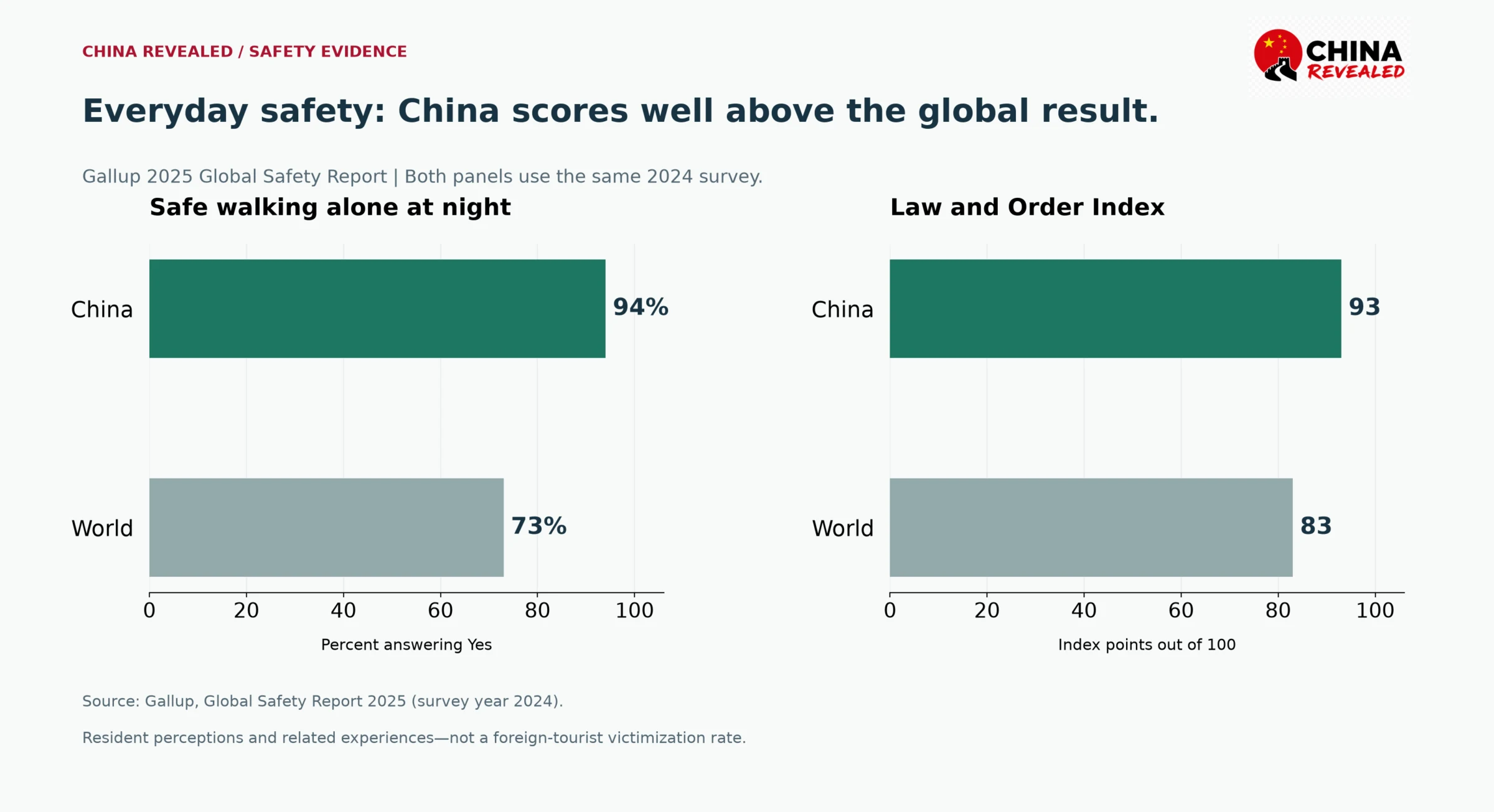
Gallup’s 2025 Global Safety Report, based on its 2024 survey, found that 94% of adults in China felt safe walking alone at night in their city or area. The global figure was 73%—a difference of 21 percentage points.
This directly addresses one of a first-time visitor’s biggest questions: whether ordinary life after dark feels threatening. It is a resident survey rather than a foreign-tourist survey, but the result gives strong evidence of everyday confidence in local safety.
China scored 93/100 on the Law and Order Index
In the same report, China scored 93 out of 100, compared with a global score of 83. Gallup combines night-time safety, confidence in local police and experiences of theft and assault or mugging in the previous year.
The two figures measure different things: 94% is the answer to the night-walking question; 93/100 is the combined index. Both put China well above the corresponding global result. The Gallup report gives the results and methodology.
Low homicide figures and fewer recorded criminal cases
The World Bank’s UNODC-sourced series records China’s intentional-homicide rate at approximately 0.50 victims per 100,000 people in 2020. That is a low population-level rate of fatal intentional violence. 2020 is the latest year with a value in the China series verified for this article; it is not a newly measured 2026 figure. See the World Bank indicator.
More recent police figures also show an improving recorded-crime picture:
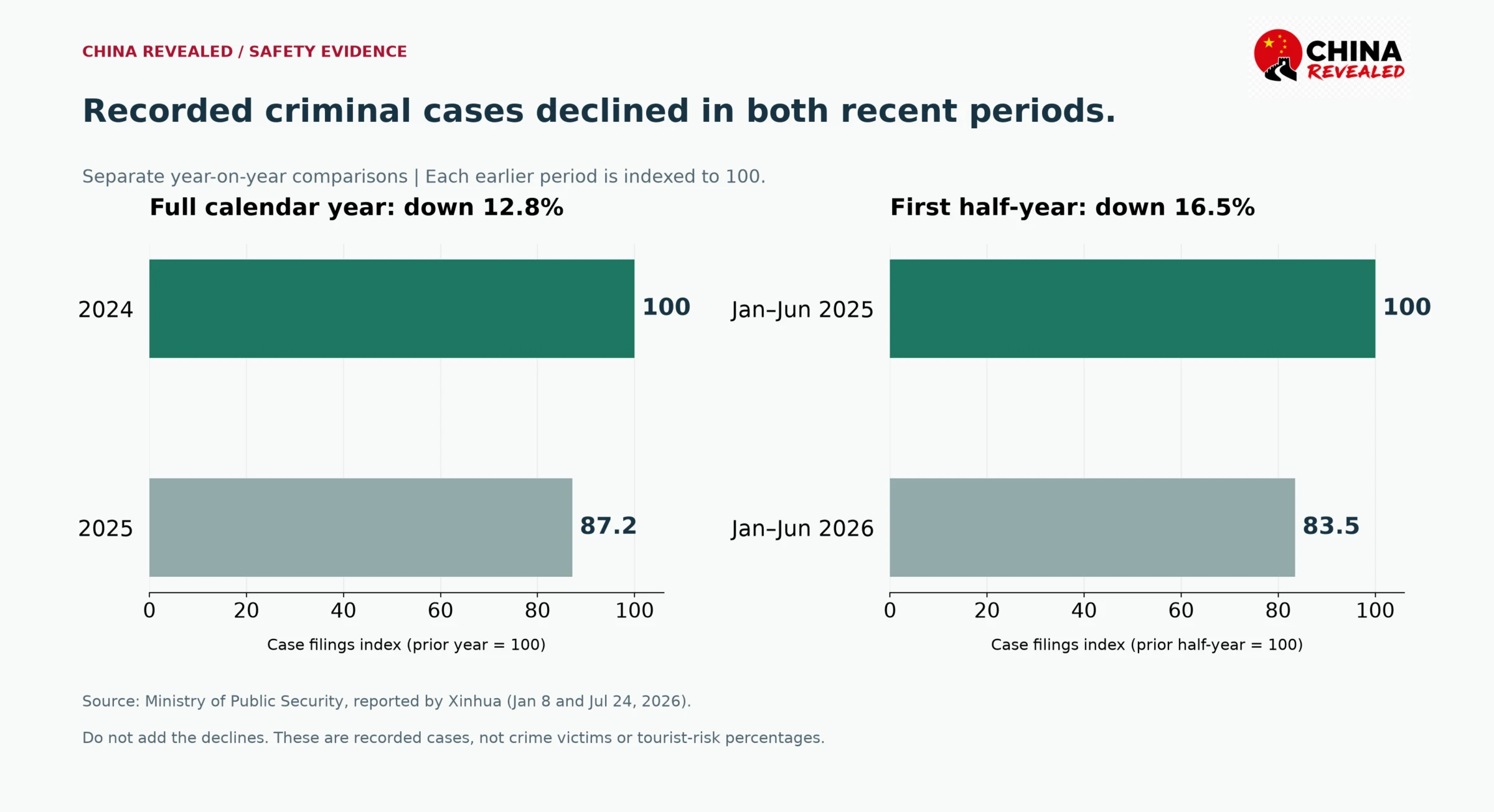
- 2025: criminal-case filings fell 12.8% compared with 2024; serious violent-crime cases fell 4.7%.
- January–June 2026: criminal cases fell 16.5% compared with January–June 2025.
The annual and half-year figures come from Ministry of Public Security releases reported by Xinhua. Each uses its own comparison period. They describe recorded cases, not a percentage reduction in any individual tourist’s risk.
Taken together, these sources support a clear message: China has a strong everyday safety picture. Ordinary travelers have good reason to feel comfortable about their personal safety.
Book hotels, flights, train tickets, attractions and other travel services on Trip.com.
What China does to keep public spaces safe
Strict firearms controls
China tightly controls unauthorized gun possession, manufacture, sale and transport. Firearms are permitted for authorized official purposes and limited approved civilian uses, rather than being freely available to the public.
These controls are one layer of the public-safety system, alongside policing and security checks. The relevant point for a visitor is a tightly regulated firearms environment.
Security checks on public transport
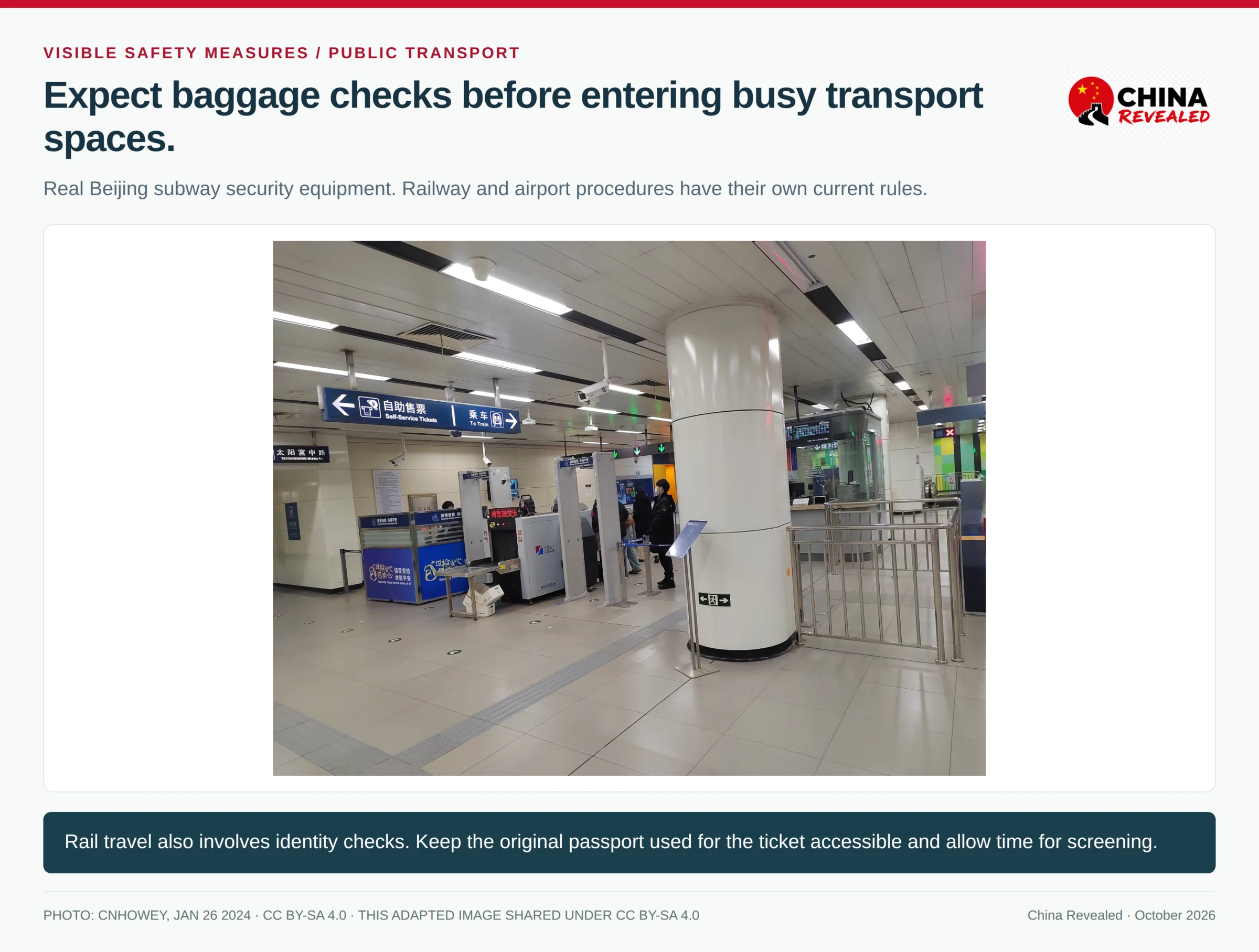
Railway stations and many metro systems screen baggage before entry. Airports screen passengers and luggage before access to controlled areas. Railway passengers also pass identity checks using the valid document attached to their ticket.
You will notice these checks during ordinary travel. Keep the original passport used for your train ticket accessible, follow prohibited-item rules and allow time for screening.
Patrols and police assistance at tourist sites
Tourist policing includes patrols, crowd management and help for visitors—not just dealing with crimes afterward. Documented arrangements at Chengdu’s Kuanzhai Alley include officers at entrances and key passages and a bilingual patrol team.
At busy destinations, look for 警务室 / police service room, or ask venue staff where to find an officer. Language support varies, but staff can help you explain the problem.
Identity checks and hotel registration
Train bookings and hotel stays are connected to verified identity details. Hotels check guests’ documents and register foreign guests’ accommodation with the police. If staying outside a hotel, complete accommodation registration within 24 hours through the applicable local process.
Use passport details that match your bookings and carry your original passport securely for required checks. Your hotel can help explain the local registration process.
Public-security cameras and anti-fraud services
Public-security video systems support monitoring and investigation. Regulations effective April 1, 2025 govern their operation, require visible signs and prohibit installation in private areas such as hotel guest rooms, bathrooms and changing rooms. Cameras are part of the infrastructure, not a promise of instant recovery of a lost item.
China also has 96110, a dedicated anti-telecom-fraud warning and consultation number. Never transfer money or reveal verification codes because a caller claims to be police; caller ID can be spoofed. If you have already been defrauded and need police action, call 110.
A few sensible habits—then enjoy the trip
There is no need for a long list of things to fear. The following habits cover the practical issues worth keeping in mind:
- Keep belongings with you. Secure your passport and take your phone and bag when you leave a seat. Ordinary care is enough; constant suspicion is unnecessary.
- Choose your own venues. Be cautious about unsolicited invitations to a teahouse, bar or private gallery near a tourist attraction. Check prices before ordering.
- Check payments and rides. Confirm the recipient and amount, protect SMS and live payment codes, and match your ride’s plate. Our Alipay guide explains the payment methods.
- Watch traffic and weather. Look for turning cars and quiet electric bikes, wear a seat belt and respect closed trails or severe-weather notices.
- Keep your phone working. Save your hotel’s Chinese address, maintain enough battery and have travel insurance for your activities.
Crime safety and legal requirements are different subjects. Follow visa, registration, drug and restricted-site rules. Your own government’s travel advice should also be checked before departure: for example, the U.S. mainland advisory dated September 4, 2026 cited arbitrary enforcement, exit bans and unjust arrest or detention. Seek relevant advice before travel if you have citizenship questions, China-related business disputes or sensitive work. Hong Kong and Macao have separate legal and emergency arrangements.
How to get help in mainland China
Keep these details as a useful backup—not because you should expect trouble.
The three emergency numbers
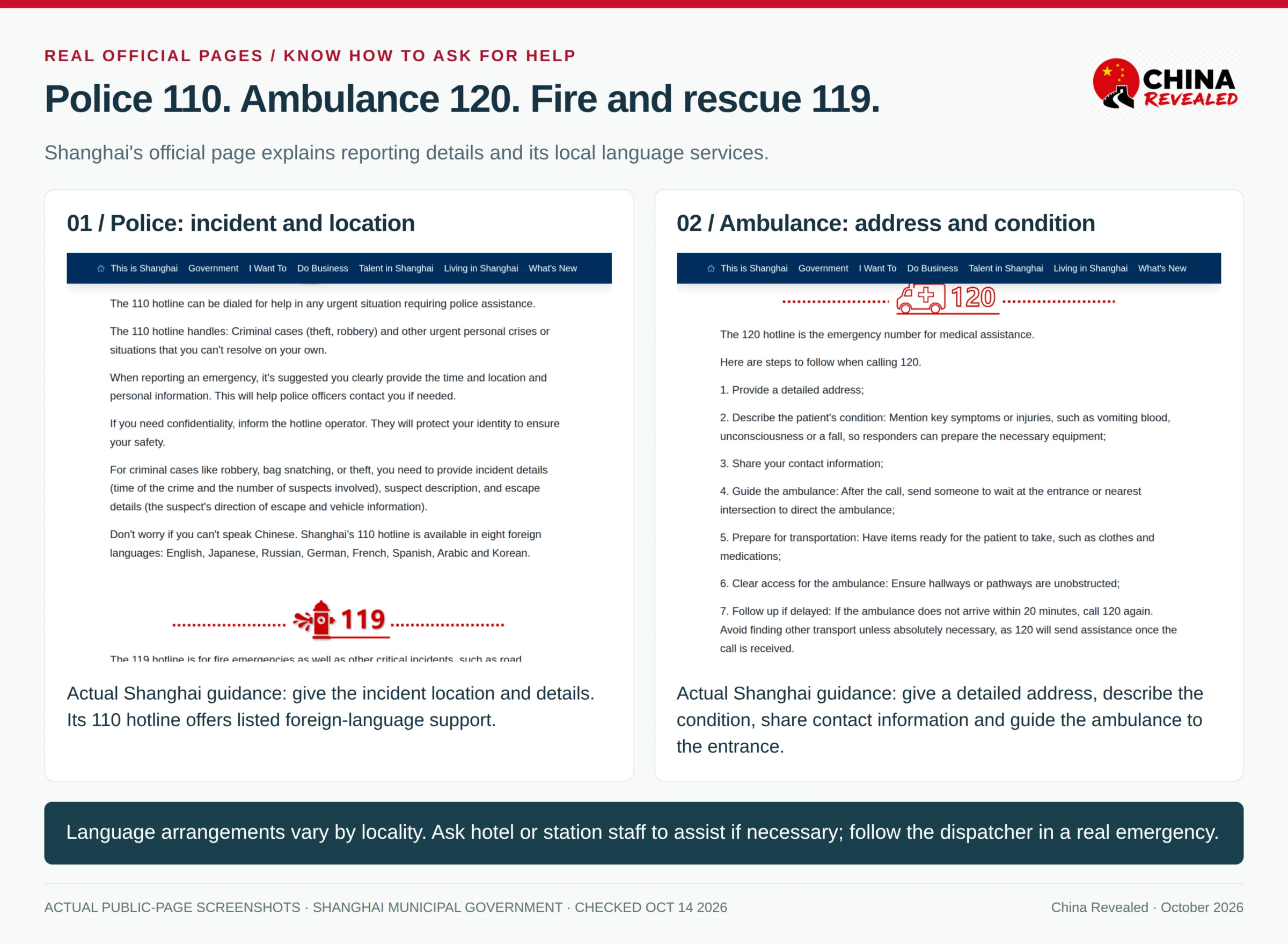
110 — Police. For an urgent situation requiring police, including a crime, threat or being prevented from leaving. After theft, follow police instructions and obtain a report if your insurer needs it.
120 — Ambulance. Give the exact location, the patient’s condition and a callback number. If safe, have someone meet the ambulance at the entrance. Follow the dispatcher’s guidance.
119 — Fire and rescue. Explain the location, what is happening and whether anyone is trapped. Get to safety rather than returning for luggage.
Shanghai’s official guide lists foreign-language support for 110 and English for 120 and 119. Elsewhere, ask hotel, station or venue staff to assist if language is a problem. A data-only eSIM may not support local calls; our SIM vs eSIM guide explains the difference.
Give the exact location
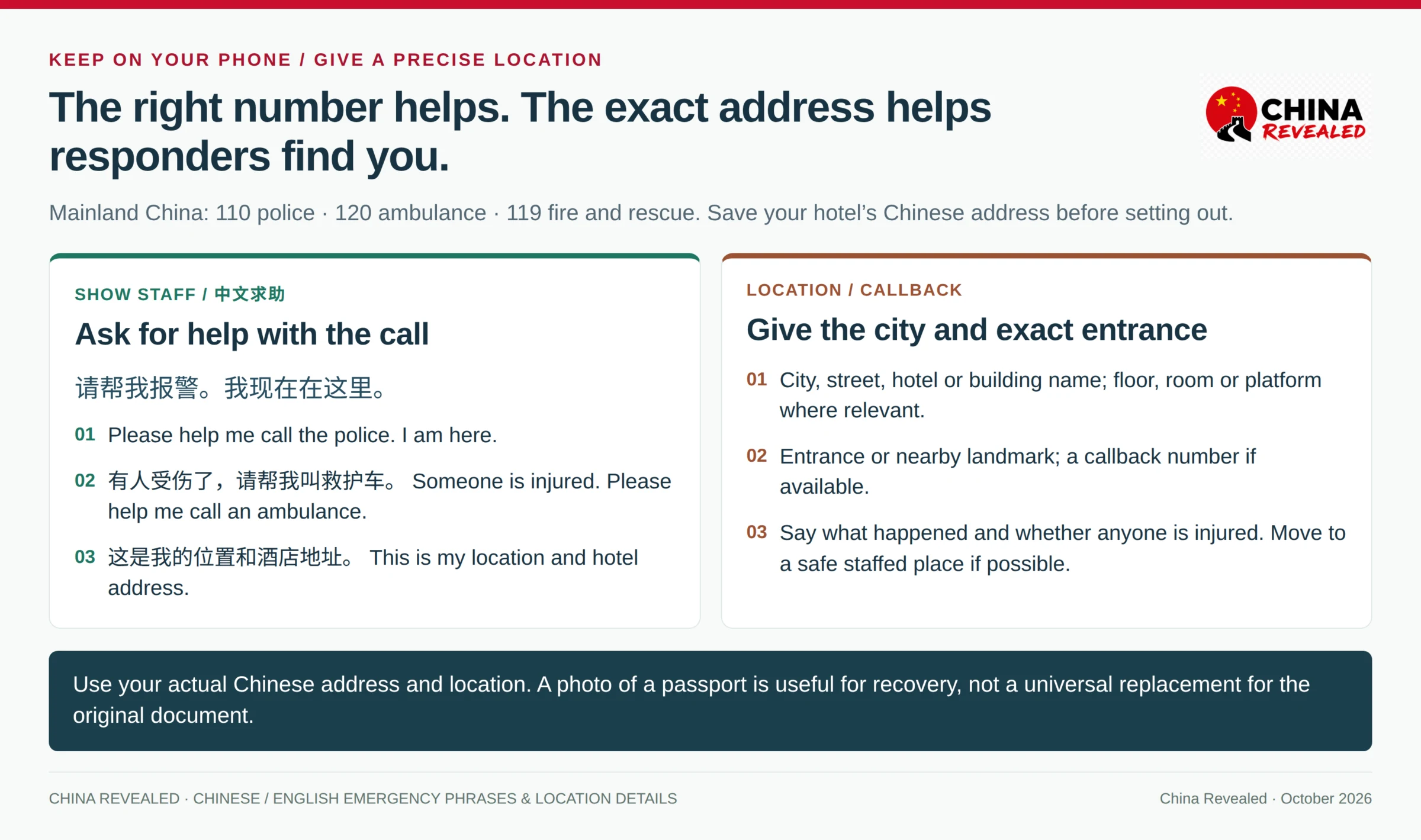
Tell the operator the city, street, building or hotel name, floor and entrance, plus a callback number. Use the Chinese address saved from your booking.
请帮我报警。我现在在这里。
Please help me call the police. I am here.
有人受伤了,请帮我叫救护车。
Someone is injured. Please help me call an ambulance.
这是我的位置和酒店地址。
This is my location and hotel address.
English immigration help: 12367
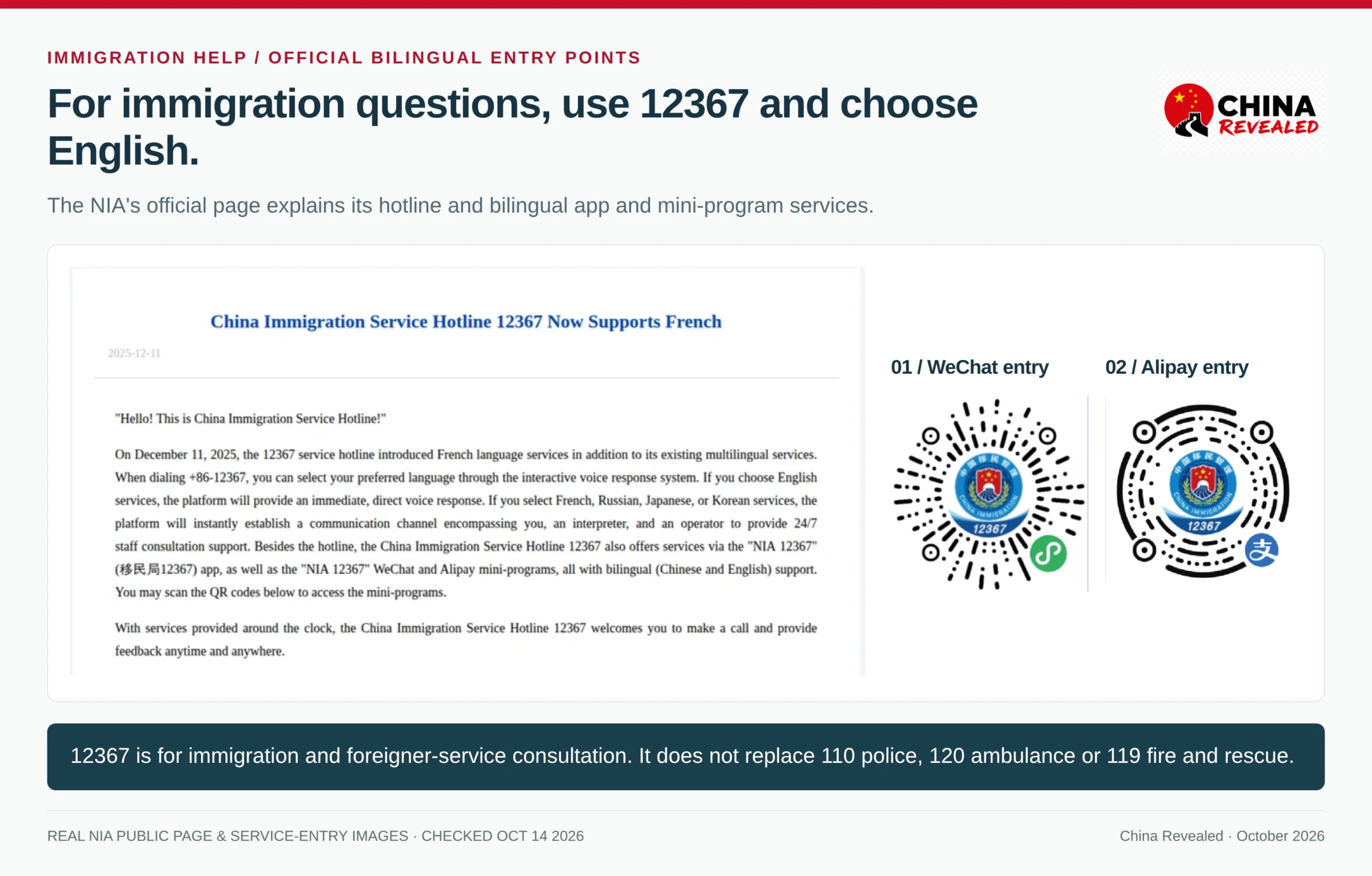
The 12367 China Immigration Service Hotline provides 24-hour Chinese and English service for immigration-policy and foreigner-service questions. Select English in the voice menu. Its NIA 12367 / 移民局12367 app and WeChat and Alipay mini programs also offer bilingual support.
Use the official NIA hotline page for the service explanation and public mini-program entry codes. For an emergency, call 110, 120 or 119 rather than 12367.
For a non-emergency purchase dispute, start with the merchant or booking platform. 12315 and the national consumer platform are additional complaint channels, subject to registration and identity requirements. Keep your embassy or consulate’s emergency contact and insurer’s number separately.
The bottom line: China is a very safe place for ordinary tourism. You can enjoy sightseeing, public transport, restaurants and evening outings without letting fear of theft or violence run the trip. Keep normal travel habits, then relax and enjoy China.
About China Revealed
China Revealed is an independent English-language travel guide dedicated to China.
We bring together China travel guides, destination information, local insights and practical travel resources in one place.
Our travel database covers China's provinces, cities, famous attractions, hidden gems, local cuisine, transportation, accommodation, visa requirements, digital payments, mobile connectivity and the other practical details travelers need to explore China.
We focus on depth, careful research and accuracy. Our guides combine official sources, detailed destination data, local knowledge and regularly updated information to give reliable, practical travel advice.
Whether you're visiting China for the first time or exploring beyond the popular destinations, China Revealed is an all-in-one resource for discovering the real China.
China Revealed — Your practical guide to China.
Some links on China Revealed, such as Trip.com booking links, are affiliate links. If you book through them, we may earn a commission at no extra cost to you. This does not change what we recommend.