

What to Pack for China: Power, Day Bags & Daily Tips
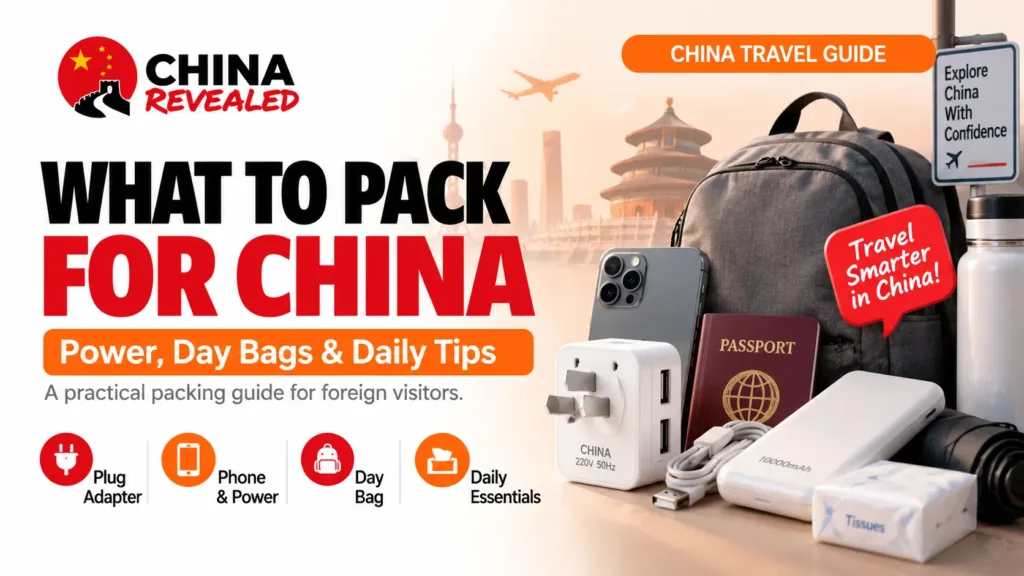
What to pack for China comes down to a few useful things: a China-compatible plug adapter, a charged phone, a light day bag and pocket tissues. I would sort those before worrying about specialist travel gear. You can buy most ordinary toiletries and small supplies after you arrive.
Quick takeaways
- Mainland China uses 220V, 50Hz. Bring an adapter explicitly marked for China; check your charger’s Input rating before plugging it in.
- Your phone handles payments, maps and bookings. Pack a reliable charger, the correct cable and one suitable power bank.
- Keep your original passport, essential medicine and valuables with you—not in a checked suitcase.
- A small zippered bag, tissues, drinking water and comfortable shoes make everyday sightseeing easier.
- Tipping is not expected in ordinary mainland restaurants or taxis. A sincere thank-you tip can still be welcome; it is a choice, not a percentage you must add.
1. The right plug adapter for China
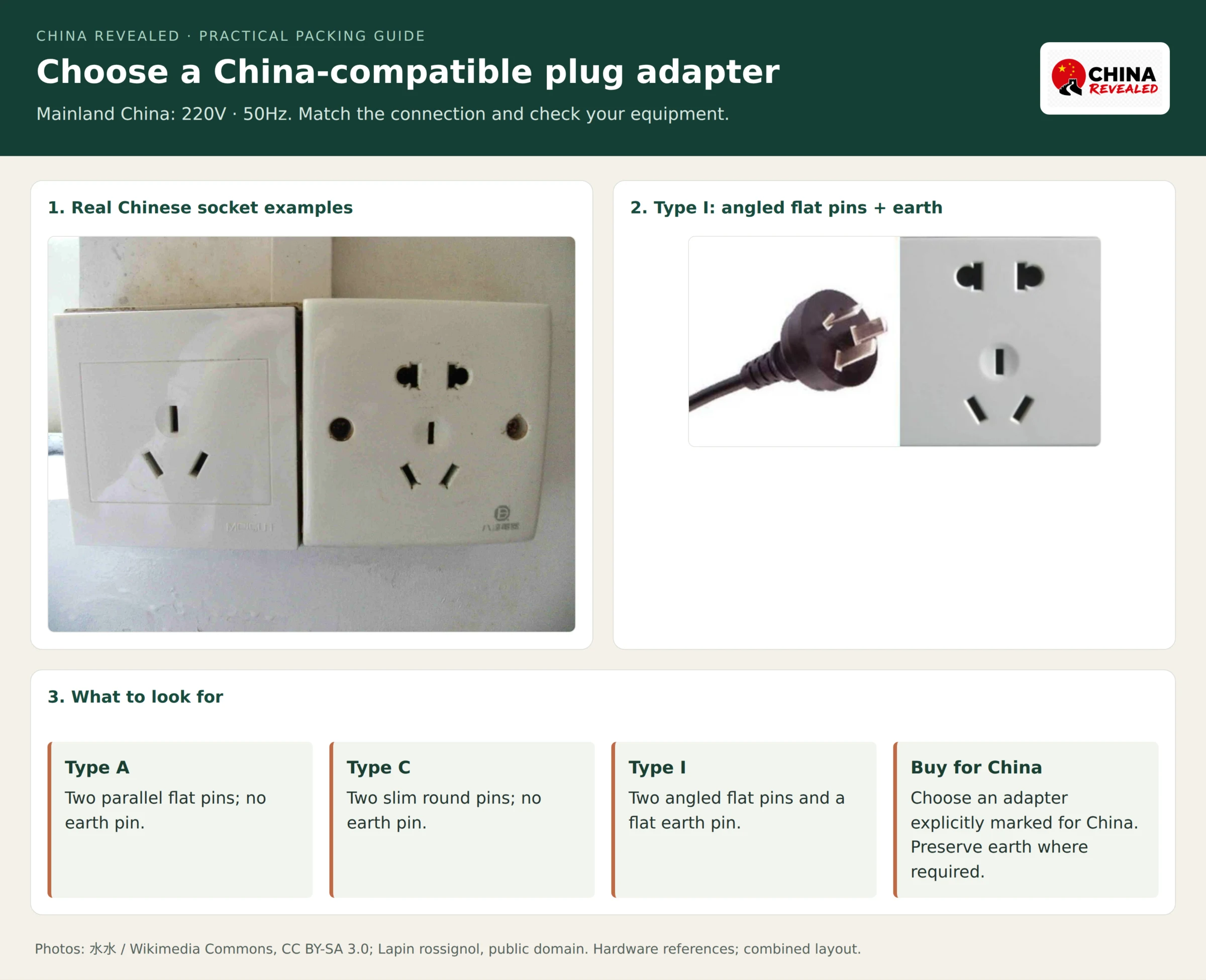
Chinese sockets may look different from the ones at home. The familiar mainland combination has a two-pin opening and a separate three-flat-pin Type I opening. You will encounter Type A plugs with two parallel flat pins, Type C plugs with two round pins, and Type I plugs with two angled flat pins plus an earth pin.
I recommend a travel adapter that explicitly lists China compatibility, rather than relying on a hotel socket to fit your plug. A British three-pin plug, a North American grounded three-pin plug and a bulky European grounded plug should not be assumed to fit the ordinary two-pin opening. If your equipment needs an earth connection, use an adapter that preserves it.
Some Chinese combination sockets accept both slim round pins and parallel flat pins. That can be convenient, but it is not a reason to force a plug into a socket that does not fit securely. Pack the adapter and avoid making your first evening a shopping trip for one.
A multiport USB charger is useful if you have a phone, headphones and a camera. Bring the right cables too: USB-A and USB-C are different connections, and an adapter with USB ports may not support your device’s fastest charging speed.
If your route includes Hong Kong or Macau, check those stops separately; Type G sockets are common there. This guide’s 220V and plug advice is for mainland China.
2. Read the charger label—not just the plug
A plug adapter changes the shape of the connection. It does not turn China’s 220V electricity into 110V.
Before packing, turn over the charger and look for Input:
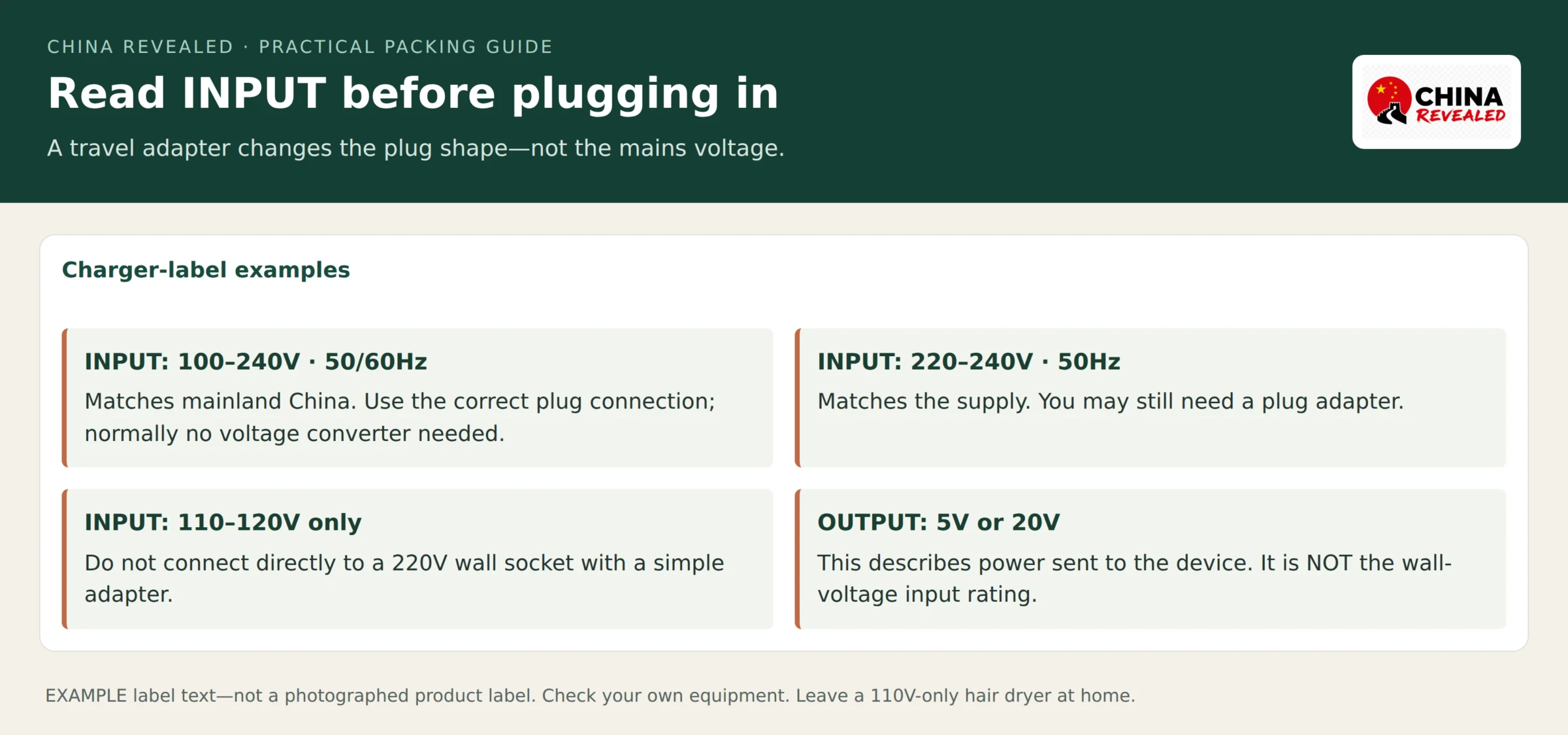
- Input: 100–240V, 50/60Hz: suitable for the mainland’s supply. Use the correct plug connection; a separate voltage converter is normally unnecessary.
- Input: 220–240V, 50Hz: also matches the mainland supply; you may still need a plug adapter.
- Input: 110–120V only: do not connect it directly to a Chinese wall socket through a simple adapter.
The Output: 5V or Output: 20V line refers to the electricity delivered to your device. It does not tell you which wall voltage the charger can accept.
Most modern phone and laptop chargers support a wide input range, but read your own label. Hair dryers, curling irons and other heating appliances deserve a separate check. My advice is to leave a 110V-only hair dryer at home and use the hotel’s dryer or a properly rated local appliance. It is simpler than carrying a heavy converter and checking its power capacity.
3. What I would put in a day bag
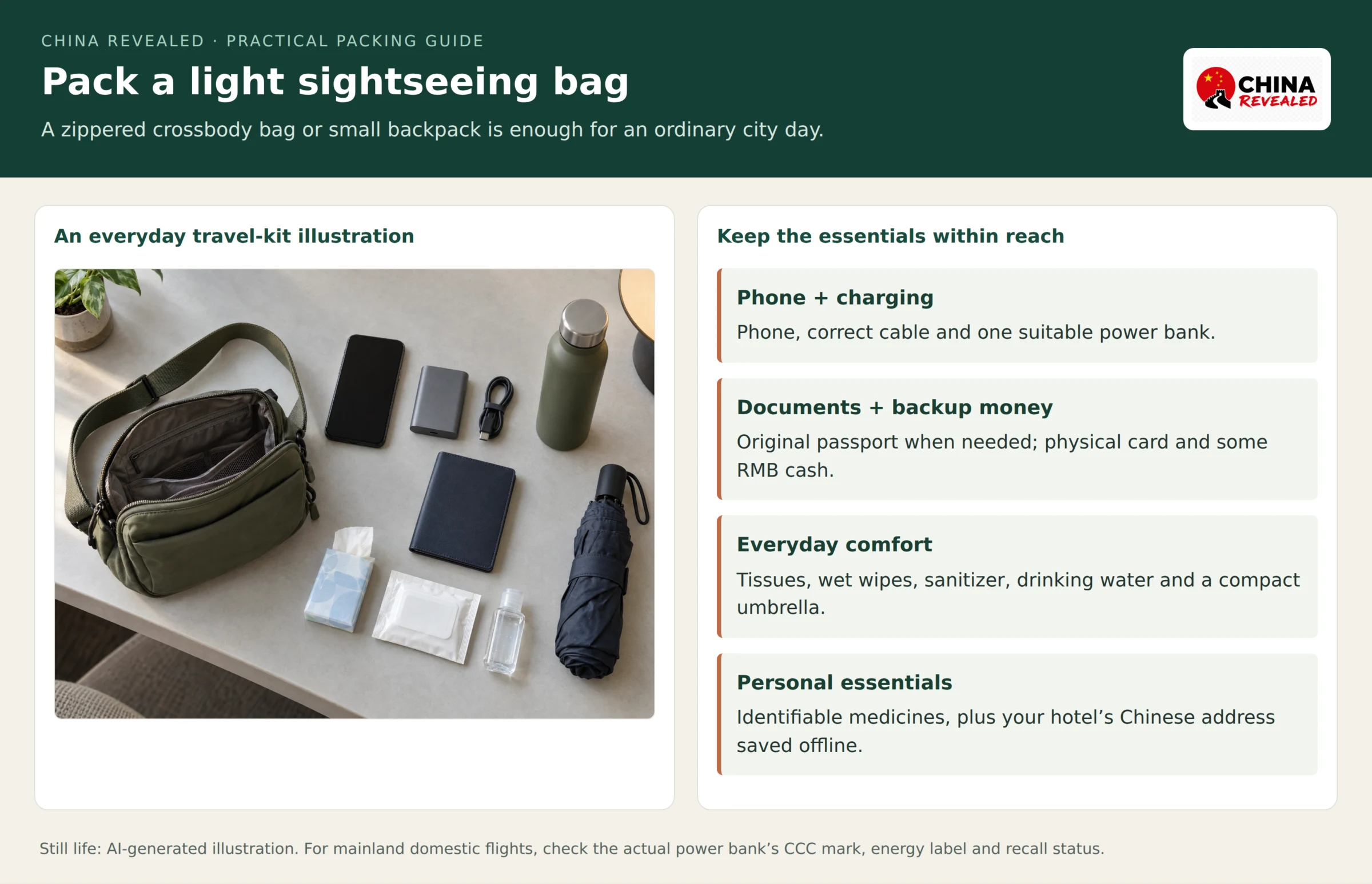
Choose a small zippered backpack or crossbody bag that leaves your hands free for a phone, ticket checks and station security. You do not need to carry a full hiking pack for a city sightseeing day.
My everyday kit would be:
- Phone, charging cable and one power bank. Maps, photos and mobile payments can use a lot of battery.
- Original passport in a secure pocket. Bring it for trains, passport-based attraction entry, hotels and other identity checks; a photo is useful backup, not a replacement at those checks.
- One physical bank card and some RMB cash, kept separately from your phone.
- Pocket tissues, a few wet wipes and hand sanitizer. Hand sanitizer is useful between stops; wash with soap and water when you can.
- Drinking water and a compact umbrella. Add sunscreen or an extra layer for your route and season.
- Any essential medicine, identifiable in its labelled packaging.
- Your hotel’s Chinese name, address and reception number, saved offline.
Keep a secure backup copy of your passport and bookings, separate from the originals. Do not keep a passport image in a public photo album or send it to an AI assistant just to translate a sentence.
A quick power-bank check
I would choose one clearly labelled power bank at 100Wh or below. If you will fly within mainland China, check that the actual device has a clear CCC / 3C mark, readable specifications and no applicable recall. Pack it in your cabin bag, never in checked luggage, and keep it disconnected during the flight.
If your home power bank lacks CCC, buy a suitable replacement from a reliable retailer in China before your domestic flight. For the full airline and medicine rules, use our China Customs and Packing Guide.
4. Prepare your phone before you fly
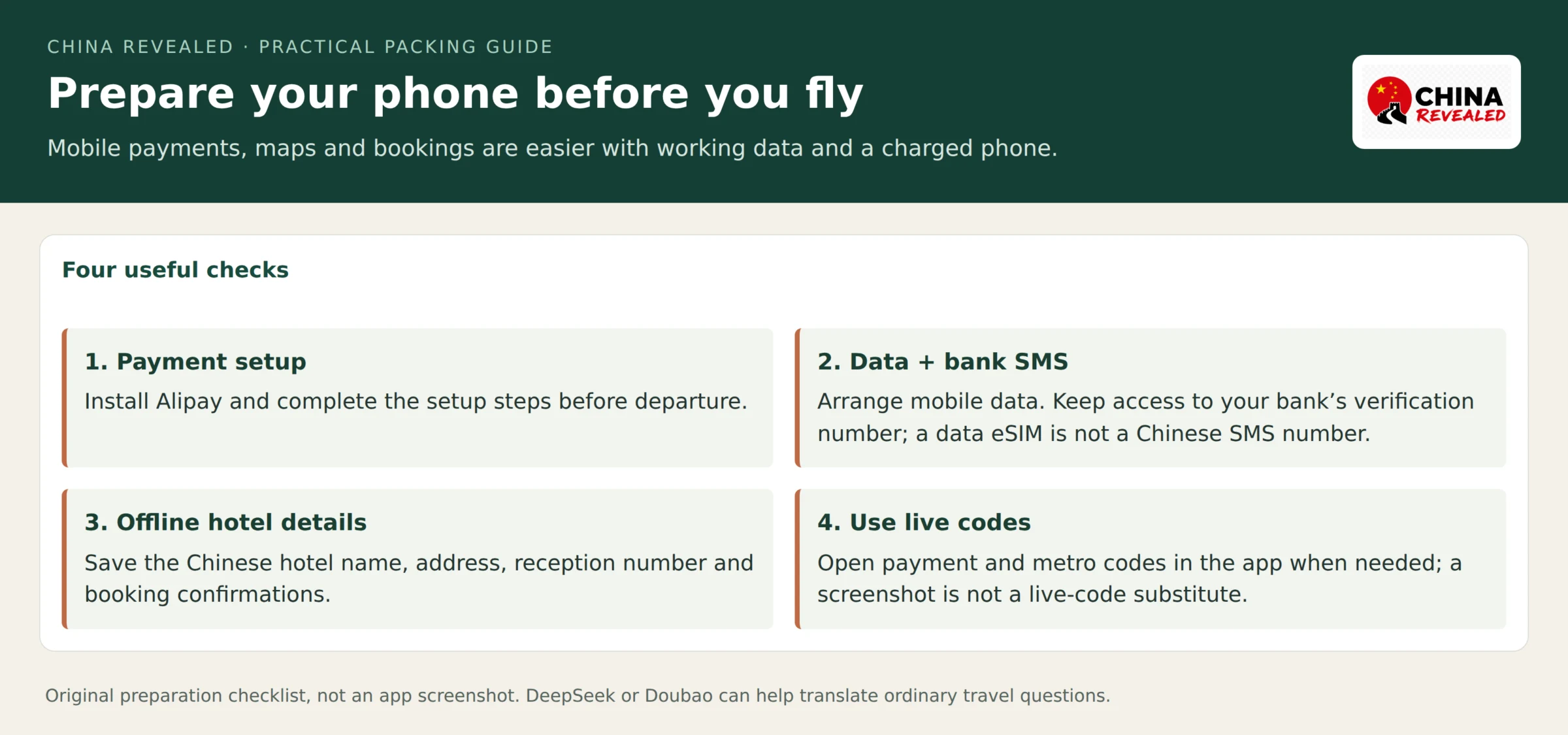
A working phone matters more than another travel gadget. Before departure, install your payment and travel apps, arrange data and make sure you can still receive any bank verification messages sent to your home number.
Start with our Alipay setup guide, then choose a data plan using China SIM vs eSIM. A data-only eSIM does not automatically give you a Chinese number or SMS service.
Save your hotel confirmation and Chinese address offline. Save transport confirmations too, but remember that a screenshot of a live payment or metro QR code is not a working substitute for opening the app.
DeepSeek or Doubao can help with ordinary Chinese travel questions and translation. Ask in English, for example:
“What is the Chinese name for a China-compatible travel plug adapter? Write a short sentence I can show a shop assistant.”
For an electrical product, the adapter’s rating and your charger’s label are the things to follow—not an AI guess about a blurry photo.
5. Small everyday things worth bringing
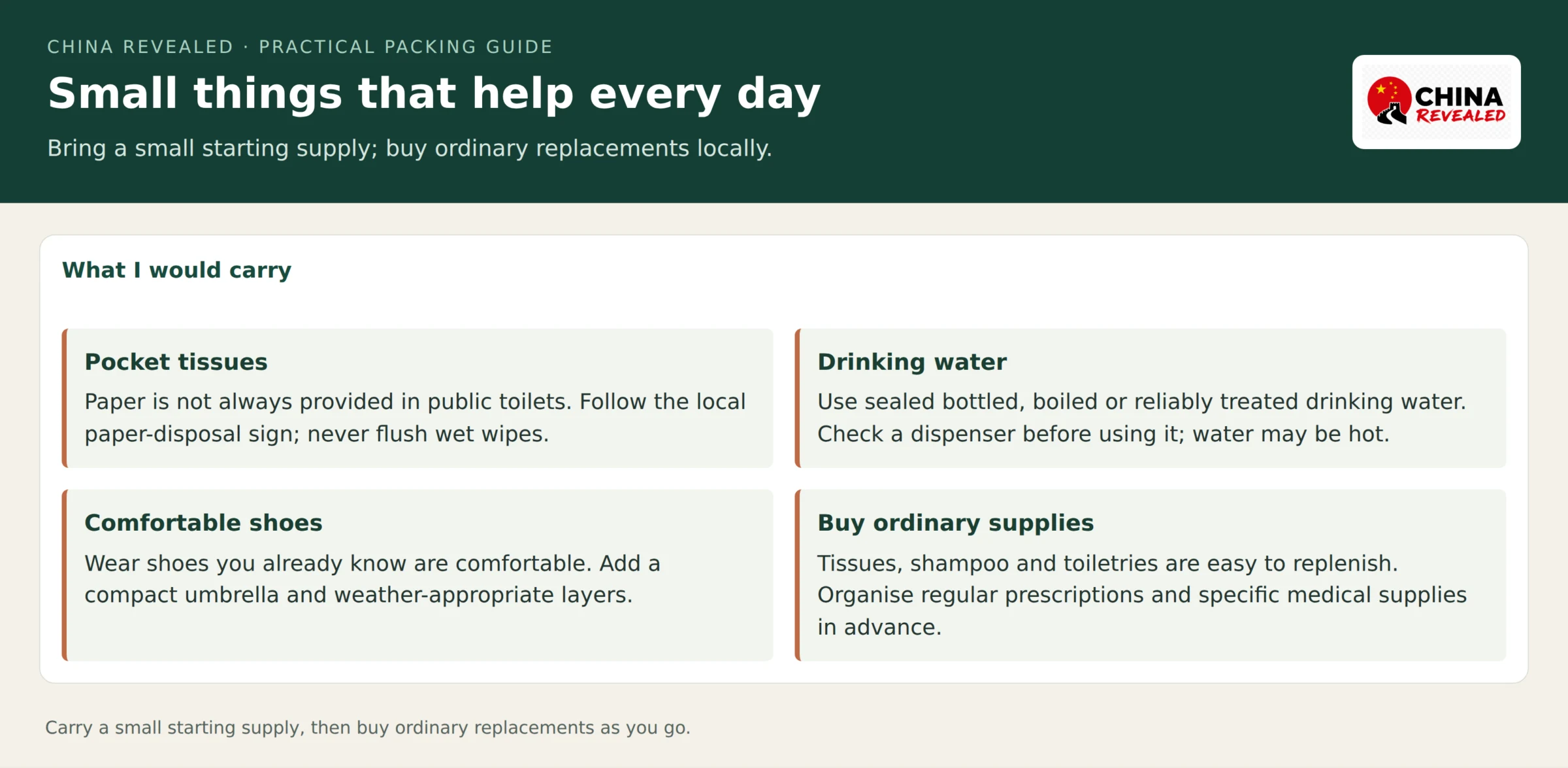
Tissues are a genuinely useful item
Public toilets do not always supply paper, so keep a small packet in your bag rather than a roll buried in your suitcase. Squat toilets remain common; hotels, airports and many modern venues also have seated toilets. Look for the cubicle you prefer.
Follow the toilet’s own sign about paper disposal. If it directs you to use the bin, use the bin; do not assume one flushing rule applies everywhere. Wet wipes belong in a bin, not down the toilet.
Bring a bottle, not a complicated water setup
Use sealed bottled water, freshly boiled water or reliably treated drinking water. Do not treat an ordinary bathroom tap as a drinking-water station. A reusable bottle is handy, but refill it from a source explicitly intended for drinking; some dispensers provide very hot water.
Comfortable shoes beat extra outfits
Large stations, palace grounds and scenic areas can involve a lot of walking. I would bring shoes you have already worn comfortably, plus socks suited to the weather—not brand-new shoes saved for the trip.
A compact umbrella works for sudden rain and shade. Add sunscreen in strong sun and a light layer for cool evenings or air-conditioned trains. Pack for your actual cities: a northern winter trip and a warm southern itinerary need different clothes.
Buy ordinary supplies locally
You will find tissues, bottled water, shampoo and basic toiletries in supermarkets, convenience stores and pharmacies. Bring a small starting supply, then buy more as needed. Your regular prescription medicine, hard-to-find personal products and any medically necessary supplies are the items I would organise in advance.
6. Tipping: optional thanks, not an extra bill
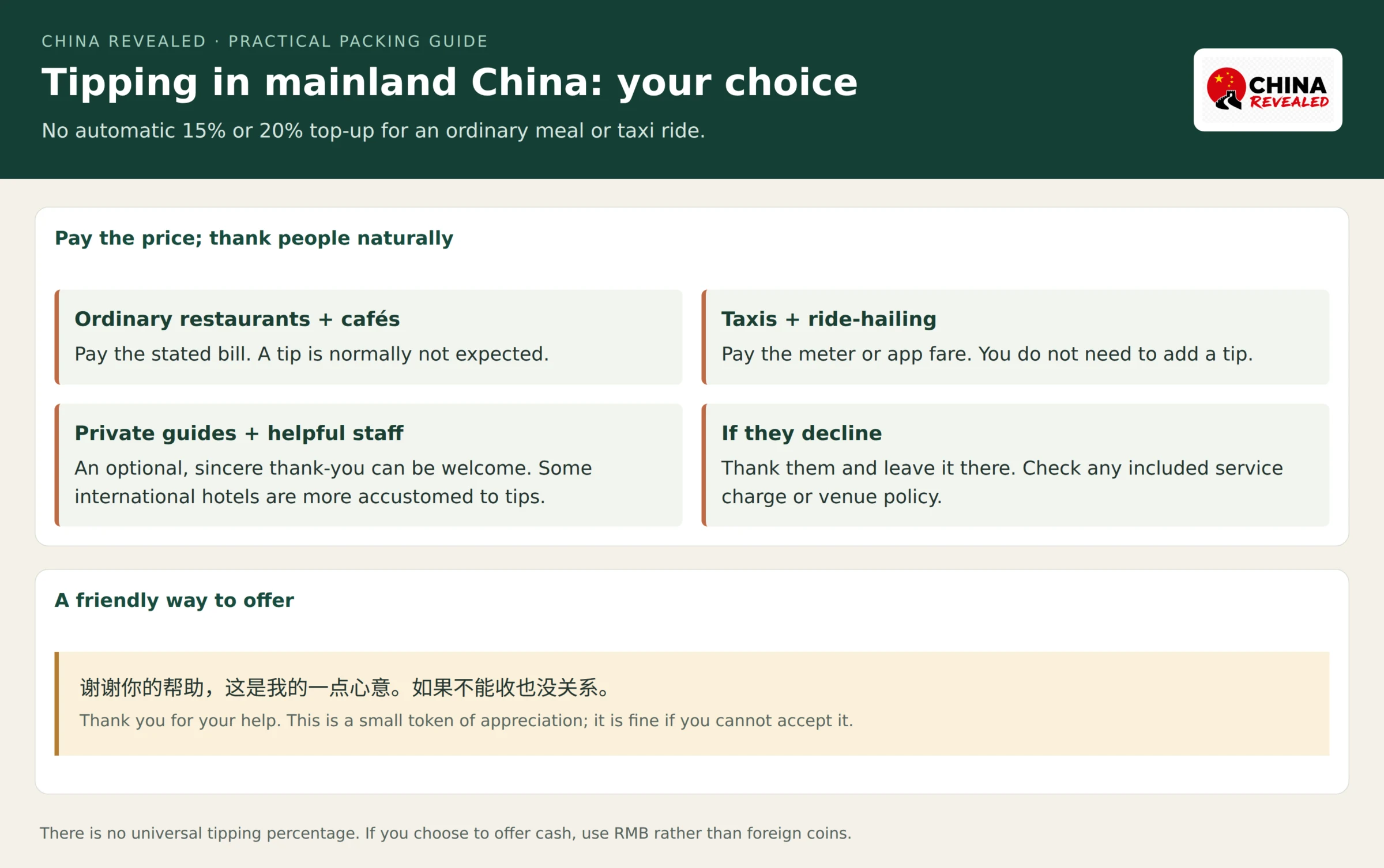
Mainland China has no general tipping routine. In an ordinary restaurant, café, taxi or ride-hailing trip, you normally pay the bill or app fare and stop there. You do not need to calculate an extra 15% or 20%.
That does not mean a tip is automatically rude. If someone has been especially helpful, a sincere small tip can make them very happy. Offer it as a personal thank-you, not as payment you are obliged to add. If they decline or their workplace does not accept tips, thank them and leave it there.
Private guides and drivers working with international visitors may be more accustomed to tips, as may some international or luxury hotels. Check your tour’s own guidance and whether a restaurant already includes a service charge; there is no single percentage to apply across China.
If you want to offer a cash thank-you, use RMB rather than foreign coins. You can show this:
谢谢你的帮助,这是我的一点心意。如果不能收也没关系。
Thank you for your help. This is a small token of appreciation; it is fine if you cannot accept it.
A warm thank-you and a specific, honest review are also good ways to recognise helpful service. Do not feel you have treated someone badly simply because you paid the stated price.
Book hotels, flights, train tickets, attractions and other travel services on Trip.com.
7. What to leave out of your suitcase
I would skip the bulky voltage converter if your actual chargers already accept 220V, the 110V-only heating appliance, the stack of spare toiletries and the heavy day bag. Bring the essentials you cannot easily replace, then keep the rest simple.
Before you zip up, put your passport, essential medicines, phone charger and permitted power bank in your carry-on. Check the baggage allowance on each flight, including any separately booked domestic segment. Keep your adapter reachable when you arrive at the hotel.
The goal is not to bring everything. It is to keep your phone working, your documents accessible and your sightseeing day comfortable.
Mainland-China electrical and travel details checked on 15 October 2026.
About China Revealed
China Revealed is an independent English-language travel guide dedicated to China.
We bring together China travel guides, destination information, local insights and practical travel resources in one place.
Our travel database covers China's provinces, cities, famous attractions, hidden gems, local cuisine, transportation, accommodation, visa requirements, digital payments, mobile connectivity and the other practical details travelers need to explore China.
We focus on depth, careful research and accuracy. Our guides combine official sources, detailed destination data, local knowledge and regularly updated information to give reliable, practical travel advice.
Whether you're visiting China for the first time or exploring beyond the popular destinations, China Revealed is an all-in-one resource for discovering the real China.
China Revealed — Your practical guide to China.
Some links on China Revealed, such as Trip.com booking links, are affiliate links. If you book through them, we may earn a commission at no extra cost to you. This does not change what we recommend.