

China Tax Refund for Tourists: Your Last Day and Departure
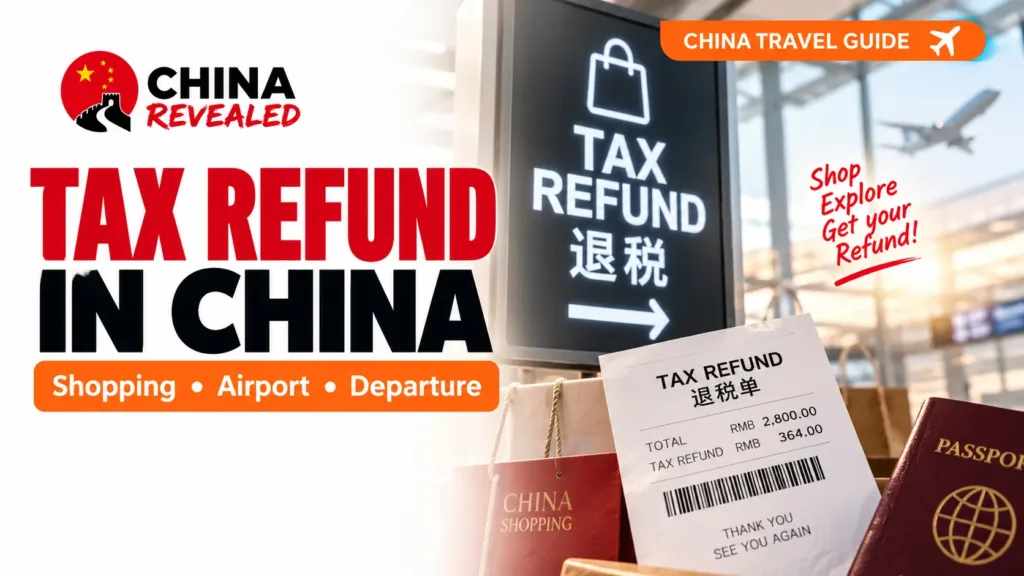
China tax refund for tourists is easiest when you arrange it at the shop, keep the goods unused and finish the airport check before sending your suitcase away. I recommend treating your last day as the reverse of your first: settle the small things in town, reach the correct terminal early, then move through the airport without rushing.
You do not need a complicated exit plan for an ordinary holiday. The part worth planning is the shopping refund—and whether the things Customs may need to see are already buried in a checked bag.
Quick takeaways
- Ask for tax-refund documents at a participating shop, not for the first time at the airport. The minimum is RMB 200 at the same shop on the same day.
- Keep refund goods unused. Retain their packaging and tags, with your original passport, invoice and refund record together.
- Refund-upon-purchase / 即买即退 gives you the money earlier; complete its agreed departure process as well.
- I would arrive about three hours before an international flight, or four hours if claiming a refund. These are planning buffers, not airline check-in deadlines.
- Spend small RMB change in town, use an authorised exchange service for larger leftovers, and keep your phone working until the flight is boarded.
1. Sort your last-day jobs before leaving the hotel
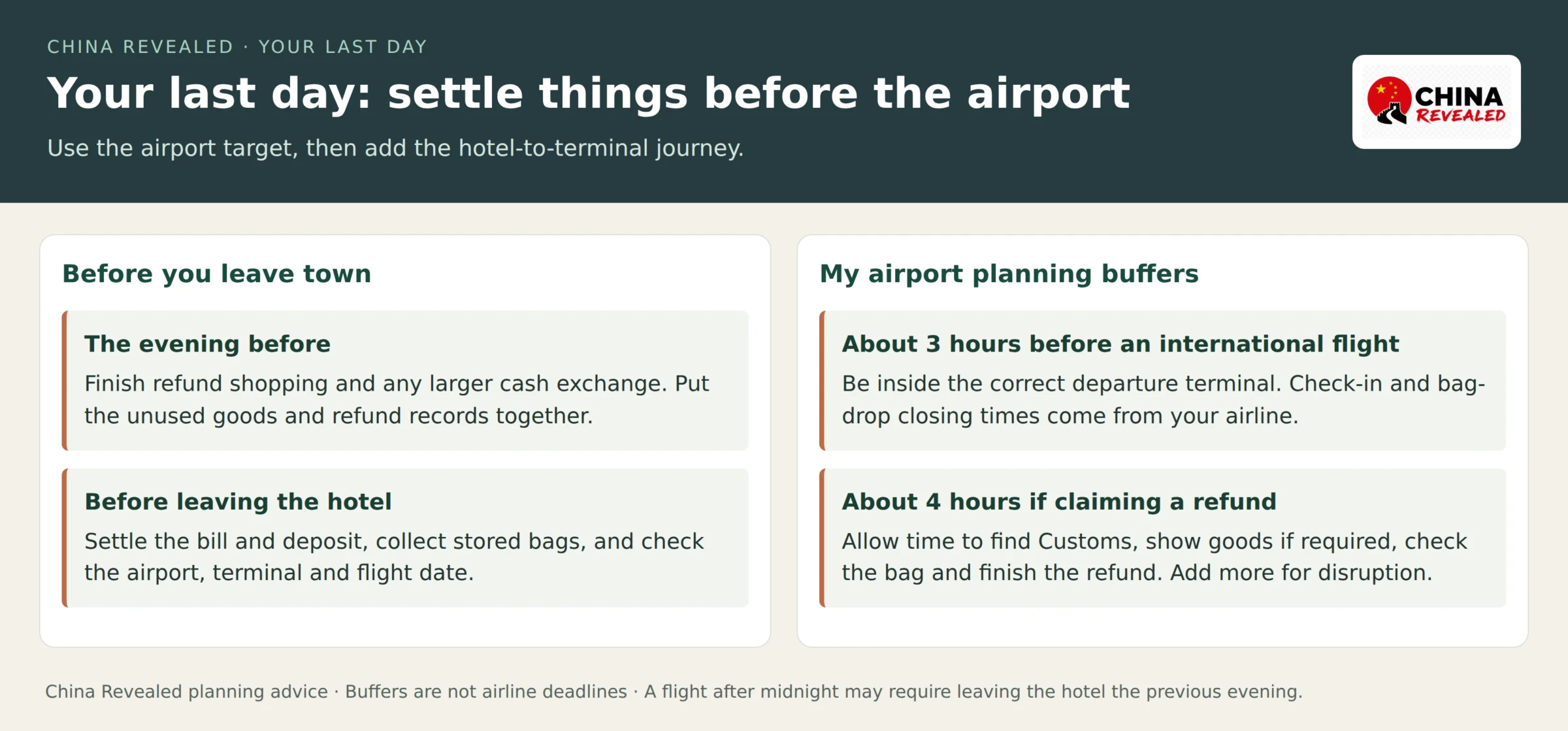
Check the airport, terminal, departure date and operating airline on your confirmed ticket. In Shanghai, Pudong and Hongqiao are different airports; in Beijing, Capital and Daxing are different airports. A flight just after midnight leaves on the next calendar date, so your airport journey usually starts the previous evening.
I would finish shopping and cash exchange the day before. Leave a final morning for breakfast and a short walk, not a cross-city shopping trip. Ask reception when you must check out, collect any stored bags, and settle the room bill. If there was a deposit, confirm whether it was a cash payment, an actual card charge or a pre-authorisation; retain the return or release record.
Use your map to route to the departure terminal, not merely the airport pin. Add the journey time to the airport buffer. A four-hour airport target means being inside the terminal four hours before the flight—not leaving the hotel then. If using the metro or airport train, check operating hours and the transfer walk with luggage.
2. Arrange the tax refund while shopping
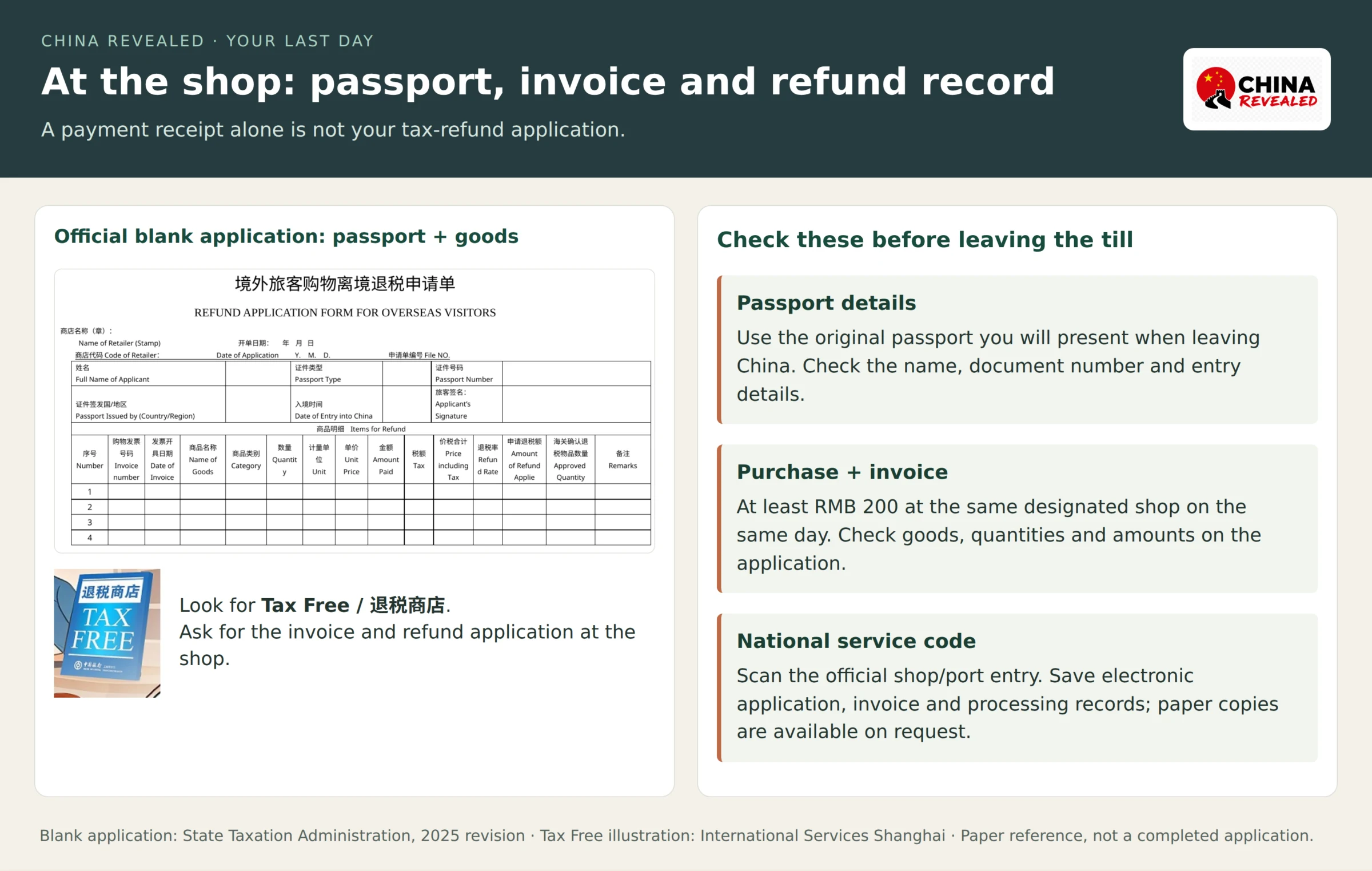
Look for Tax Free / 退税商店 at participating stores. Ask before paying: “Can you issue departure tax-refund documents for this purchase?” A normal card slip or payment-app receipt is not the refund application.
The main eligibility checks are straightforward:
| Check | What you need |
|---|---|
| Visitor | An eligible overseas visitor staying in mainland China no more than 183 consecutive days. |
| Purchase | At least RMB 200 at the same designated shop on the same day. |
| Timing | Leave mainland China within 90 days of buying the goods for the ordinary departure-refund route. |
| Goods | Unused and unconsumed, carried out with you or in your checked baggage. |
| Exit | A designated tax-refund departure port with the relevant service. |
This is for eligible goods, not a refund of your hotel bill, restaurant meals or taxi rides. You do not have to buy luxury goods: the important thing is a participating shop, an eligible purchase and the refund documents.
The easy mistake: using the purchase before you leave
A new backpack can still look perfect after a week of sightseeing, but if you have already used it as your day bag, it no longer meets the unused-goods condition. The same goes for a jacket you have worn or cosmetics you have started using.
My advice: leave tags attached, keep the original box and packaging, and leave factory seals intact until you have left mainland China. Do not activate a new device or start wearing a refund purchase during the trip. Intact packaging makes it much easier to show Customs what you bought and that it is still unused.
The official condition is that goods have not been used or consumed; there is not a blanket wording on that page that every product must be factory-sealed. Before paying, ask the shop what packaging and evidence to retain for that item. Keep purchases you will use during the holiday separate from the ones intended for a refund. If an application mixes used and unused items, ask Customs or the refund agency which goods can be accepted and whether the shop must correct the documents.
At the till: passport, invoice and refund record
- Show the original passport you will use when leaving China.
- Ask for the sales invoice / 发票 and departure tax-refund application / 离境退税申请单. Check your passport details and the purchase amounts before leaving.
- Use the official national departure tax-refund service code / 全国离境退税服务码 when staff offer it. Scan the official poster or staff-provided entry, open the browser page and enter the personal details it requests. Use your real passport information.
- Save the code and electronic records. The service lets you view the application, invoice, processing progress and refund information. A paper copy is also available on request.
- Keep your payment record with those documents, and pack the unused goods where you can take them out for inspection.
The system became paperless in July 2026. The service code lets shops, Customs and refund agencies retrieve the records electronically; you do not need to collect a paper stamp simply because an older travel guide says so.
How much money comes back?
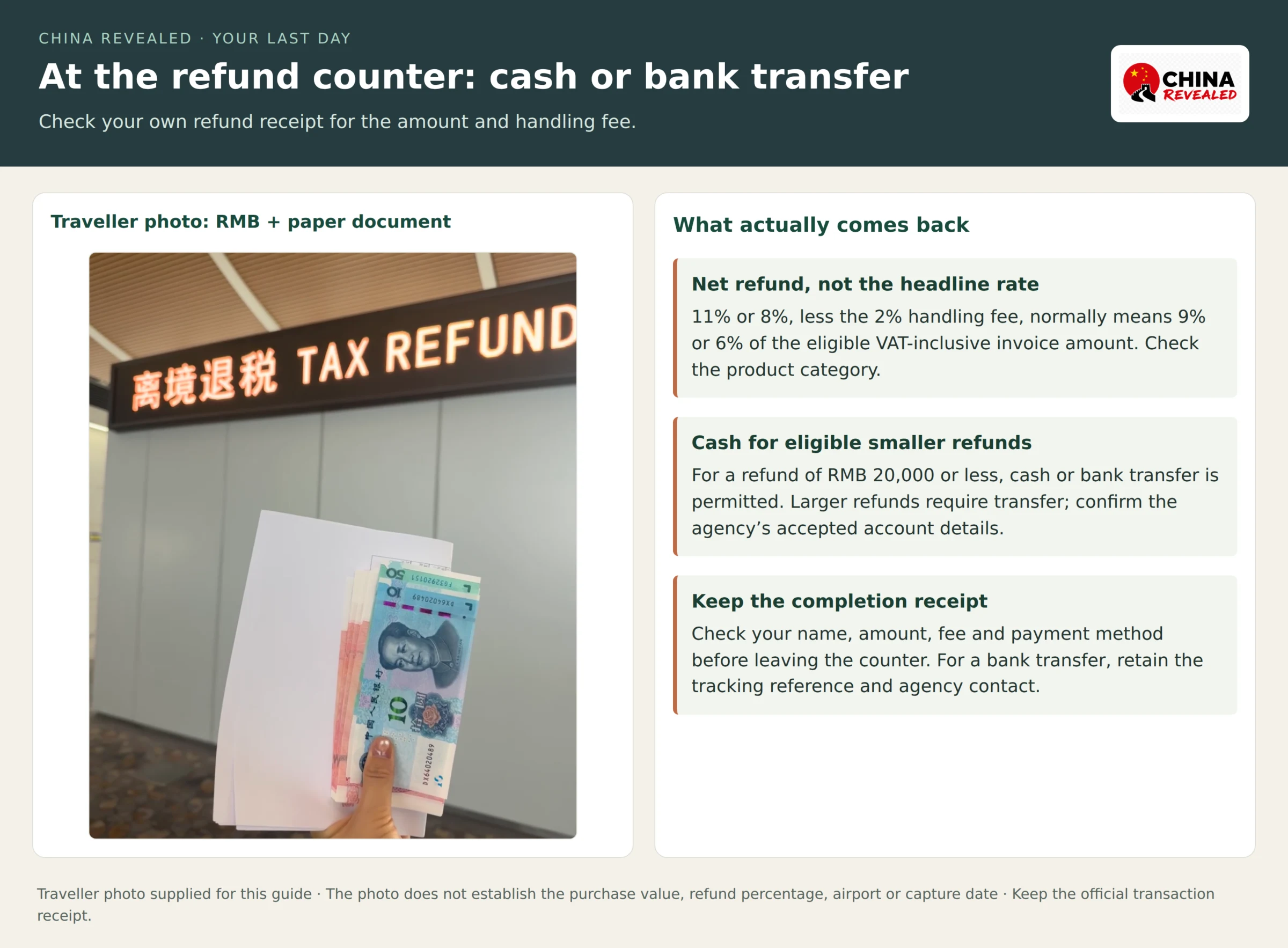
The applicable refund rate is generally 11% or 8%, less a 2% handling fee. That usually means a net refund of 9% or 6% of the eligible VAT-inclusive invoice amount, rather than an extra 11% discount.
For example, an eligible RMB 2,000 purchase in the 11% category produces RMB 180 after the handling fee. In the 8% category, the net amount is RMB 120. Ask the shop to show your actual calculation; the product category determines the rate.
If shopping across cities, tell the shop where you will leave mainland China. The national service code is usable nationwide, while the airport or port still needs to provide the applicable departure-refund service.
3. Understand refund-upon-purchase
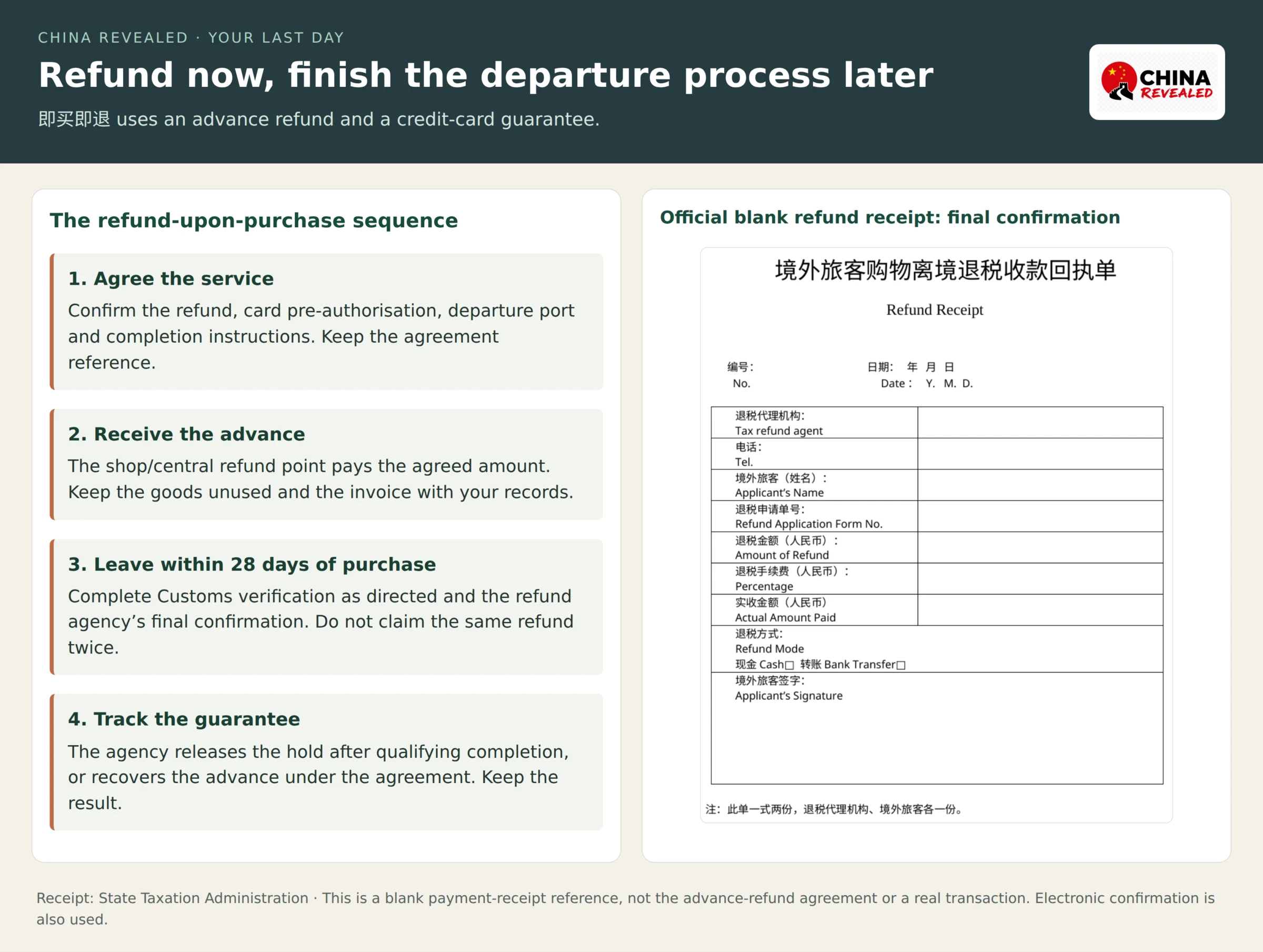
Refund-upon-purchase / 即买即退 is useful if you want the money back while you are still shopping. A participating shop or central refund point pays the refund in advance, rather than making you wait until the airport.
The standard route uses a service agreement and a credit-card pre-authorisation as a guarantee. The hold reserves card funds; it is separate from paying for your purchase. Before signing, ask staff to confirm:
- the refund you receive now;
- the pre-authorisation amount and accepted card;
- your departure airport or port and the completion procedure there;
- what happens if your departure changes or the goods no longer qualify.
The unified departure period for this service is now 28 days from purchase. That is shorter than the ordinary 90-day refund window. Cross-region processing has been expanded, so you can use participating arrangements for shopping in one city and departing elsewhere; have the shop confirm your actual departure route when setting up the advance refund.
At the airport, complete the required Customs process and the refund agency’s specified final confirmation. Some local arrangements use an electronic completion process; others direct you to a document-drop point. Follow the instructions attached to your agreement, rather than queueing for a second refund or assuming the earlier payment finished everything.
Keep the completion record and check the guarantee hold afterwards. If it remains unresolved, contact the refund agency with the agreement reference, then your card issuer. Save those contacts before leaving China.
4. Finish the airport tax-refund process
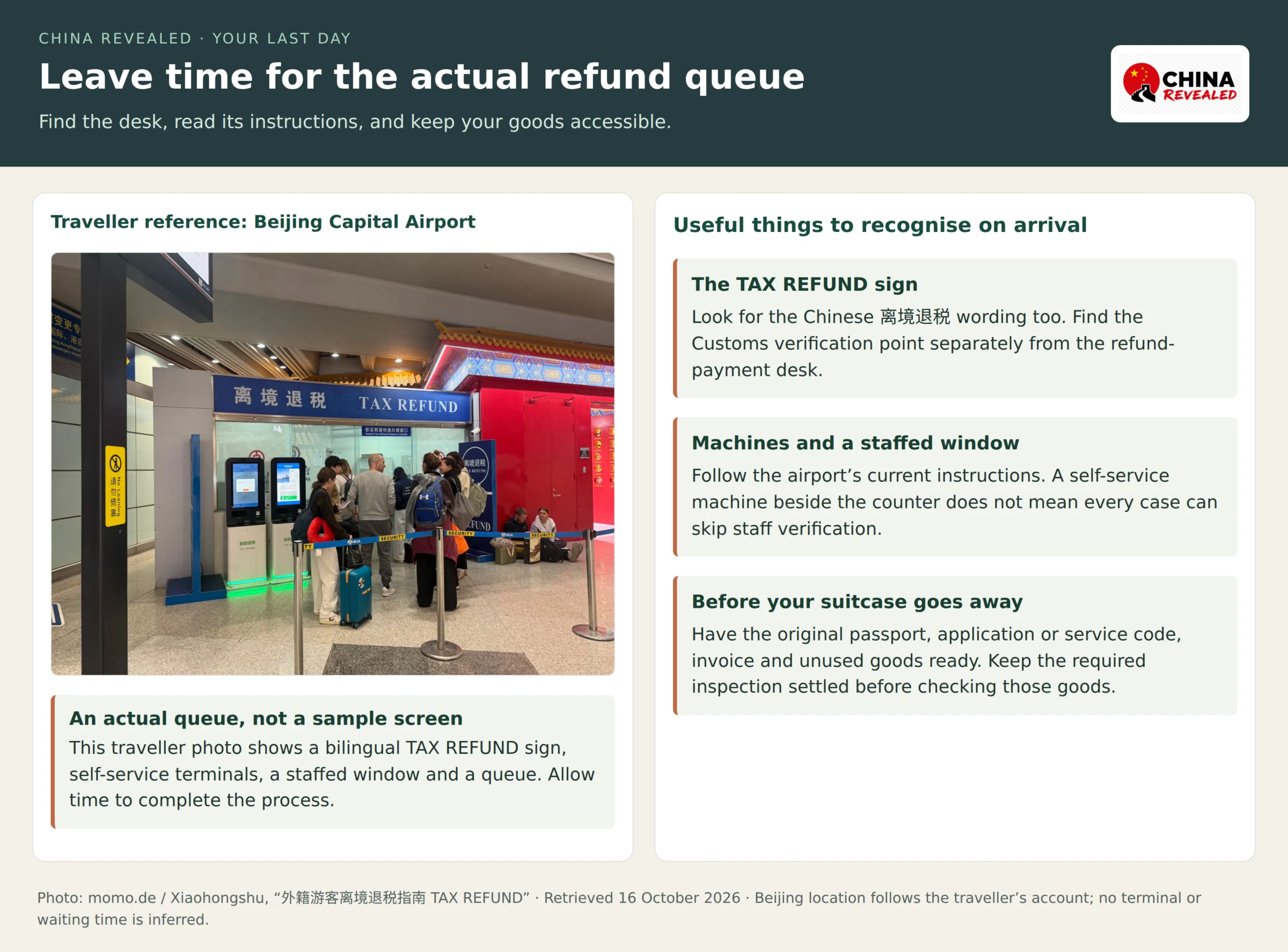
There are two different jobs: Customs handles the goods and verification; the refund agency handles the money or closes your advance-refund case. “Customs” and “Tax Refund” signs may point to different desks.
Before checked baggage goes away
If the first information desk is unsure, show staff 海关离境退税验核 for the goods check. For the payment desk, ask for 退税代理柜台. Keeping the two names separate saves you being sent between the wrong counters.
Find Customs Tax Refund Inspection / 海关离境退税验核 and tell staff whether your refund goods are in checked baggage or your cabin bag. The airport may have separate inspection locations for the two.
Do not hand over a suitcase containing refund goods until its required inspection is settled. If you need a boarding pass first, explain the refund to the airline and keep that suitcase with you while following the Customs instructions. Then return to bag drop if necessary.
Have these ready:
- original passport and flight or boarding details;
- unused refund goods;
- national service code and electronic application/invoice, or the paper documents supplied by the shop;
- refund-upon-purchase agreement, if you used that service.
Under the current process, applications with purchase sales below RMB 10,000 are subject to random physical checks; those at RMB 10,000 or above receive individual physical verification. If the system marks your application exempt from physical inspection, follow that result. A small purchase is not a reason to decide for yourself that the whole airport process can be skipped.
If you fly domestically before the international flight, confirm where the refund verification happens and whether your bag is checked straight through. A domestic flight is not departure from mainland China; keep the goods accessible until the airline and departure-port staff confirm the correct inspection arrangement.
After the departure formalities
For an ordinary refund, go to the tax-refund agency counter in the restricted departure area. Present your passport and the verified records or service code; complete the agency’s confirmation and choose its available refund method. Keep the receipt or completion reference.
Refunds are calculated and paid in RMB. For a refund of RMB 20,000 or less, cash or bank transfer is permitted; above that refund amount, bank transfer is required. Additional options depend on the agency—for example, Shanghai offers an eligible Alipay refund option. Choose an overseas-account or card method only after the agency confirms it accepts your details.
For a refund received earlier under 即买即退, follow the finalisation route in your agreement instead of claiming it twice.
A real airport example: Shanghai Pudong T2
After clearing T2 security, turn right and walk about 200 metres towards D83. Look for the illuminated 离境退税 / TAX REFUND sign in the photo below. This is the refund agency’s payment counter—not a substitute for the earlier Customs verification.
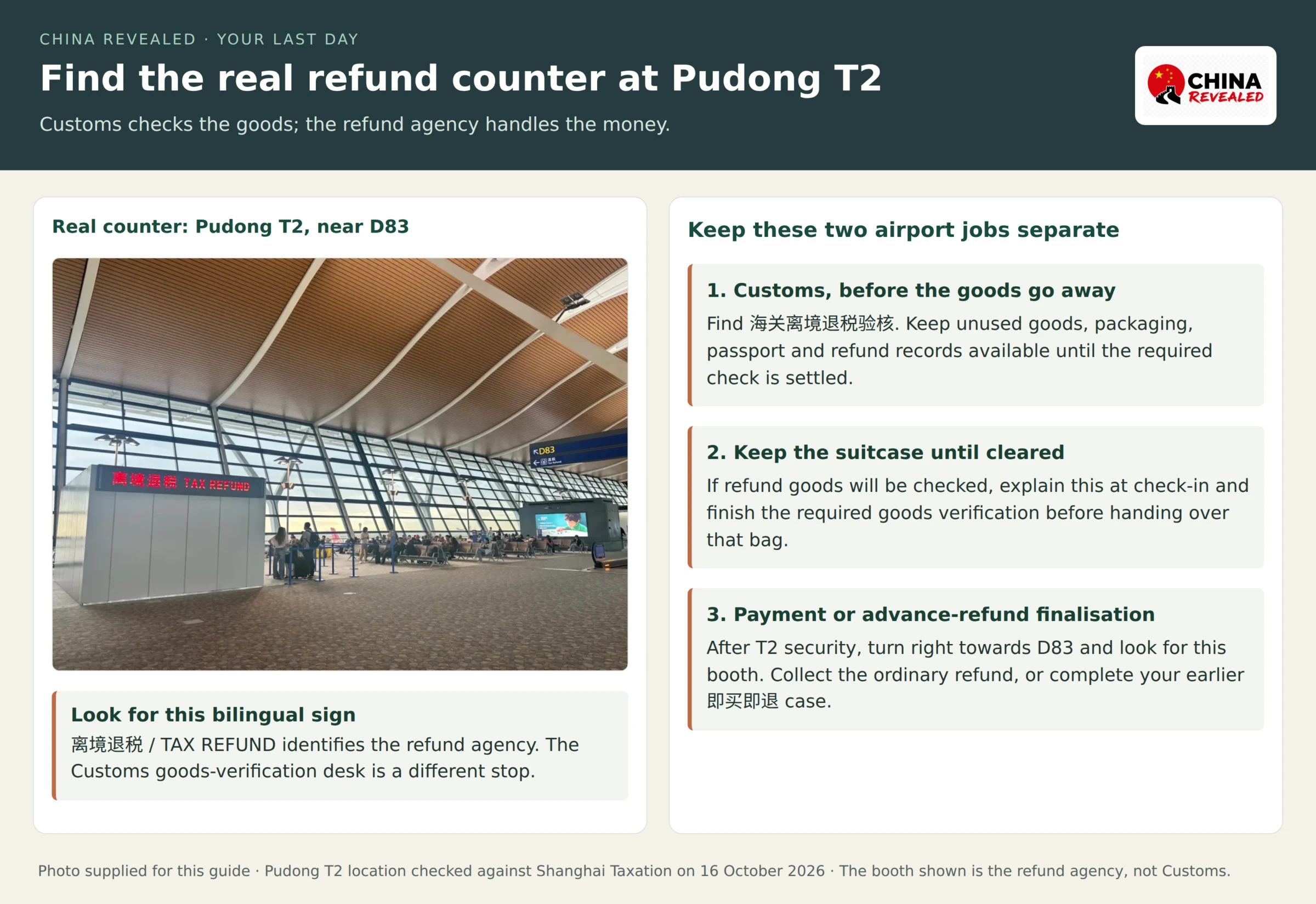
The Shanghai Taxation counter list, updated on 15 July 2026, confirms D83, 24-hour opening and +86 21 6833 0115. The on-site notice below gives the same gate and telephone number. Save the photo and number before travelling to the airport.
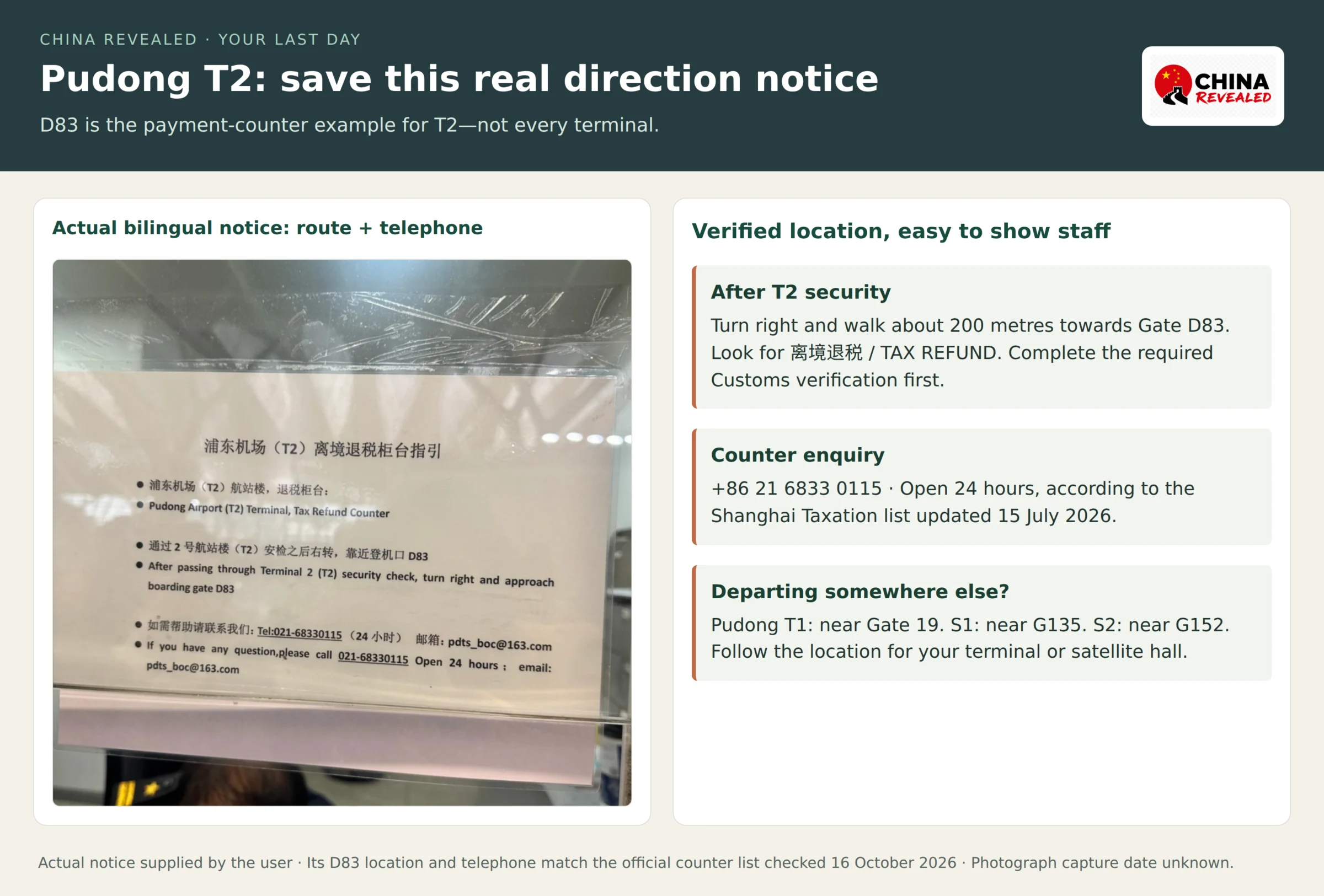
For T1, the payment counter is near Gate 19. The S1 and S2 satellite halls have separate locations near G135 and G152. Use the location for your actual departure area rather than walking back towards T2 just because this example uses D83.
Leaving through Guiyang instead? Guiyang Airport’s official announcement places its refund agency in the T3 fourth-floor international departure lounge. The airport enquiry number is +86 851 96967. Ask separately for the Customs verification point and the payment counter; use the current terminal signs for the exact position.
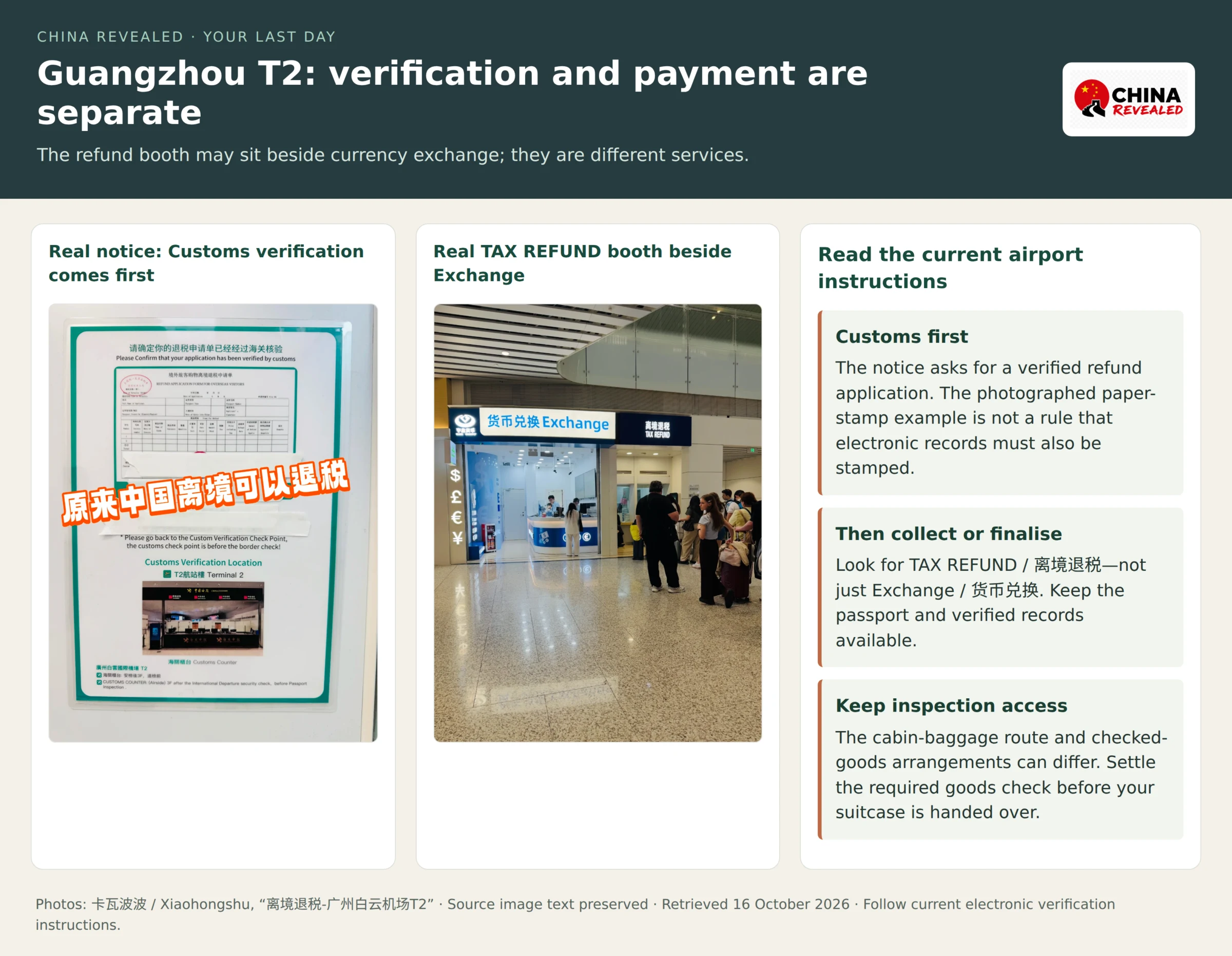
Another useful visual: Guangzhou Baiyun T2
The traveller photos below show a notice asking for Customs verification first, then the Tax Refund booth beside currency exchange. Those are different services: exchanging leftover cash is not the same as collecting a shopping refund. The notice’s paper-stamp example is an older format; use your verified electronic record or the documents your shop and departure port require.
Book hotels, flights, train tickets, attractions and other travel services on Trip.com.
5. Check in, clear exit control and pass security
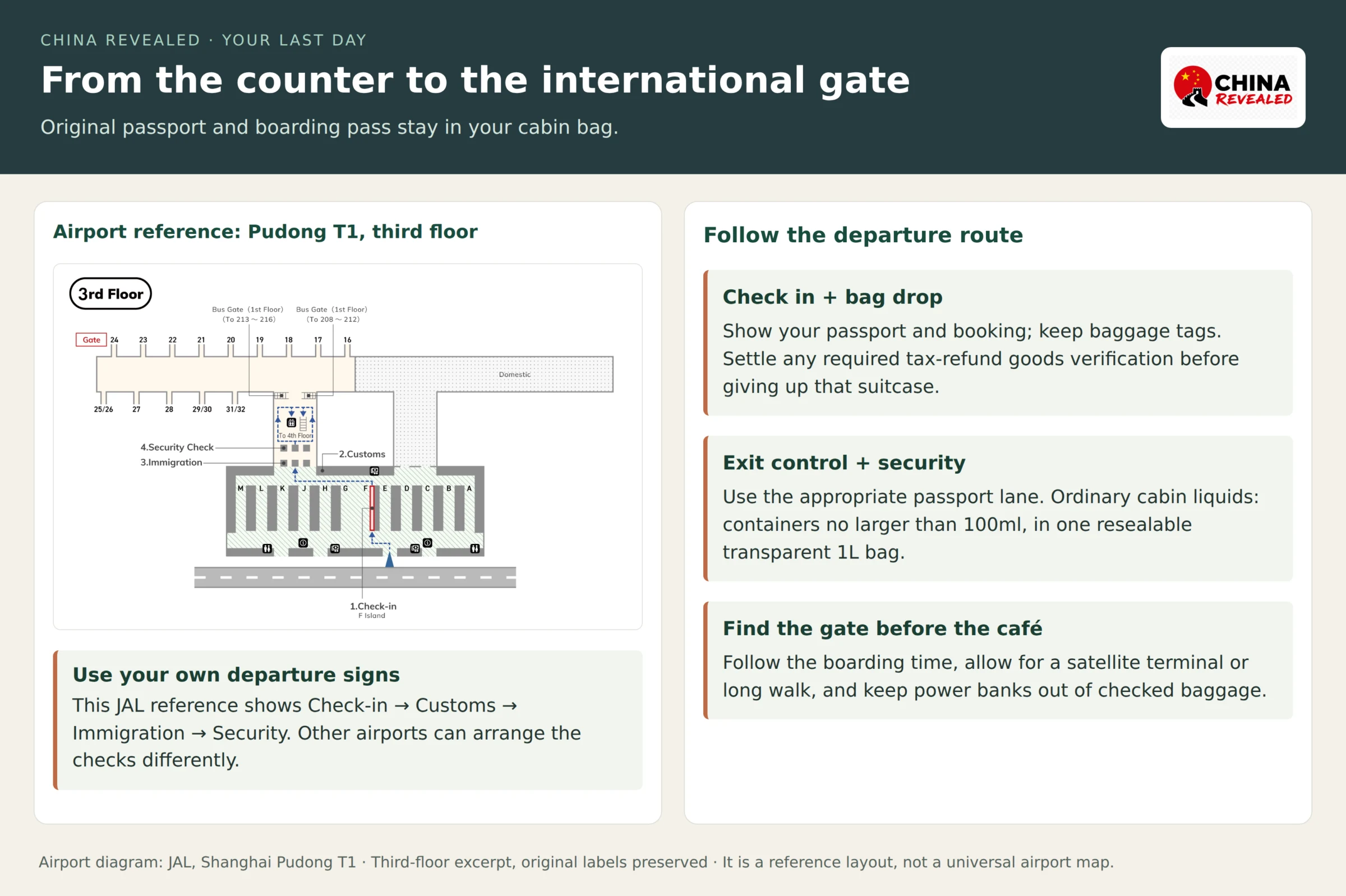
At the airline counter, show your original passport and confirmed booking. The airline checks documents for your destination and any transit stop as well. Keep the passport, boarding pass and baggage-tag receipts in your cabin bag.
My usual planning target is three hours before an international flight, increasing to four hours for a tax refund, holiday crowds or an unfamiliar large terminal. Use the operating airline’s published check-in and bag-drop deadlines as the hard cut-offs. Some counters only open three hours before departure; arriving early still gives you time to find the right desk and tax-refund inspection point.
Follow the actual departure signs. The journey includes check-in/bag drop, Customs where required, Exit Border Inspection / 出境边检, security, then the gate. Their placement varies by terminal; the critical exception is keeping refund goods available before checking them in.
Exit border inspection
Use the foreign-passport/manual channel unless you are eligible and directed to an automated lane. Present your passport and boarding pass, and answer any questions about your stay plainly. Keep your entry-permission and accommodation records available if requested.
Check your permitted stay before the last day. If the date or status is unclear, use the official immigration enquiry service 12367 in advance. A return booking is not an extension of your permitted stay.
You do not complete a new arrival card just to leave China. If you have goods or cash requiring an exit Customs declaration, handle that separately at Customs.
International-flight security
Prepare the cabin bag before joining the queue. Empty your drinking-water bottle; refill it after security. For ordinary cabin toiletries, use containers of 100ml or less, fitting into the permitted one-litre resealable bag. Essential liquid medicines and baby food have separate procedures—tell security staff and keep the relevant documents handy.
Take out the electronics, liquids and batteries that staff ask to screen separately. Put knives, tools and other cabin-restricted items into checked baggage where permitted. Keep power banks and spare lithium batteries in the cabin, not checked baggage, and follow your international airline’s current capacity, quantity and in-flight-use rules. The mainland domestic-flight CCC requirement should not be treated as an identical rule for every international carrier; our luggage and power-bank guide explains the distinction.
Once through, find the gate before shopping or eating. A satellite terminal, shuttle train or long concourse can add a substantial walk. Follow the boarding time, not just the scheduled take-off time.
6. Deal with your remaining RMB
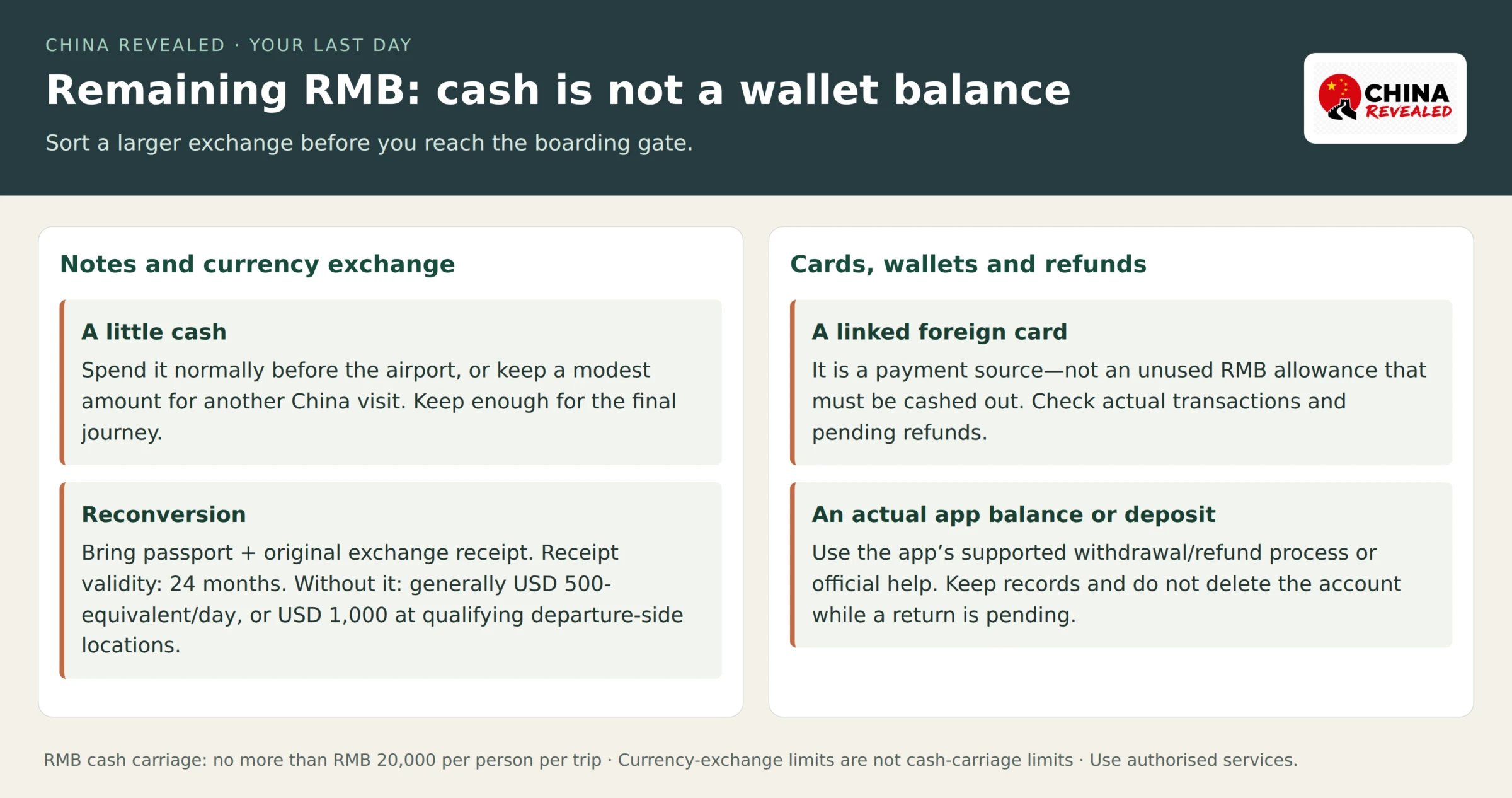
I would use small notes and coins for ordinary purchases before the airport: a meal, snacks or your last transport journey. Keep enough for the journey until it is actually paid. There is no need to make a final shopping detour just to spend a few yuan; taking a modest amount home for another visit is fine.
Changing a larger cash balance back
Use a bank or authorised exchange service. Bring your passport and original exchange receipt / 兑换水单, then ask what currency they can give you and the total amount you will receive after charges. The original receipt remains usable for reconversion for 24 months from the exchange date.
Without that receipt, the identity-document-only limits are generally the equivalent of USD 500 per day, or USD 1,000 per day at qualifying departure-side locations beyond exit control. The larger limit does not apply automatically to every airport exchange desk. Ask the counter which service it provides, and compare the net rate rather than the headline rate.
For a substantial balance, sort the exchange in town rather than relying on an airside counter being open or stocking your preferred currency. If your tax refund will arrive as RMB cash after security, plan whether to use an available authorised exchange service or take that money home within the carriage limit.
Cash in your bag versus money in an app
| What is left | What I would do |
|---|---|
| A little RMB cash | Spend it normally or save it for another China trip. |
| A larger RMB cash balance | Ask an authorised exchange service about reconversion, with passport and exchange receipt. |
| A foreign card linked to Alipay or WeChat | There is no unused spending allowance to cash out: it is a payment source, not automatically an RMB wallet balance. |
| An actual wallet balance, pending refund or deposit | Check the app’s supported withdrawal/refund route or official support before deleting the account or removing the payment card. |
RMB cash taken out of China must not exceed RMB 20,000 per person per trip. For foreign-currency cash, check against your most recent entry declaration; without a qualifying declaration record, amounts above the equivalent of USD 5,000 need the relevant carrying documentation. Arrange large-cash questions with the bank and Customs before departure, not at the boarding gate.
Keep genuine merchant refunds and hotel-deposit returns going through the original payment process. There is no need to exchange with strangers or pay someone to “cash out” your app.
7. Make the final boarding check
Before settling into a café, put your hand on the passport, phone and boarding pass. Check that the refund case is finished or that you have its tracking reference, the hotel deposit has a return record, and the bag tags are still with you.
Keep your mobile data and the number used for bookings available until boarding is complete. Save important receipts and contacts offline too. Do not delete Alipay or WeChat while a refund is still pending, and do not put your only working phone in a checked suitcase.
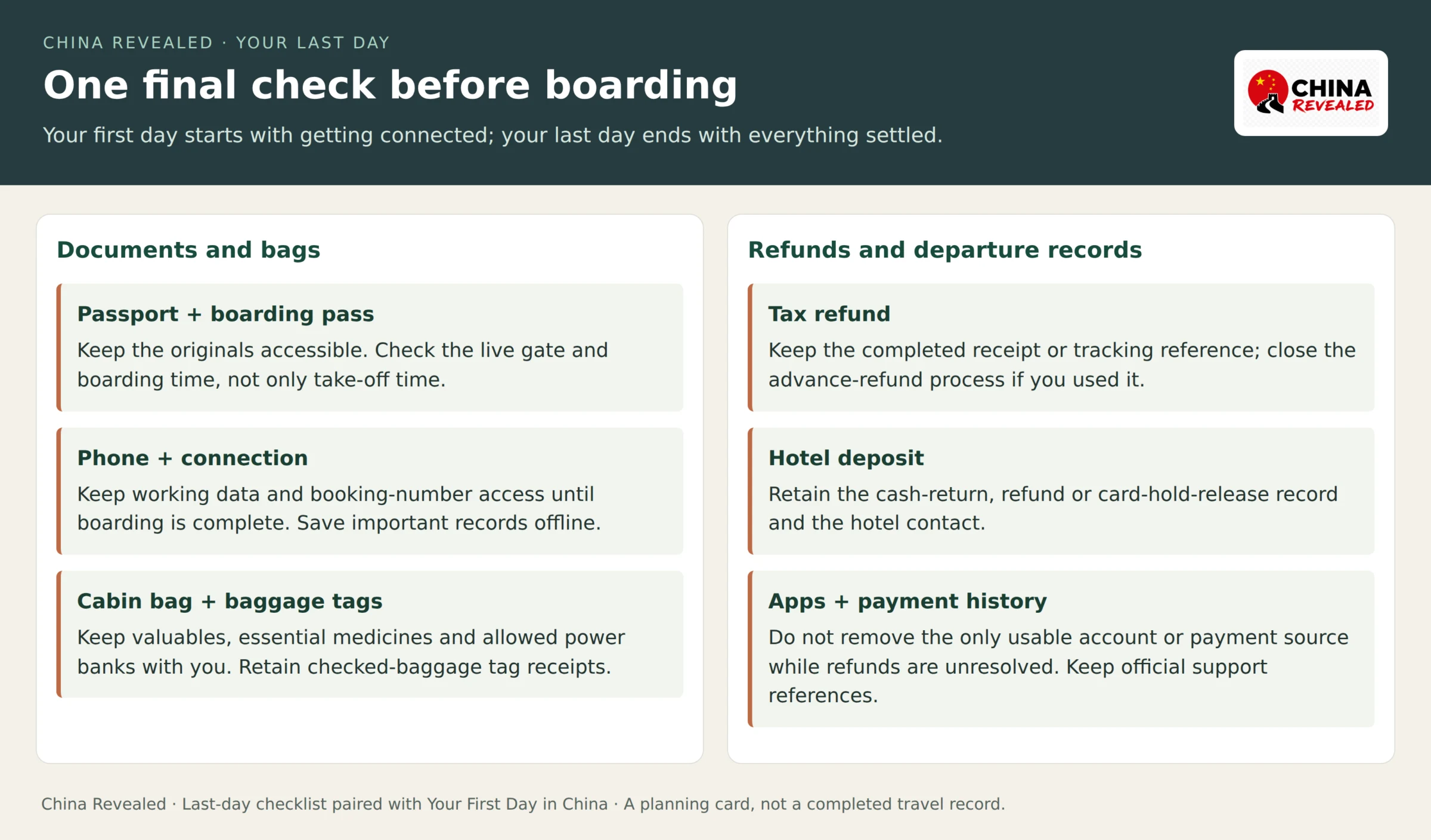
Our Your First Day in China guide starts with getting your phone working and reaching the right hotel. Your last day is its mirror image: close the payments, keep the documents handy and reach the right departure gate. Once those jobs are done, you can leave the rest of the day simple.
Mainland-China departure and tax-refund information checked on 16 October 2026.
About China Revealed
China Revealed is an independent English-language travel guide dedicated to China.
We bring together China travel guides, destination information, local insights and practical travel resources in one place.
Our travel database covers China's provinces, cities, famous attractions, hidden gems, local cuisine, transportation, accommodation, visa requirements, digital payments, mobile connectivity and the other practical details travelers need to explore China.
We focus on depth, careful research and accuracy. Our guides combine official sources, detailed destination data, local knowledge and regularly updated information to give reliable, practical travel advice.
Whether you're visiting China for the first time or exploring beyond the popular destinations, China Revealed is an all-in-one resource for discovering the real China.
China Revealed — Your practical guide to China.
Some links on China Revealed, such as Trip.com booking links, are affiliate links. If you book through them, we may earn a commission at no extra cost to you. This does not change what we recommend.