

Extend Your China Stay: Visas and Residence Permits
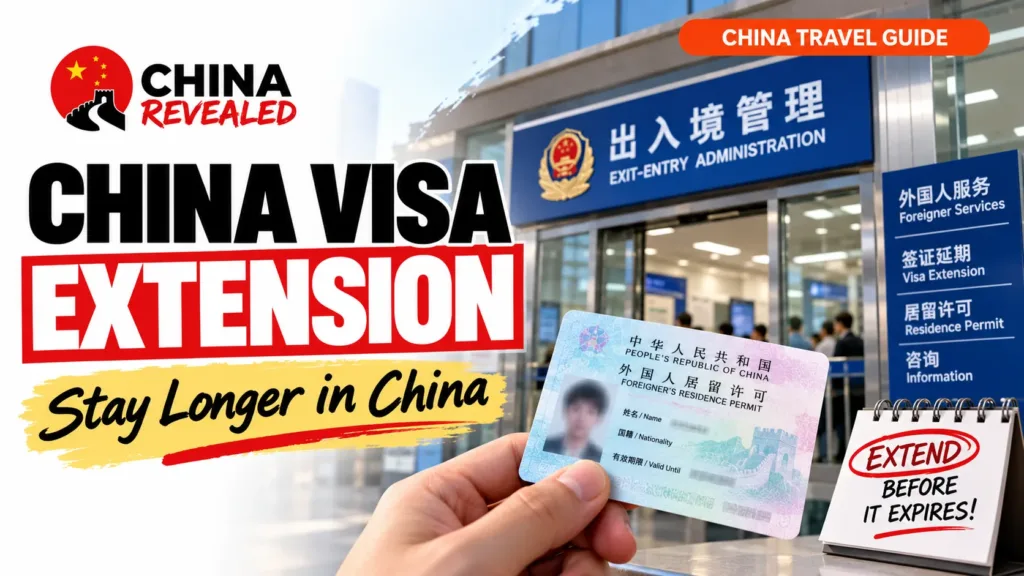
China visa extension is handled inside China by the local Exit-Entry Administration / 出入境管理, not by an overseas visa centre. If your plans change, identify your current document and act before its stay deadline—not just before the visa’s entry-validity date.
Quick takeaways
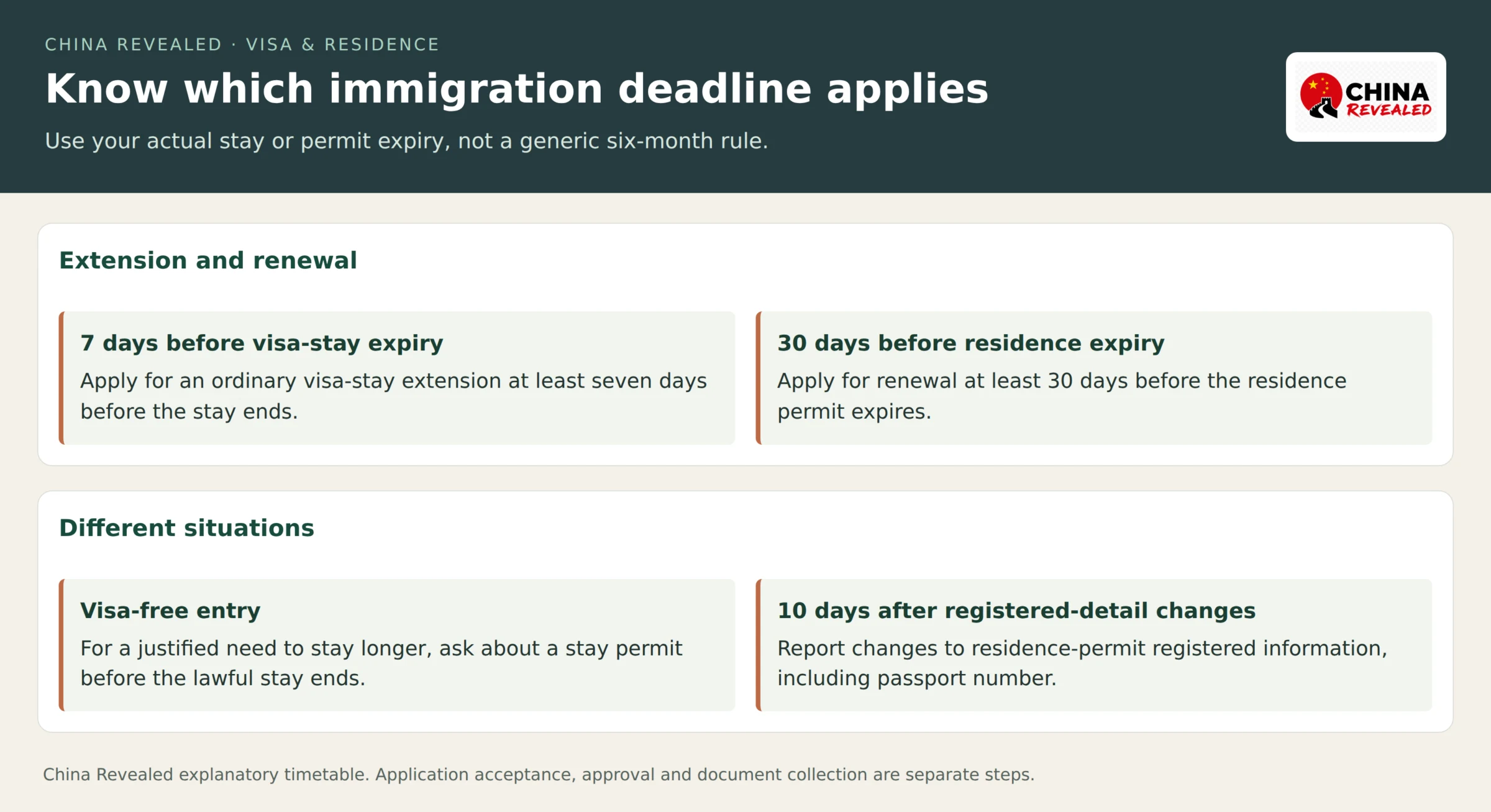
- Visa-stay extension: apply at least seven days before the permitted stay expires.
- Residence-permit renewal: apply at least 30 days before the permit expires.
- After visa-free entry, ask about a stay permit for a justified need to remain longer.
- Keep the acceptance receipt if the office retains your passport, and plan cross-border travel around passport collection.
- For the right office or urgent questions, contact the NIA’s 12367 immigration hotline, which offers English service.
1. Choose the correct procedure
| Your situation | What to ask about | Planning deadline |
|---|---|---|
| Ordinary visa, such as L or Q2 | Extension of the current permitted stay | At least seven days before it expires |
| Valid work, study or family residence permit | Residence-permit renewal | At least 30 days before expiry |
| Visa-free entry and a justified need to stay longer | Stay permit | Contact the office before the visa-free stay ends |
| New passport or changed residence-permit details | Permit change or reissue | Report registered-detail changes within 10 days |
I recommend writing down the actual last lawful day of stay first. Enter Before is the last day you may enter using the visa, not necessarily the last day you may remain after entry. A residence permit has its own expiry. Keep these dates separate.
For an L tourist visa, NIA lists an extension of no more than 30 days, with a travel plan and itinerary as supporting evidence. Total extended stay cannot exceed the original visa’s permitted stay. An original 15-day stay therefore does not automatically become an extra 30 days.
For a residence renewal, show that the original reason continues: current school enrolment for study, employer/work-permit documents for work, or updated host and relationship evidence for family residence.
After visa-free entry, a documented need to remain can lead to a stay-permit application. This is a different procedure from extending an existing L visa. Explain the real reason and provide evidence; the published legal maximum is not an automatic grant.
2. Prepare and find the office
Read the “Accepting Authorities” section of the NIA’s residence-permit service guide, then confirm with your city’s exit-entry service which office handles your place of stay or residence. Check whether it needs an appointment and which foreigner-services counter handles the case. A passport-service centre serving Chinese citizens is not automatically the right counter for your application.
Bring the original passport, current visa or permit, photograph/application materials, accommodation-registration evidence where required, and documents supporting the request. Your employer, school or family host may need to provide a fresh letter. Keep copies and electronic backups.
A hotel usually handles accommodation reporting. At a non-hotel address, complete registration within 24 hours; nationwide NIA online registration is available, with host assistance for the first registration. If a missing registration record is blocking the application, sort it out with the host or local police station promptly.
For the actual registration steps, see accommodation registration in China. It covers private addresses, host assistance, usable electronic records and the difference between repeat self-service and the same-home return exemptions.
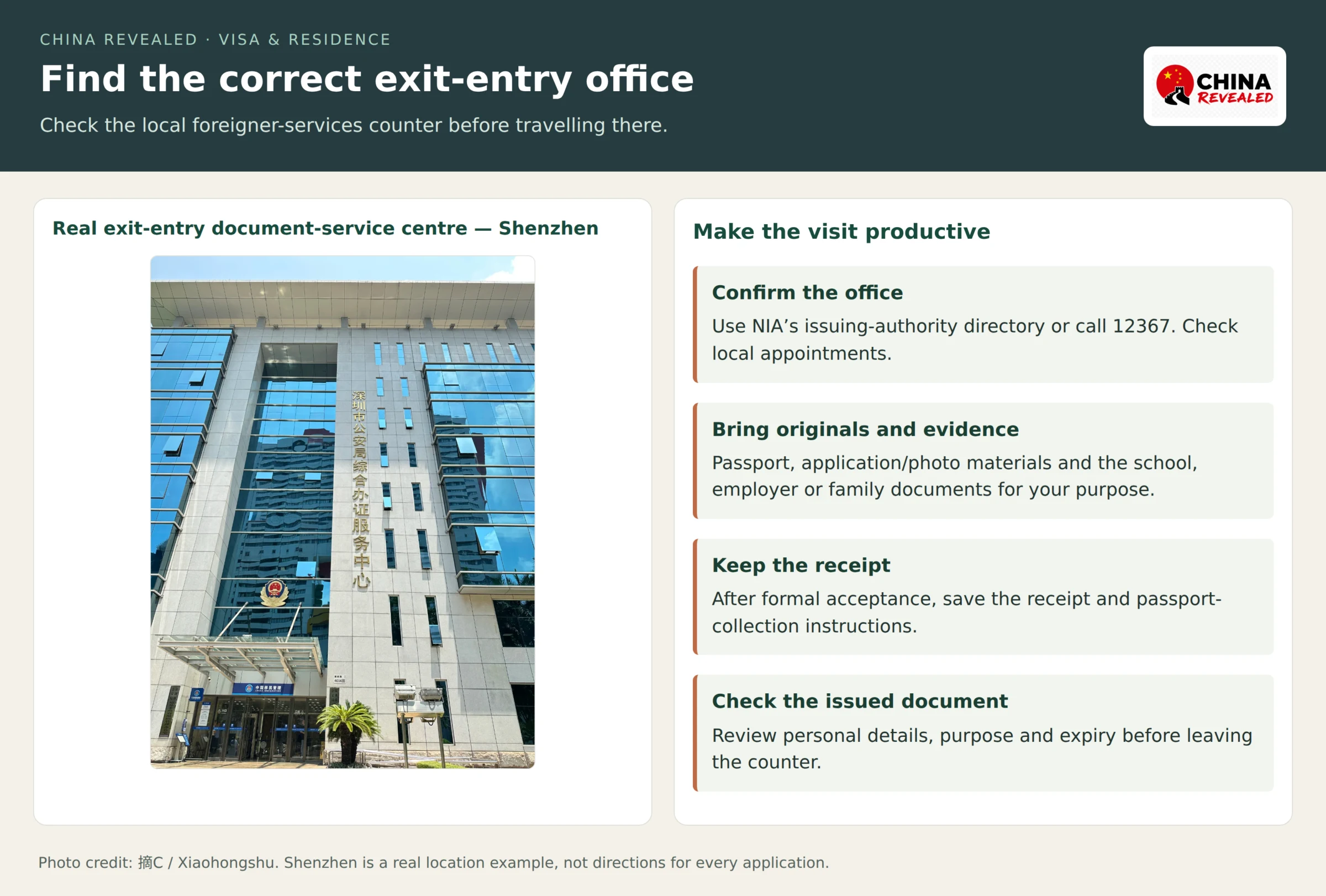
The 12367 hotline can help identify the authority and documents. It has 24-hour service and direct English assistance; from within China, dial 12367. If you are very close to expiry, tell the adviser your entry date, current document, expiry and location first.
3. Submit and keep the receipt
At the office, explain the request plainly and submit the originals and copies it asks for. It may verify the invitation or reason with your host, school or employer.
When the application is formally accepted, keep the acceptance receipt / 受理回执, collection instructions and payment record. Uploading information or reserving an appointment is not the same as formal acceptance.
If the office retains your passport, the receipt supports lawful stay or residence during its validity. Published processing limits are no more than seven working days for visa/stay-permit applications and 15 working days for residence applications after acceptance. Follow the date on your own receipt; extra document preparation happens before that clock starts.
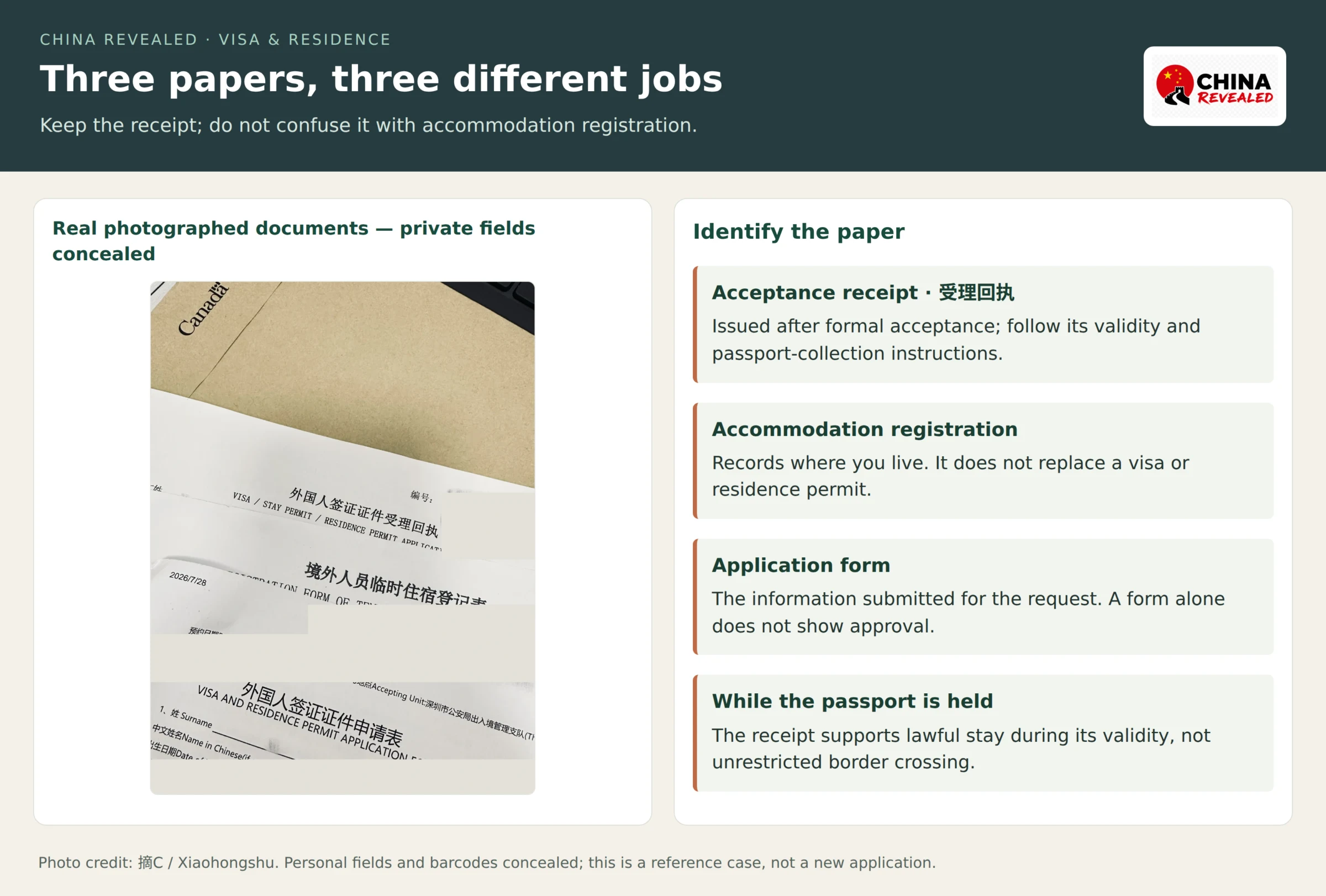
I would avoid international travel while the passport is held. The receipt is not a passport or an unrestricted border-crossing document. If travel is urgent, ask the accepting office how passport release would affect the application and which documents you need.
4. Collect and check the result
Take the receipt and any required identification to collect the passport or document. Before leaving the counter, check the name, passport number, document purpose, expiry and entry/stay conditions. Keep a scan separately from the original.
A valid foreigner’s residence permit, carried with a valid passport, normally allows multiple exits and re-entries during its validity without a separate ordinary visa. An acceptance receipt, accommodation record or application form does not serve that function.
If the request is refused, arrange departure within the existing lawful stay. Start early enough to have a practical departure plan instead of discovering the outcome on the final day. Do not rely on an informal “border run” to fix an expired stay.
Book hotels, flights, train tickets, attractions and other travel services on Trip.com.
5. Changed or lost passports
New passport
Residence-permit registered details include the passport number. Report changes to registered information within 10 days. Take the old passport or evidence of its withdrawal, new passport and existing permit; the office will tell you whether it requires a change or reissue.
This differs from the overseas situation in which an ordinary Chinese visa remains valid in an old passport. A residence permit tied to an old passport number should be dealt with through the local authority rather than assuming the ordinary-visa rule applies.
Lost or stolen passport
Report the loss to Chinese police and contact your embassy or consulate for the replacement passport or travel document. Then ask Exit-Entry Administration to reissue the relevant Chinese document, using the police loss report or embassy evidence it requires. If your flight is close, contact all three parties promptly instead of going straight to the airport with a police report alone.
Stay already expired
Contact the local authority immediately and explain the dates and circumstances. An expired stay is not fixed by an online appointment or a new outbound booking. The office will tell you the required resolution and departure steps.
For purpose-specific paperwork, use our student guide, work guide or Q/S family guide. For selecting a first entry route, return to the published China visa and entry guide.
About China Revealed
China Revealed is an independent English-language travel guide dedicated to China.
We bring together China travel guides, destination information, local insights and practical travel resources in one place.
Our travel database covers China's provinces, cities, famous attractions, hidden gems, local cuisine, transportation, accommodation, visa requirements, digital payments, mobile connectivity and the other practical details travelers need to explore China.
We focus on depth, careful research and accuracy. Our guides combine official sources, detailed destination data, local knowledge and regularly updated information to give reliable, practical travel advice.
Whether you're visiting China for the first time or exploring beyond the popular destinations, China Revealed is an all-in-one resource for discovering the real China.
China Revealed — Your practical guide to China.
Some links on China Revealed, such as Trip.com booking links, are affiliate links. If you book through them, we may earn a commission at no extra cost to you. This does not change what we recommend.