

Hong Kong & Macau to Mainland China: A Border Guide
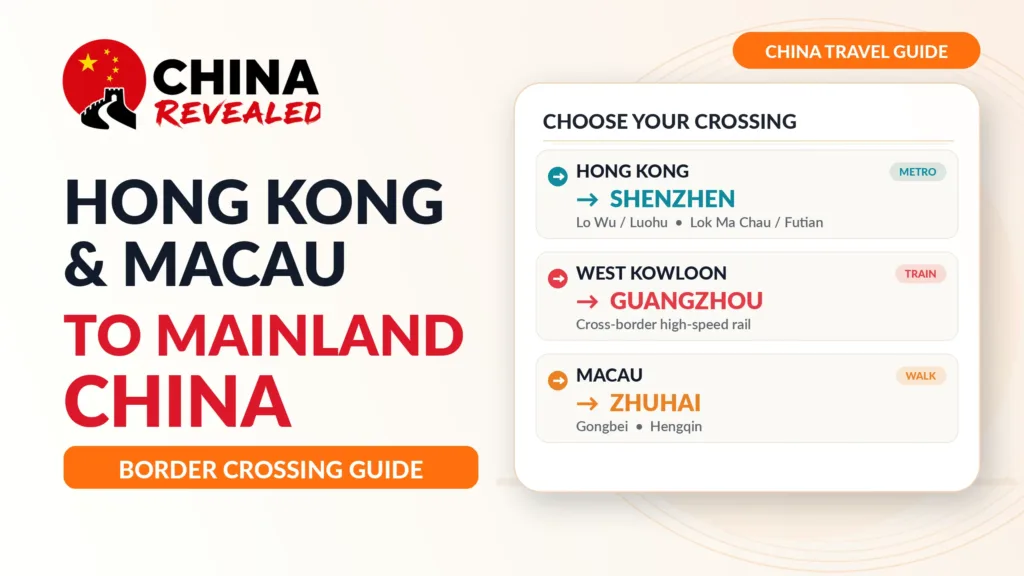
Hong Kong to mainland China for foreigners is mainly a choice between walking across at Lo Wu or Futian and taking a booked high-speed train from West Kowloon. From Macau, I recommend Gongbei for central Zhuhai or Hengqin when you are staying around Cotai. Get your mainland entry permission sorted first, then choose the crossing closest to your destination—not simply the one with the shortest train ride.
Quick takeaways
- Lo Wu → Luohu: useful for eastern Shenzhen; connect to Metro Line 1. Lok Ma Chau → Futian Checkpoint: useful for central Shenzhen; connect to Lines 4 or 10.
- West Kowloon: best for continuing by high-speed rail. Both Hong Kong exit and mainland entry checks happen in Hong Kong, before you board.
- A Hong Kong or Macau visa-free visit does not give you mainland entry permission. A used single-entry mainland visa cannot be reused after a side trip to Hong Kong or Macau.
- Prepare your regular Alipay or mainland Weixin Pay setup, a little RMB cash and a data plan that explicitly covers mainland China.
- Bring the original passport. For a first West Kowloon journey with a foreign passport, I recommend arriving 90 minutes before departure.
In this guide
- 1. Choose the crossing for your destination
- 2. Check your mainland entry permission first
- 3. Hong Kong to Shenzhen via Lo Wu / Luohu
- 4. Hong Kong to Shenzhen via Lok Ma Chau / Futian
- 5. Take high-speed rail from Hong Kong West Kowloon
- 6. Macau to Zhuhai: Gongbei or Hengqin
- 7. What changes with money and payments?
- 8. Your first 15 minutes in mainland China
- Common questions
1. Choose the crossing for your destination
For a Shenzhen day trip, I would usually take the East Rail Line and walk across the border. It is flexible: you do not need to reserve a seat on a specific cross-border train. For Guangzhou or a longer mainland rail journey, West Kowloon is usually the cleaner choice because you can book straight through to your destination.
| Crossing | Hong Kong / Macau approach | Mainland connection | Best fit |
|---|---|---|---|
| Lo Wu / Luohu 罗湖口岸 | MTR East Rail Line to Lo Wu | Shenzhen Metro Luohu, Line 1 | Luohu, Dongmen and eastern Shenzhen |
| Lok Ma Chau / Futian 福田口岸 | MTR East Rail Line to Lok Ma Chau | Futian Checkpoint, Lines 4 and 10 | Central Shenzhen and onward metro travel |
| Hong Kong West Kowloon 香港西九龙站 | Reach the high-speed station near Austin / Kowloon MTR stations | Your booked mainland high-speed station | Guangzhou, Shenzhen North or longer rail trips |
| Macau Border Gate / Gongbei 拱北口岸 | Macau bus or taxi to Portas do Cerco / Border Gate | Zhuhai city transport; nearby Zhuhai railway station | Central Zhuhai and the Gongbei area |
| Hengqin 横琴口岸 | Macau LRT Hengqin Line or road transport | Hengqin and onward Zhuhai transport | Cotai hotels and Hengqin destinations |
Three names that catch visitors out: Lok Ma Chau MTR station is the rail crossing connected to Futian; the separate Lok Ma Chau road crossing leads to Huanggang. Futian Checkpoint metro station is not Futian high-speed railway station. And Shenzhen’s Luohu is not Hong Kong’s Lo Wu, even though they sit on opposite sides of the same crossing.
2. Check your mainland entry permission first
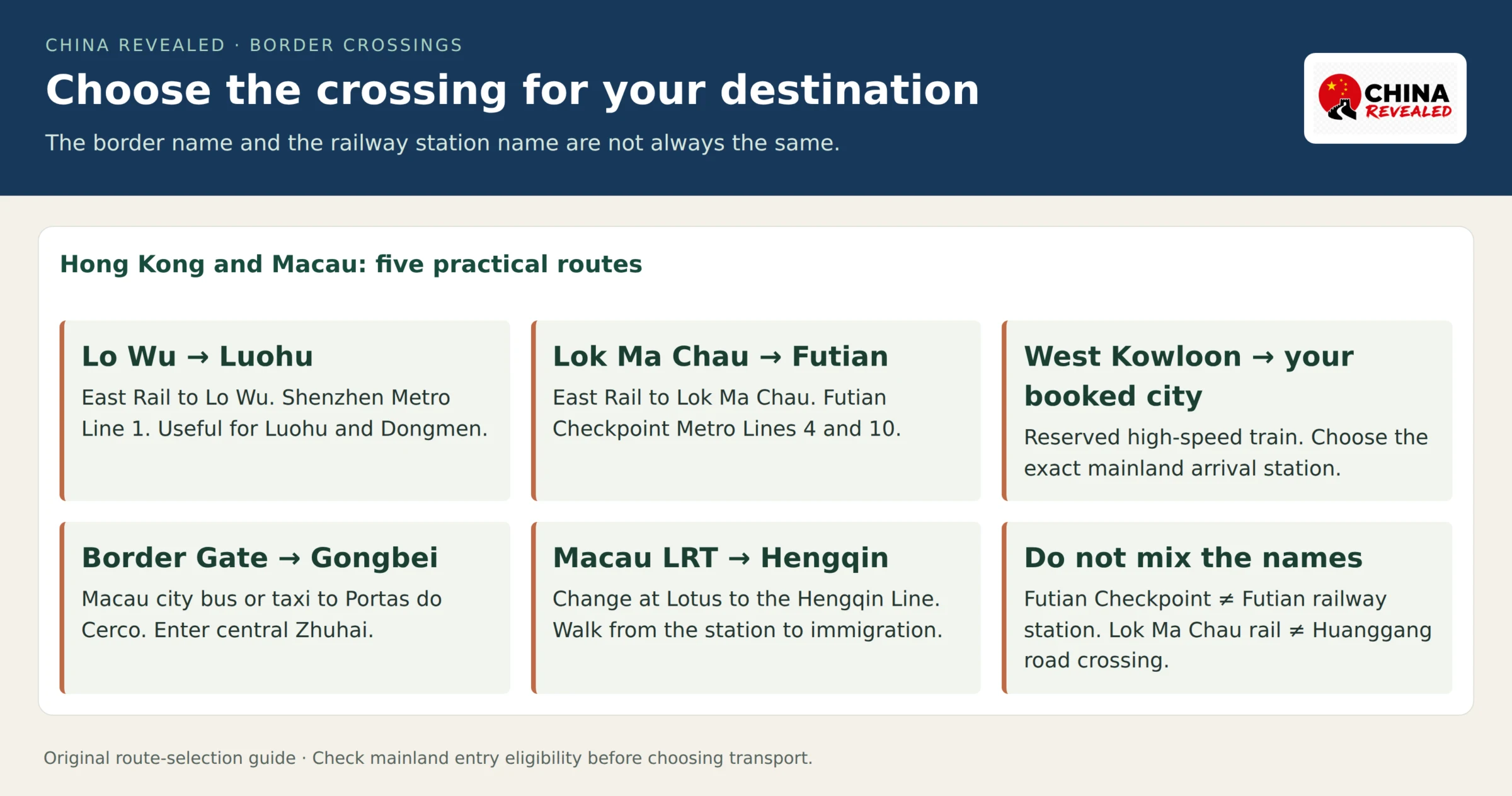
Hong Kong, Macau and mainland China have separate immigration arrangements. Being admitted to one does not automatically admit you to the others.
For a normal mainland visit, use a valid mainland visa with an unused entry, an applicable residence document, or a visa-free arrangement that covers your passport nationality and the purpose of your trip. Check the policy for your actual travel date through the China visa and entry guide. Ordinary-passport visa-free entry for eligible nationalities can cover land crossings as well as airports; it is not restricted to people flying into China.
If you entered mainland China on a single-entry visa, then went to Hong Kong or Macau, that entry has been used. Returning to Shenzhen or Zhuhai is a new mainland entry. A double- or multiple-entry visa needs an entry remaining and must still be valid. Do not read the visa’s overall validity date as permission to reuse a consumed entry.
The 240-hour transit route is different
For eligible travellers, the 240-hour visa-free transit scheme requires an approved entry port and a qualifying onward journey to a third country or region. The current approved entry list includes West Kowloon, but does not include Lo Wu / Luohu, Futian or Gongbei.
That makes a real difference: a qualifying Hong Kong–mainland–Japan itinerary through West Kowloon is not the same as a Hong Kong–Shenzhen–Hong Kong day trip. If you already qualify for ordinary nationality-based visa-free entry, use that route instead of trying to force your trip into the transit scheme.
Do not rely on a Shenzhen port visa as your default plan
Shenzhen has a limited special-economic-zone tourist port-visa route, often described online as a “five-day visa.” It has its own eligibility, location and processing conditions, and is not a general China visa for travelling onward to Guangzhou or Shanghai. Luohu has a port-visa service; Futian is not listed among Shenzhen’s published instant-application locations, and West Kowloon has no port-visa office. Arrange your normal entry permission before travelling unless you have specifically confirmed that the port-visa route fits your passport and itinerary.
Prepare the arrival card and your documents
Use the official NIA arrival-card website before crossing, or follow the official QR code / paper-card instructions at the port. The arrival card is free and does not replace a visa.
Keep these together in your day bag: original passport, visa or supporting entry documents, mainland hotel address and onward booking where relevant. Save copies offline. At immigration, use the staffed visitor / foreign-passport channel unless you are enrolled and eligible for the relevant automated channel. The fast-moving Hong Kong resident queue is not automatically your queue.
3. Hong Kong to Shenzhen via Lo Wu / Luohu
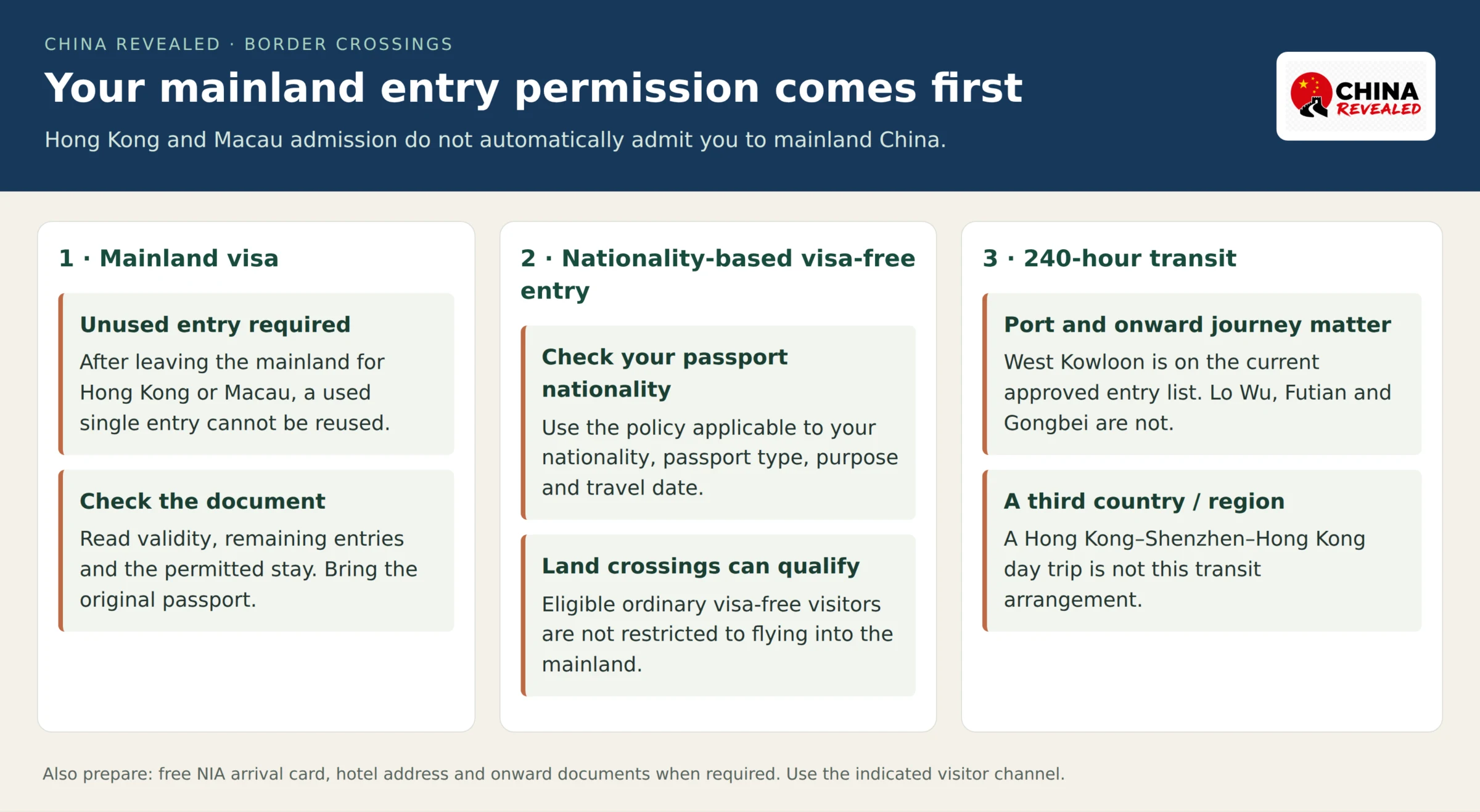
Current border hours: 06:30–00:00 daily. Check the MTR border-service page for train services before a late journey; the last useful train is not the same thing as the border’s closing time.
- Take the East Rail Line towards Lo Wu. Read the destination on the platform and train. East Rail also runs to Lok Ma Chau, so not every northbound train goes to Lo Wu. If needed, change at Sheung Shui for the correct branch.
- At Lo Wu, finish the MTR journey and follow the Shenzhen / mainland crossing signs. Keep your passport out and your luggage with you.
- Complete Hong Kong departure immigration, then follow the pedestrian connection to mainland entry. These are two separate checks. Use the visitor channel indicated by staff, not a resident-only automated lane.
- Complete mainland immigration and customs. Have your arrival-card information ready. Follow the declaration channel appropriate to your belongings.
- Continue from the Shenzhen side. Follow signs to Luohu Metro Station, Line 1, or the signed taxi / ride-hailing pickup area. This is where you switch from Hong Kong MTR to Shenzhen transport.
I would choose Luohu for Dongmen or a hotel in the Luohu district. If your hotel is across the city, open the Amap guide and compare the onward journey before deciding. The shortest border queue does not necessarily give you the shortest trip to your hotel.
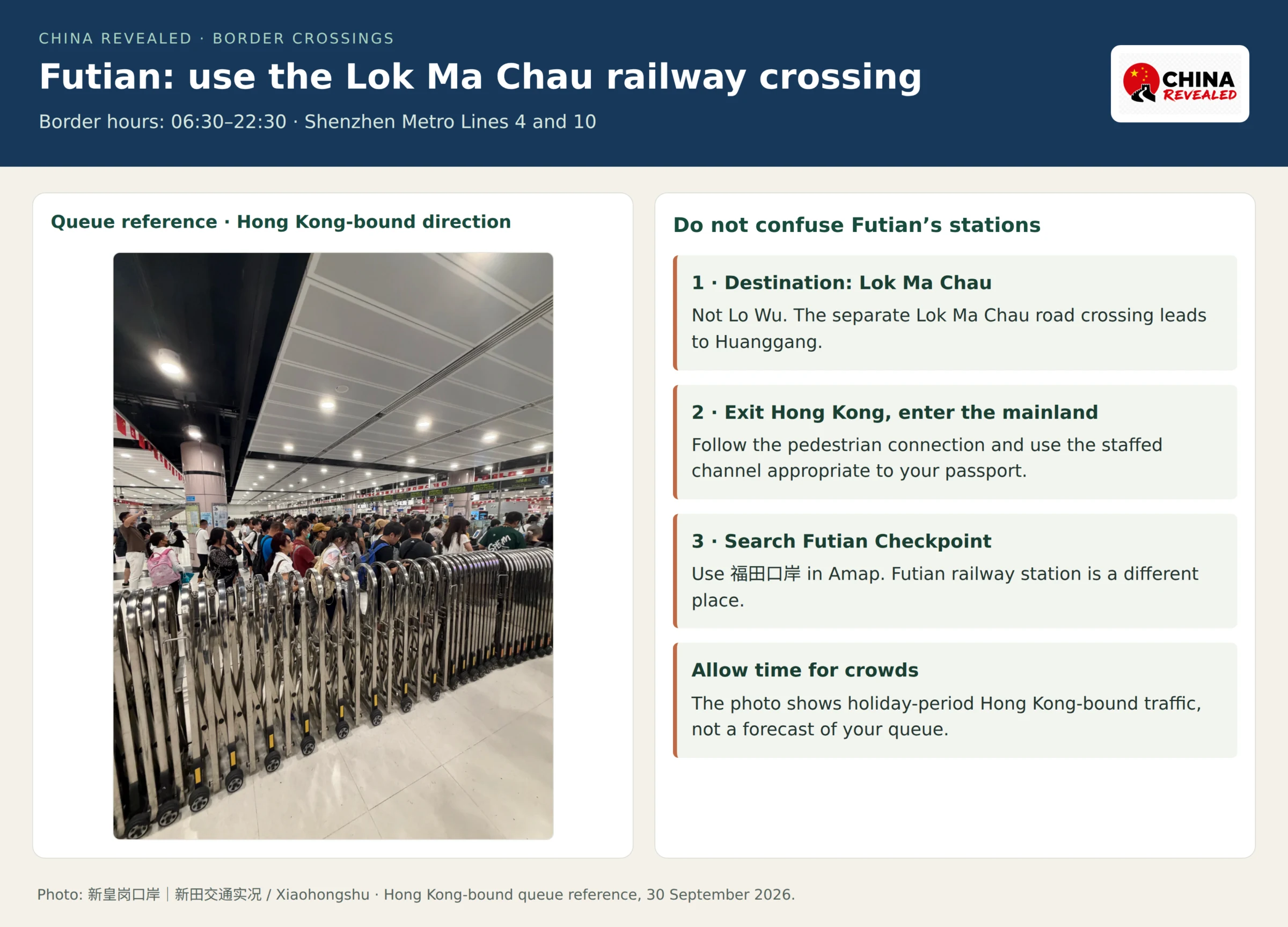
4. Hong Kong to Shenzhen via Lok Ma Chau / Futian
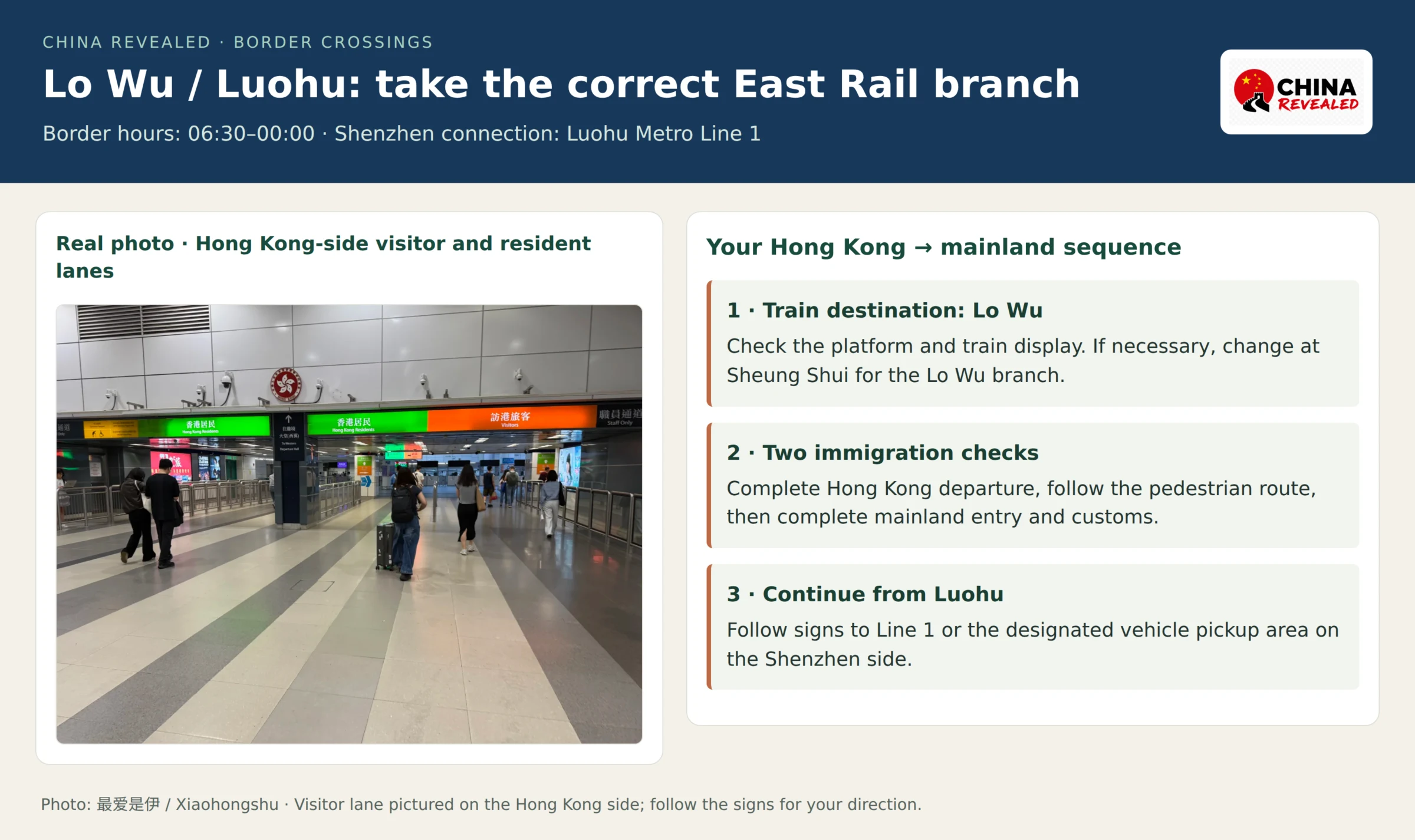
Current border hours: 06:30–22:30 daily. This railway crossing closes earlier than Lo Wu.
- Take an East Rail train whose destination is Lok Ma Chau. Change at Sheung Shui if you are on the Lo Wu branch.
- At Lok Ma Chau, leave the paid MTR area and follow the crossing signs. Complete Hong Kong departure checks.
- Walk along the pedestrian connection and complete mainland entry at Futian Checkpoint.
- Follow signs for Shenzhen Metro Lines 4 or 10, or your chosen taxi / ride-hailing pickup point.
For much of central Shenzhen, this is the crossing I would check first. Search 福田口岸 / Futian Checkpoint in Amap, not just “Futian.” If you want a high-speed train afterwards, plan the separate transfer to Futian railway station or Shenzhen North.
Border queues can build around weekends and holiday departures. Allow extra time before any fixed onward train. If you reach the area too late for the railway crossing, do not assume the nearby road crossing is the same entrance—plan a different open port and its transport connection.
5. Take high-speed rail from Hong Kong West Kowloon
West Kowloon is a booked intercity train journey, not an ordinary MTR ride across the border. Book a seat first and select Hong Kong West Kowloon as the departure station. Choose the actual arrival station—not just the city: Guangzhou South and Guangzhou East are different destinations, as are Futian and Shenzhen North.
Use the China train-booking guide for the booking walkthrough. If you use Trip.com, choose its Trains section, enter the route and travel date, select Passport, and enter the passenger name and number from the original document. Check that the booking shows issued / confirmed, then save the train number, time, arrival station and order details. An order screenshot helps staff find your booking; it does not replace the passport used to buy it.
Arrive early enough for both borders
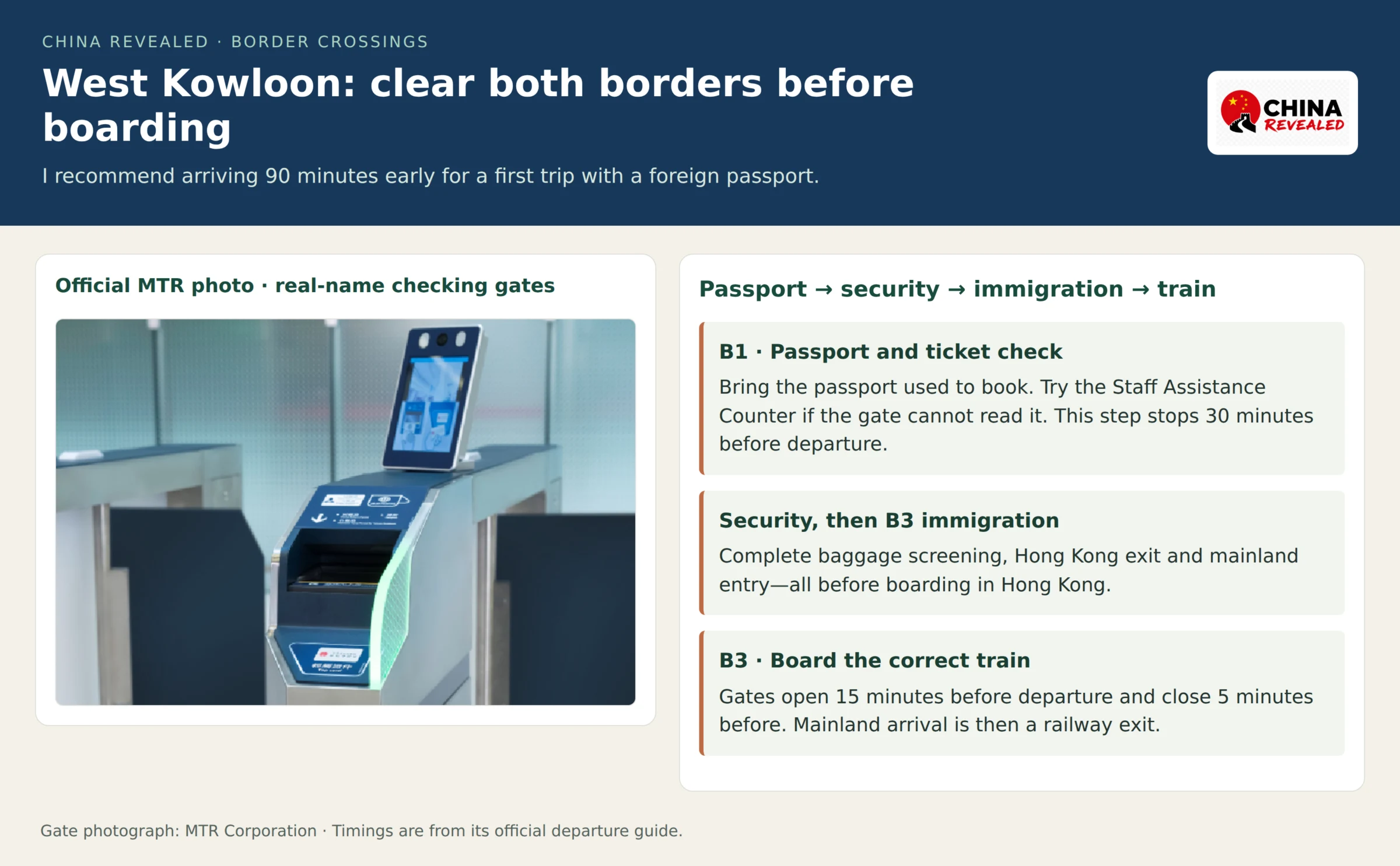
For a first visit with a foreign passport, I recommend arriving 90 minutes before departure. MTR says the usual procedures take around 30–45 minutes, with extra time needed for passport holders, traditional counters and busy periods. Real-name checking and ticket verification stop 30 minutes before departure. That is the deadline for completing those steps, not a suggested time to walk through the station’s front door.
Follow this sequence:
- B1 ticketing concourse: complete real-name checking and ticket verification using the original booking passport. Use the Staff Assistance Counter if the gate cannot read it.
- Security check: put your luggage through inspection and follow the screening instructions.
- B3 departure concourse: complete Hong Kong exit and mainland entry immigration. Both happen here, before you board the train.
- B3 boarding gate: check the train number and gate. Boarding gates open 15 minutes before departure and close 5 minutes before departure.
- Mainland arrival station: leave through the railway exit gate using your booking document and staff assistance if needed. You have already completed mainland immigration at West Kowloon.
The official MTR departure guide is the useful page to save. A passport holder should not plan the journey around a screenshot of a 12306 boarding QR code: that feature has its own registration and verification requirements, and its code is dynamic.
6. Macau to Zhuhai: Gongbei or Hengqin
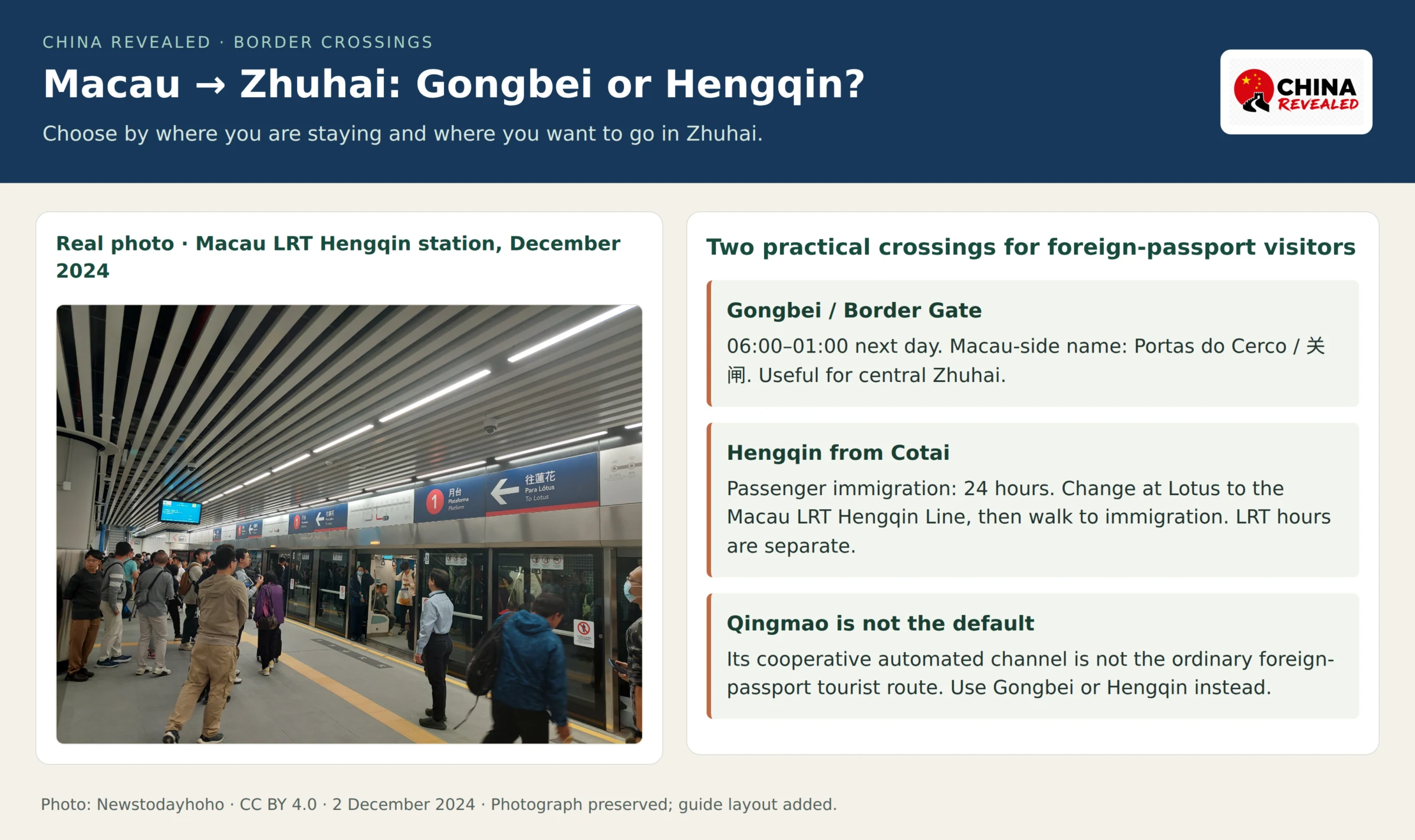
Border Gate / Gongbei: my pick for central Zhuhai
On the Macau side, look for Portas do Cerco / Border Gate / 关闸. On the mainland side, it is Gongbei / 拱北口岸. The current crossing hours are 06:00–01:00 the following day.
Take a Macau bus or taxi to the Border Gate, follow the pedestrian immigration route, complete Macau departure and mainland entry, then continue into Zhuhai. Gongbei is convenient for central-city transport and the nearby Zhuhai railway station. You do not need to take a train just because the station is there; use the route that fits your hotel.
Hengqin: useful from Cotai
Hengqin passenger immigration operates 24 hours, but the light rail and other connecting transport have their own service hours.
From the Macau LRT network, travel to Lotus station, change to the Hengqin Line, then get off at Hengqin station in the Macau-side port area. Follow signs up to the departure hall, complete the border procedures through the appropriate staffed channel, and continue into mainland Hengqin / Zhuhai. Check the Macau LRT route and service times before a late trip.
The Macau LRT station and the mainland intercity railway station are separate transport facilities around the same border complex. Follow the immigration route first; do not assume arriving at a station named Hengqin means you have entered mainland China.
Do not choose Qingmao simply because a map says “24 hours.” Its cooperative automated crossing is intended for eligible mainland, Hong Kong and Macau document holders; it is not the normal route for an ordinary foreign-passport tourist. I would use Gongbei or Hengqin instead.
Book hotels, flights, train tickets, attractions and other travel services on Trip.com.
7. What changes with money and payments?
Start thinking in RMB
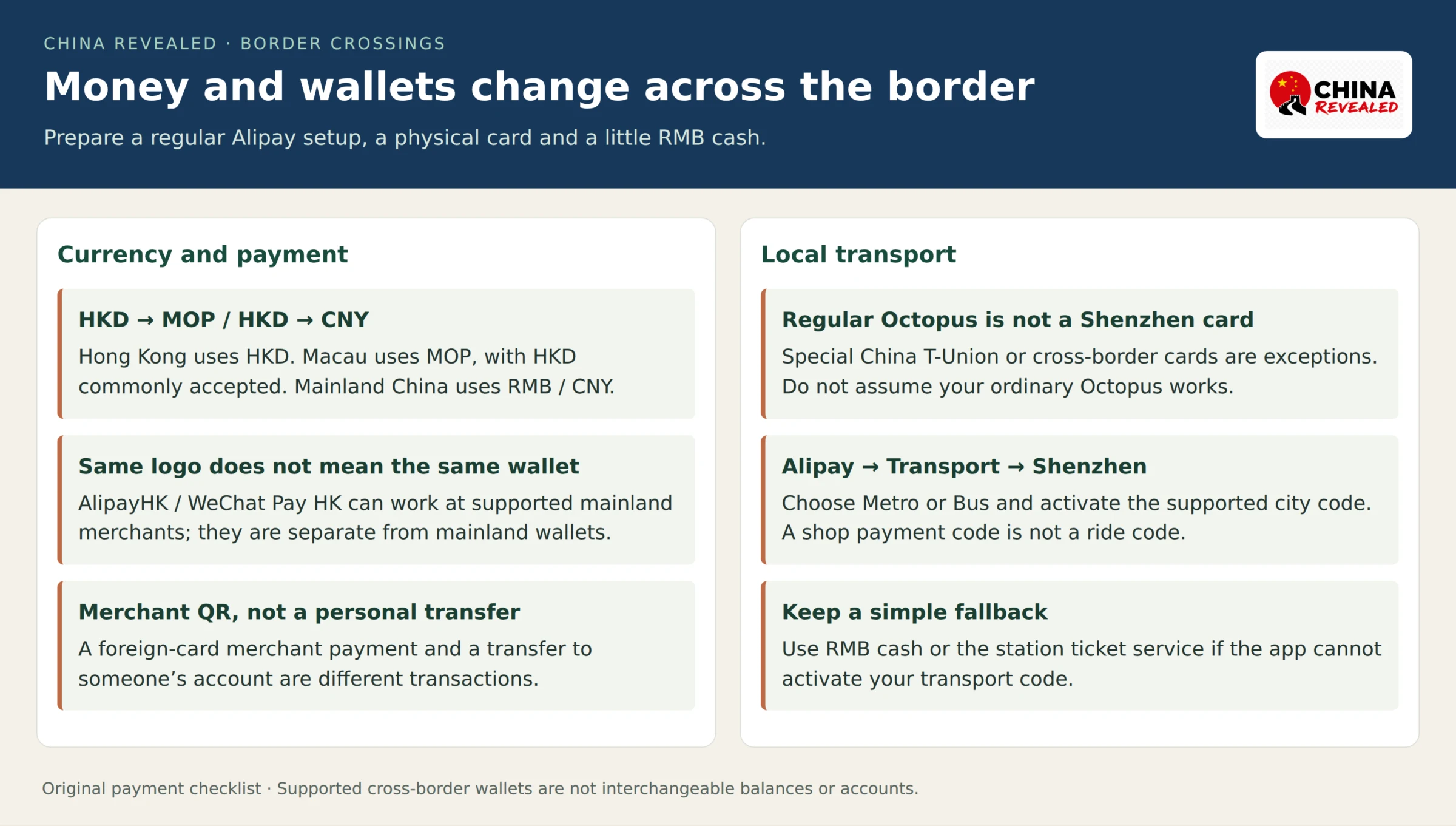
Hong Kong prices are in HKD. Macau uses MOP, with HKD commonly accepted by shops. Mainland China uses CNY / RMB. Do not expect Hong Kong dollars or patacas to work for Shenzhen metro fares or an ordinary Zhuhai restaurant bill.
I recommend a small amount of RMB cash for your first transport connection, alongside a physical bank card. If you need to exchange money at the border, check the displayed rate and any fee before handing over cash.
Keep the right wallet—not just the right-looking logo
For a foreign visitor continuing around mainland China, I recommend preparing the regular Alipay app with your passport and supported foreign card before the crossing. Follow the Alipay setup guide; there is no reason to start again if you already have a working account.
AlipayHK and WeChat Pay HK are different wallet services from the mainland versions. They can make cross-border payments at supported mainland merchants, but their balances, transfer functions and local-service coverage are not interchangeable with mainland wallets. If you already use one, check the merchant’s support rather than assuming it works everywhere—or assuming it never works.
For a mainland Alipay or Weixin account linked to an international card, use a merchant payment QR code. A request to transfer money to someone’s personal account is a different transaction and may fail. Keep cash for that situation instead of repeatedly trying the same transfer.
Your Octopus is not automatically a Shenzhen metro card
A regular Hong Kong Octopus does not become a Shenzhen transport card when you cross the border. Special cross-border products such as the Octopus China T-Union Card have their own coverage, but an ordinary tourist Octopus is not one of those products.
After entering Shenzhen, open Alipay Transport, select Shenzhen, then activate the supported Metro or Bus code. A shop payment code is not a metro entry code. If activation fails, use the station’s single-journey ticket service and ask staff for help.
8. Your first 15 minutes in mainland China
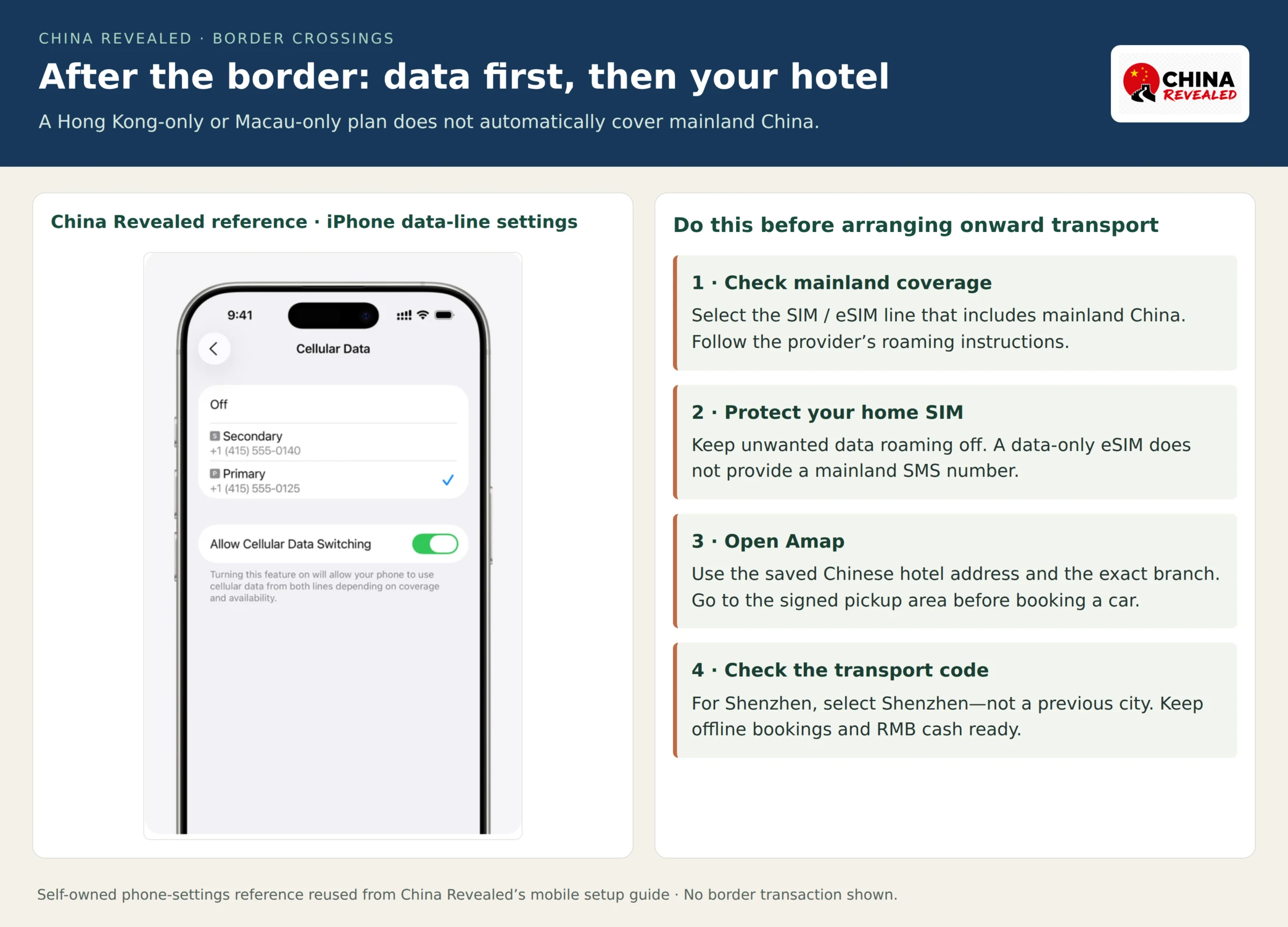
Before leaving Hong Kong or Macau, confirm that your SIM, eSIM or roaming package explicitly covers mainland China. A Hong Kong-only or Macau-only data plan does not automatically extend across the border. A data-only eSIM also does not supply a mainland SMS number.
Once you are through:
- Get mobile data working. Choose the line that covers mainland China. Turn on that line’s data roaming if the provider instructs you to, and keep unwanted roaming off on your home SIM.
- Open Amap and check the exact hotel branch. Use the saved Chinese address. At a road crossing, follow the signed pickup area before booking a car; do not pin the car to the immigration building’s restricted area.
- Open the relevant payment or transit tool. For a Shenzhen metro connection, use the Shenzhen transport code, not the code for another city.
- Reach the hotel and register with the original passport. A hotel handles accommodation registration for its guests. If staying in a private home, follow the non-hotel registration steps in the visa and entry guide.
Prepare the SIM and eSIM setup before travelling, and save the hotel address and route screenshots offline. Doing that in your Hong Kong or Macau hotel is much easier than trying to configure everything in a crowded border hall.
Common questions
Can I enter Shenzhen visa-free because Hong Kong admitted me visa-free?
Only if your passport also qualifies for a mainland visa-free arrangement. Hong Kong’s permission is separate. Check your mainland eligibility before choosing a crossing.
Can I walk across in the morning and return to Hong Kong that evening?
Yes, with the right entry permission for each side. Your mainland stay ends when you leave, and Hong Kong re-entry is a new immigration decision. If you plan another mainland visit later, account for that additional visa entry too. Leave time for queues and the last return transport.
Is West Kowloon always faster than walking across?
Not door to door. The train ride can be short, but you still need to reach West Kowloon, pass ticket verification, clear security and complete two immigration checks. For a hotel near Luohu or Futian Checkpoint, East Rail may be more convenient; for a through trip to Guangzhou, high-speed rail often makes more sense.
Can I cross without internet?
You can use staffed immigration with your physical documents and the port’s arrival-card option. But navigating onward and using payment or transport codes is much easier with working data. Carry offline booking details, the Chinese hotel address and a little RMB cash.
What if I miss my West Kowloon train while waiting at immigration?
Contact MTR or the booking platform immediately and check the ticket’s change conditions. Keep your passport and booking number ready; do not assume a seat reservation on one departure lets you board any later train.
My recommendation: decide your mainland entry permission first, choose the crossing by the hotel or railway station you actually need, and prepare your payment and data tools before leaving Hong Kong or Macau. Once those three things are settled, this is a manageable start to a mainland trip.
Entry rules, border hours and transport procedures checked on 17 October 2026; recheck the applicable visa policy for your travel date.
About China Revealed
China Revealed is an independent English-language travel guide dedicated to China.
We bring together China travel guides, destination information, local insights and practical travel resources in one place.
Our travel database covers China's provinces, cities, famous attractions, hidden gems, local cuisine, transportation, accommodation, visa requirements, digital payments, mobile connectivity and the other practical details travelers need to explore China.
We focus on depth, careful research and accuracy. Our guides combine official sources, detailed destination data, local knowledge and regularly updated information to give reliable, practical travel advice.
Whether you're visiting China for the first time or exploring beyond the popular destinations, China Revealed is an all-in-one resource for discovering the real China.
China Revealed — Your practical guide to China.
Some links on China Revealed, such as Trip.com booking links, are affiliate links. If you book through them, we may earn a commission at no extra cost to you. This does not change what we recommend.