

Explore the region
What Lucun is, and how it differs from Hongcun
Lucun sits in Hongcun Town, Yi County, at the southern foot of Yangzhan Ridge (羊栈岭), on the old Ningchi road (宁池古道) that crossed the ridge between the Xuan–Chizhou country to the north and Shexian and Xiuning to the south. The pass was a controlled route — “commanding the north, reaching south”, in the old description — and the village grew because of it. The Lu clan traces itself to a move south from Ge village in Taiping County (today’s Guocun area, Huangshan District) in the last years of the Southern Tang, so the settlement is well over a thousand years old.
It is worth being precise about its status. Lucun is not one of the two villages on the UNESCO World Heritage list — that inscription covers Xidi and Hongcun — and its formal protection is provincial: Zhicheng Hall (志诚堂) was listed as an Anhui provincial protected building in the sixth batch (no. 6-94, 2012), and the wider Lucun building group (卢村建筑群) followed in the eighth batch (no. 8-149). It is also not Hongcun in miniature. Hongcun is a single catchment feeding one channel, one half-moon pond and one lake; Lucun is a compact village between two streams whose reputation rests on carving rather than planning, with a fraction of the visitors and residents still living in the halls. The practical consequence: come here to look closely at individual door panels and beams, and treat the walk through the lanes as the interval between them.
The building campaign at Lucun came just before catastrophe. Between 1854 and 1864 Taiping and Qing armies crossed the ridge and moved through Yi County repeatedly, and Lucun, sitting on the pass road, was burned more than once; clan records written afterwards describe the village as reduced to rubble and the surviving population as fewer than two or three in ten. That the carved halls are here at all reflects how completely the Lu clan rebuilt afterwards, and it explains why the village’s Qing houses read as a coherent group rather than an accumulation.
Zhicheng Hall: the woodcarving hall
Lu Bangxie (卢邦燮), known locally as Lu Baiwan, “Lu the Millionaire”, was the 33rd generation of the village’s Lu lineage. He made money in trade and then took office, rising to the fourth rank as a chaoyi dafu (朝议大夫), and in the Daoguang reign (1821–1850) he built the group of residences still known as the “seven households” (七家里). Two craftsmen worked the carving for about twenty years.
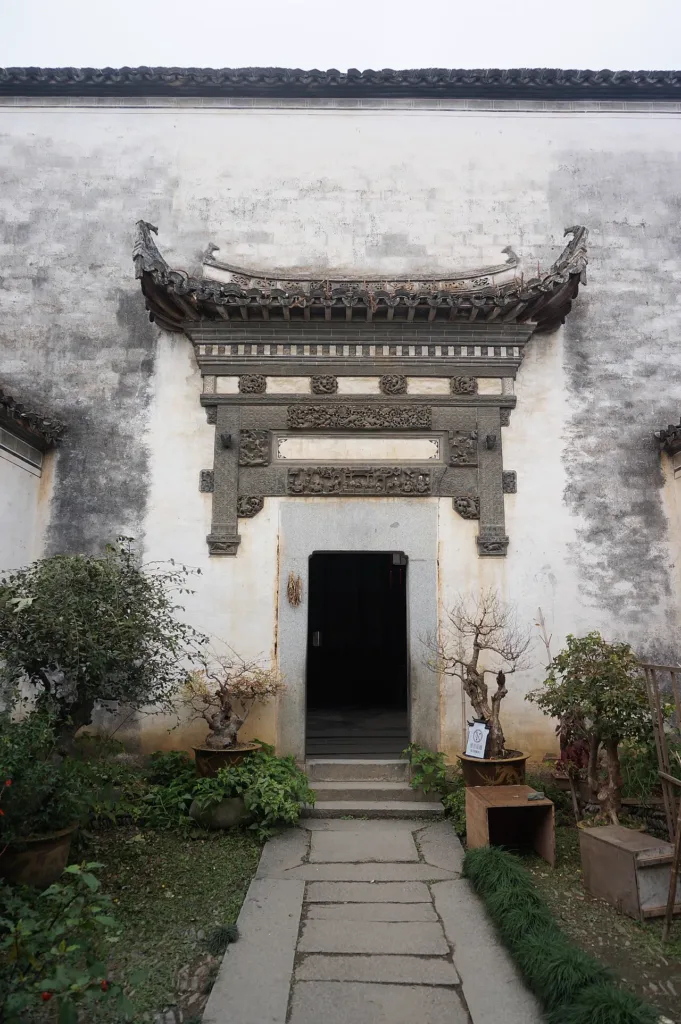
Zhicheng Hall, where his first and second wives lived with his parents, is the best of the group. The house faces south, with the Yangzhan River channel passing on its east side, and it is modest in plan: about 13.4 m across and 18.3 m deep, roughly 244 sq m on the ground, two courtyards, three bays on each of two storeys. The decoration is not modest. Above the entrance, the gatehouse stacks stone and brick in bands — four stone kui-dragon motifs at the top, and below them a long auspicious sequence running from west to east through a lotus, mandarin ducks, a phoenix with peony, a pine with crane and a magpie. Read as puns, they carry a household’s wishes in order: many sons, a harmonious couple, wealth, long life, good news. Under the band sits a battle scene in deep relief, with fighting on water and on land and eighteen figures in the central composition, carved by men working in the decades when Lu lived through the Opium War and the Taiping wars.
Inside, the place to start is the main hall’s courtyard doors: eight leaves on each side, and every leaf divided into four registers. The chest panel is a “many-treasures” lattice with vases and peonies, for wealth and peace. The narrow waist panel above and below it carries punning animals — bat for blessing, deer for official salary, bee and monkey for “enfeoffed marquis” — or scenes of the twenty-four filial exemplars. The skirt panel at the bottom is where the carvers let go, because ordinary houses left it plain: here each door tells a story, and walking the hall from one side to the other passes Su Wu herding sheep, the Grand Duke fishing, Wang Xizhi watching geese, Tao Yuanming drunk and the Seven Sages of the Bamboo Grove — the standard repertoire of a literate Qing household, told in wood. Some doors also carry the village’s own subject: the Lantern Festival, with its lanterns and crowds, carved as ordinary life rather than as legend.
Find the panel on the left side of the main hall where a candidate on horseback meets a monkey at a bridge: 马上封侯, “a marquisate at once”. The reporter from People’s Daily counted nine planes of carving in that one composition, from the expressions of the servants to the bend of the willow twigs. Panels elsewhere in the hall are described as six or seven layers deep, cut with mixed, line, hidden, incised and openwork technique.
Two things temper the pleasure of looking. Many of the carved figures in Zhicheng Hall lost their heads in the Cultural Revolution, and the missing heads are obvious in the main hall. And this is a house with a doctrine, not a museum with labels: the couplets in the main hall and the rear hall speak of hearing out ancestral teaching and serving family and state, and of knowing the farmer’s labour and practising thrift.
The other halls of the seven households
The complex is several houses rather than one, linked by lanes, side doors and covered passages, and the entry ticket covers the houses that are open.
Siji Hall (思济堂), “the official hall”, is where the fifth wife lived and where Lu received guests. It is the grandest in plan, and local accounts say Hongcun’s Chengzhi Hall was modelled on it and built about fifty years later — which makes it the earlier, plainer answer to the more famous house. Look at the carved beams (冬瓜梁) and at the official’s couch on the right of the reception room.
Sicheng Hall (思成堂), for the third and fourth wives, is plainer outside and better in small objects: a well in the floor under a square opening, a pair of stone plinths carved as bound bundles of bamboo in Yi County stone, a wooden tub for warming a bed, and old furniture.
Glass Hall (玻璃厅), also called Double Tea Hall (双茶厅), was built for the youngest wife. It mixes a Chinese plan with imported German glass, about 2 mm thick, in a walled garden with old camellias.
The schoolroom Lu built for his twenty-four children survives in the northern part of the group, and it is the one place where the carving is undamaged: villagers sealed these panels with yellow mud during the Cultural Revolution, and the carved faces came through. For a first-time visitor this is the most legible interior in the village, because the comparison with the main hall shows exactly what was lost elsewhere.
Some houses are closed and some are under repair — the state heritage administration approved a conservation project inside the protected building group in October 2025 — so expect a door or two to be shut on any visit.
Walking the village
Enter at the ticket check, cross the bridge and take the path to the left, which is the direction the village is read in. The woodcarving halls check the ticket again inside, so keep your ticket, or a screenshot of the QR code, on your phone.
The water is the easiest thread to follow. The Yangzhan River runs roughly west to east along the village, the Qianjie Stream comes down from the north on the eastern side, and the two meet at the southern end; an artificial channel (水圳) is cut across the village west to east to link them, which is why stone bridges, washing steps and open water sit beside the lanes. Ducks on the water, laundry on the steps and sketching students along the banks are the ordinary scene rather than an event.
At the village mouth is Siche Bridge (驷车桥), first built in the Song and rebuilt in the Ming Xuande era after flooding. The name comes from the four-horse carriage of a great official, and it points to Lu Chenzhong, a Northern Song jinshi from the village who was posthumously made a remonstrance official and commemorated with a shrine and a couplet.
Above the village, on the hillside east of Provincial Highway 218, is the viewpoint (观景台) where people go before dawn for mist, smoke and the first light on the rooflines. Visitors consistently report that the viewpoint itself is not ticketed; the twenty to thirty minutes after sunrise are the peak, space is limited, and mornings in the valley are cold, so bring a jacket. Expect the lane up to be busy on autumn mornings.
A sequence that works: village entrance and ticket check → Siche Bridge and the stream → Zhicheng Hall, slowly → the schoolroom → Siji Hall → Sicheng Hall → Glass Hall → the lanes and washing steps → up to the viewpoint. That is an editorial order, not a marked route, and no transfer is implied by it. Ninety minutes covers the village at a brisk pace; three hours is better if you actually read the panels.
Seasons and timing
Two windows are worth planning around. In spring the rapeseed terraces below the village flower — about 600 mu of terraced fields, according to local reporting — and in late autumn, roughly late October to late November, the tallow trees turn and the valley holds mist in the early morning. The village is at its emptiest at either end of the day, which is also when the light is best on the carving.
The village’s own festival is the Lantern Festival on the fifteenth day of the first lunar month, when dragon lanterns, lion lanterns and phoenix lanterns are carried through the lanes; accounts describe up to nine dragon lanterns at once, each up to thirty-four sections, in a formation known as “nine dragons out to sea”. The phoenix lantern developed into a dance of its own, the Zhishan Phoenix Dance (雉山凤舞), now counted as provincial intangible cultural heritage, and the dragon-lantern fair was revived in 2025. Dates follow the lunar calendar, so check locally rather than travelling for a fixed day.
Tickets, hours and what is included
Entry to Lucun is a single paid ticket, and it covers the woodcarving halls. Chinese and international ticketing platforms list the adult ticket at CNY 50 (about US$7), sold with immediate confirmation and often at a small discount online. This is a separate ticket from Hongcun’s; the halls check it a second time inside the village, which is the local way of confirming that the same ticket covers the whole group.
Older English-language coverage quoted CNY 28 in 2010, which is the clearest sign that any figure from before the 2020s should be treated as history rather than a price.
The published concession list gives free entry to children 1.2 m or under, or aged six and under, and to visitors aged 65 and over; half price for ages 6–18, full-time students and ages 60–64; and free entry for serving military personnel, disabled visitors, fire and rescue staff and cadets, members of photographers’ associations, journalists, retired military cadres, and family members holding martyr or bereaved-family certificates. Documents are checked at the gate, and the notice board on site governs on the day.
County-level promotions can override all of this at short notice. On 7–8 March 2026, for example, Lucun was one of eight Yi County scenic areas admitting women free of charge, while Xidi and Hongcun were half price that weekend through the official Huangshan booking channel — so it is worth checking current announcements before buying.
Hours are published as 07:30–17:30, which is when the ticket check and the halls are staffed; the hillside viewpoint is separately listed as open around the clock, which is about the viewpoint and not the ticketed village. If dawn or evening access matters to you, ask at the gate rather than assuming either way, because listings describe the lanes and the halls differently. No advance reservation requirement appeared in the sources consulted for this page; the platforms sell same-day tickets, and the gate sells on the spot.
There is no cableway, shuttle or separate hall fee inside the village that this page could verify, and parking at the entrance is free, with about fifty spaces.
Getting there and away
There is no metro in Huangshan or Yi County and no station in the village, so the workable pattern is rail or coach to Yi County, then a short road hop.
- Yixian East Railway Station (黟县东站) is the closest station to Lucun as well as to Hongcun and Xidi, about 14 minutes by train from Huangshan North and served by trains from Hangzhou, Shanghai, Hefei, Nanjing and Beijing. The bus station is next to the station exit; buy the ticket there. Bus 10 runs from Yixian East to Hongcun Bus Station (宏村客运站) in about 40 minutes for a reported CNY 8, calling at the Xidi Scenic Area and other stops; the published timetable runs from about 09:20 to 21:00 out of the station and 08:00–18:50 back from Hongcun.
- From Hongcun to Lucun, the last stretch is about 2 km and there is no dedicated shuttle. Visitors take a taxi or the local three-wheeled cart, which is published as roughly a ten-minute ride, or rent a bicycle or e-bike; walking out of Hongcun along the road that runs north-west towards Tachuan is also common.
- Huangshan North Railway Station (黄山北站): coaches run from the Huangshan Tourism Passenger Transport Centre beside the station to Hongcun, a journey of over 1.5 hours, and the same route is served from the downtown Tunxi bus station; from Hongcun, continue by taxi, cart or bicycle.
- From Mount Huangshan‘s south gate at Tangkou (汤口): take the shuttle down to Tangkou, then a coach from the tourist distribution centre to Hongcun, listed at roughly 1.5 hours, and continue from there.
- Taxi and ride-hailing: give the driver a place rather than the bare village name — 卢村游客中心 (Lucun visitor centre) or 卢村木雕楼景区 (Lucun Woodcarving Halls scenic area) — and the address used in listings is 卢村前街23号, Hongcun Town, Yi County. Drivers in Hongcun also know it simply as 卢村木雕楼.
- Self-drive: Provincial Highway 218 (S218) runs past the village, there is a free car park of about fifty spaces at the entrance, and navigation apps accept “卢村木雕楼” for the woodcarving halls.
- Onward: back to Hongcun the same way, or further up the same valley for Tachuan’s autumn colour and the Mukeng bamboo forest; other village days in the county pair Lucun with Nanping and Bishan.
The times and fares above are what the sources listed, with the reading dates in the reference list. Yi County’s services change with the season and with public holidays, so confirm the day’s last departure at the station or the ticket window before you rely on it.
Practical notes
Residents live in the halls and lanes. Ask before entering a courtyard or a private room and before photographing people, and keep voices down in the early morning. Paving is stone slab, with steps at the bridges and uneven surfaces, and no step-free route through the village is published; the interiors of the old houses are dark and the doorways low. Accommodation inside Lucun is simple farmhouse guesthouses, which is why many visitors stay in Hongcun and come out for an early or late visit; the village does have a few kitchens and vendors selling simple food, and in winter cured ham hangs under the eaves.
Find Lucun Village
卢村 · 黟县
The pin marks the area, not the entrance.
Sources & visit information
Sources checked on 22 October 2026. Hours, tickets, reservations and transport can change; confirm with the operator before you go.
- 走进卢村木雕楼 (人民日报海外版, 2018-02-02) ↗
- 徽风皖训·黟县千年卢村:安生理 禁非为 (安徽省纪检监察网) ↗
- 志诚堂 (中文维基百科) ↗
- 黟县各级文物保护单位列表 (中文维基百科) ↗
- 卢村(安徽省黟县的村庄)(百度百科) ↗
- 卢村木雕楼 (百度百科) ↗
- 黟县卢村木雕楼景区 (百度百科) ↗
- 卢村 (去哪儿网景区页) ↗
- 黟县卢村宏村西递怎么坐公共交通游玩?(去哪儿旅行, 2026-07-27) ↗
- Yixian East Station – Hongcun Village by Bus & Timetable (chinatrain12306) ↗
- Lu Village: tickets, opening hours, address (Trip.com travel guide, 2026) ↗
- Lucun Village: highlights, halls and transfers (China Discovery) ↗
- 2026安徽黄山黟县8大景区免票活动 (合肥本地宝) ↗
- Lucun Viewing Platform: address, hours and visitor reports (Trip.com) ↗
- 想清晨看晨雾?黟县卢村门票50元且距宏村10分钟 (去哪儿旅行) ↗
- Lucun Village (China.org.cn, 2010-01-25) ↗
Image credits & notes (1)
- The carved stone-and-brick gateway of Zhicheng Hall, seen from the courtyard Photo: 猫猫的日记本 (Wikimedia Commons)Photo: CC BY-SA 4.0