

Huizhou hairy tofu 徽州毛豆腐
Firm tofu deliberately grown over with a white Mucor mould coat, then griddled or braised: crisp, sauce-darkened outside, soft and savoury inside. A Huangshan (old Huizhou) speciality whose making technique is provincial-level intangible heritage.
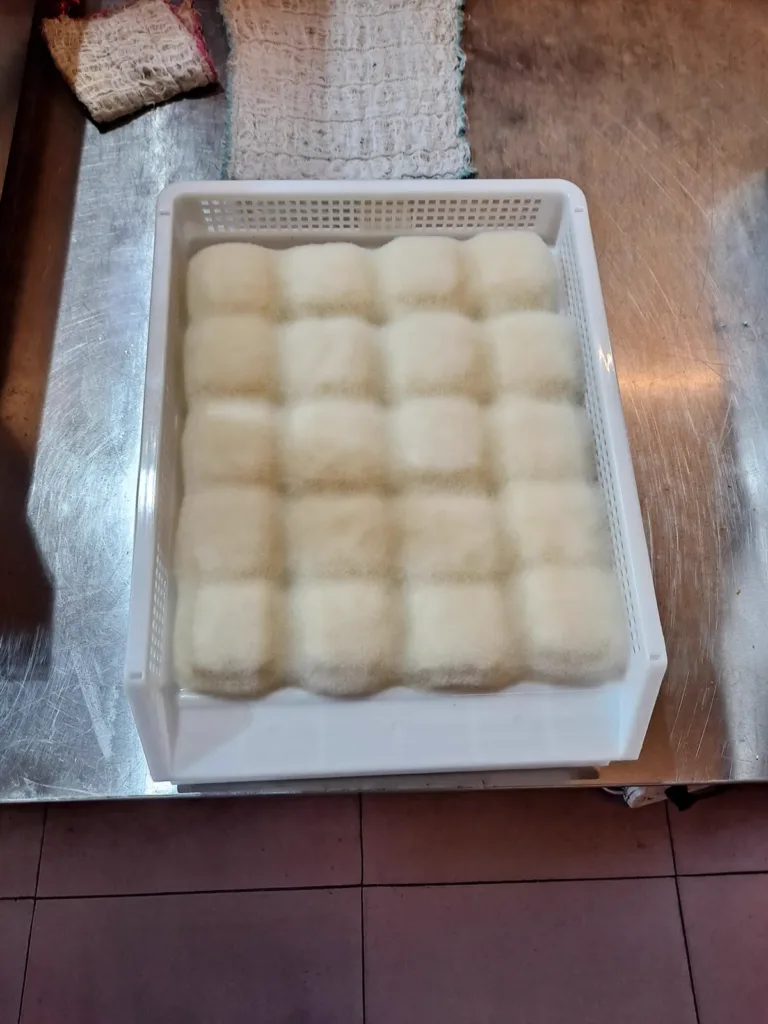
Hairy tofu is firm tofu that has been left to grow a coat of white mould, then fried and braised until the surface puckers and the inside turns creamy. In Huangshan and the wider old Huizhou region of southern Anhui it is both street food and restaurant dish: it appears among the city’s named local specialities on municipal government food routes, and the technique behind it — 徽州毛豆腐制作技艺 — was added to Anhui’s provincial intangible cultural heritage list in 2022, filed under Huizhou District (徽州区). English-language reports describe it in the same plain terms: a Huizhou District delicacy made by hand through soaking, grinding, pressing, dicing and fermenting, until the prepared tofu is covered with white mould.
What the fuzz actually is
The starting point is ordinary firm tofu (老豆腐): local soybeans, soaked, ground, boiled and set with a coagulant, then cut into blocks and laid out with gaps between them in a warm, humid room. A Mucor mould — a food-grade genus used across East Asia for mould-ripened foods — colonises the surface, and its mycelium spreads over every face until each block looks furred. In the traditional method the blocks stand for three to five days at roughly 15–25°C; when the coat matures, small dark specks of spores appear, and cooks read that as the batch being ready.
Coat length is a matter of weather and habit rather than quality. Huizhou makers name the types by appearance — cotton hair, mouse hair, rabbit hair, and the longer, even “straw-raincoat hair” (蓑衣毛) that the Luo family workshop at Chengkan is known for, which they attribute to the starter culture used when the tofu is set.
The fermentation does two jobs at once. Enzymes from the mould break soy protein down into amino acids and smaller peptides, which is why the block tastes savoury and faintly cheesy rather than plainly beany, and the curd softens from the middle outwards. The coat itself is edible and flattens or melts during cooking — it is a production stage, not a garnish to be eaten raw.
From tray to plate
On the tray the tofu is an intermediate product, and it is always cooked before it reaches you. The street version is the simplest: blocks go onto a flat iron griddle or into a pan with oil — rapeseed oil is the local standard — and are fried until the surface browns and puckers into what cooks here call “tiger skin”, then finished with chilli sauce and spring onion. In restaurants the same fried blocks are braised (红烧) with soy sauce, sugar, stock, ginger and chilli, so the sauce soaks into the wrinkled skin while the interior collapses into something soft and rich. Charcoal-grilling is the other classic treatment; CCTV’s material from the documentary A Bite of China notes that in Huizhou eyes all a grilled piece needs is a little chilli sauce. Steamed and deep-fried versions also exist.
Eat it hot, one or two bites per piece. The point of the dish is the contrast: a crisp, sauce-coated exterior against a molten, fermented interior. It is milder than the brine-sharp stink of stinky tofu (臭豆腐) and far less salty than jarred fermented bean curd (腐乳) — hairy tofu is the freshly moulded block itself, sold in trays and cooked to order rather than a condiment from a jar.
Local roots and variations
- Chengkan (呈坎), Huizhou District — the Luo family recipe (呈坎罗氏毛豆腐) is traced back to the Ming dynasty.
- Lantian (蓝田镇), Xiuning County — a long-standing local reputation for hairy tofu. The 方 family brand from here, marketed as 方鑫玉毛豆腐, was the one shown in the first season of A Bite of China (2012).
- She County (歙县) — village-level makers, including an elderly vendor in Dameikou village who sells his tofu with a rhyming patter rather than from a shopfront.
- Tunxi District (屯溪区) — Naxinan village is known locally as a tofu village; its workshops supply much of the city’s tofu, which is where the chain starts.
The same dish name covers real variation: coat length, salt, chilli and whether the tofu is griddled or braised all differ between kitchens and between seasons. Vacuum-packed blocks are sold as souvenirs and shipped to other cities.
How to order it
Show 徽州毛豆腐 (or simply 毛豆腐) when ordering. Say 煎的 for the pan-fried version or 红烧 for the braised one; chilli sauce (辣酱) usually arrives with it, so ask for 不要辣 if you want it plain. Portions are small and sold by the piece or by the plate — start with a few pieces.
Two practical caveats. First, this is a mould-ripened food: anyone with a soy or mould allergy should skip it. The tofu itself is plant-based, but the braise may use meat stock and the stall’s sauce and frying oil are kitchen-specific, so vegetarians and vegans should ask. Second, Chinese food coverage advises against fermenting tofu at home and recommends established producers — a sensible rule for visitors too.
Where to eat it
You can find Huizhou hairy tofu all over Anhui, so there is no need to seek out one particular restaurant. To find one near you, search for “徽州毛豆腐” in Meituan (美团) or Amap (高德地图) and check recent reviews, distance and opening hours.
More dishes to compare
Explore related local specialties and compare their names, preparation notes and ordering guidance.
Linhuan fermented-tofu pork 临涣培乳肉 →
Pork is seasoned with fermented bean curd and cooked slowly until its fat and connective tissue soften. The bean curd dissolves into the sauce rather than remaining as large tofu cubes. The result is deeply savory, rich and soft, with a fermented aroma that distinguishes it from an ordinary soy-sauce braise. Sauce strength varies by kitchen.
Hu Shi's one-pot dish 胡适一品锅 →
Several ingredients are arranged in layers inside one pot and slowly cooked so their juices mingle. Meat, tofu products and vegetables may appear, but the exact combination is set by the kitchen. The upper layers stay distinct while lower ingredients absorb a rich, savory broth. The pleasure comes from comparing those textures within one serving.
Sources & reading
Recipes and servings vary between kitchens.
- 黄山市人民政府:精品旅游线路(含特色美食名单)
- 安徽省人民政府关于公布第六批省级非物质文化遗产代表性项目名录的通知(皖政秘〔2022〕67号)
- 香港商报:徽州毛豆腐非遺很「吃香」
- 中安在线/黄山日报:一块豆腐的守艺与创新
- 合肥网:美食带你游安徽——点豆成金的『徽州第一怪』:毛豆腐
- 人民日报海外版:千年霉豆腐玩儿出『新剧本』(健谈)
- 'Hairy tofu' an Anhui treasure (China Daily)
- 央视网《舌尖上的中国》:毛豆腐的吃法
- Mao tofu (English Wikipedia)
- 百度百科:毛豆腐
- 新华网安徽:黄山旅游T1线建设跑出『加速度』
- 黄山春秋国旅:黄山北站(高铁站)到屯溪老街怎么走?
Image credits & notes (1)
- Uncooked hairy tofu on a vendor's tray, each block furred with white mould, at a shop in Hongcun, Yi County. Photo: EditQ (Wikimedia Commons user)Photo: CC BY-SA 4.0