


Get to know Yongjing County

Photo adjustments
Full frame retained; proportionally resized and converted to WebP. No retouching or changes to the photographed subject. Card displays may crop the view.
- Administrative area
- County · 县
- Part of
- Linxia Hui Autonomous Prefecture
- Chinese name
- 永靖县
- Local areas
- County guide
Area & population
- Area in the source
- 1,863.60 km²
- Population · 2020
- 180,650
- Administrative seat
- Liujiaxia
Source: cited geographic source, as of the dates shown.
Setting and landscape
Lanzhou (兰州) and Lintao County (临洮县) lie to the east. Dongxiang Autonomous County (东乡族自治县), Linxia County (临夏县) and Jishishan (积石山) face it across the Yellow River to the south, Minhe (民和县) in Qinghai adjoins it to the west, and Lanzhou's Honggu district (红古区) lies across the Huangshui (湟水) to the north.
Lying between the Tibetan and Loess plateaus, the county is split into eastern and western uplands by the Liujiaxia and Yanguoxia (盐锅峡) gorges. It ranges from 1,563 metres at Yanguoxia to 2,851 metres on Balengshan (八楞山). The Tao (洮河) and the Huangshui join the Yellow River inside the county. Its gorge lakes are Bingling (炳灵湖), Taiji (太极湖) and Dinosaur (恐龙湖).
History
Yangshao, Majiayao, Qijia and Xindian culture remains lie here. Yongjing, meaning "forever peaceful", was carved out of Linxia and Gaolan (皋兰县) counties in 1929 with its seat at Lianhuacheng (莲花城). It was merged into Linxia City in 1958, restored in 1961, and its government moved to Liujiaxia in 1962.
What to see
The Bingling Temple World Heritage tourist area, rated 5A in December 2020, groups the Liujiaxia Dam, the reservoir, the Bingling Stone Forest (炳灵石林) and the Bingling Temple Grottoes (炳灵寺石窟). The grottoes, begun under the Western Qin or earlier, cover a cliff 200 metres long with 196 caves and niches, 694 stone statues and more than 900 square metres of murals; the largest figure is a seated Tang Maitreya 27 metres high. They joined the World Heritage List in 2014 as part of the Silk Roads.
Dinosaur tracks were first found in August 1999 on the north shore of the Yanguoxia reservoir: 1,831 footprints of sauropods, theropods, ornithopods, pterosaurs and birds. The Liujiaxia Dinosaur Museum (刘家峡恐龙博物馆) was built at the find site, with a walkway to the tracks. Taiji Island (太极岛) wetland shows the Yellow River flowing west and hosts more than 30 species of waterbirds.
Crafts and folk arts
Yongjing pig-iron casting (永靖生铁冶铸技艺) makes moulds from Yellow River sand, one mould per object, and is best known for ritual vessels. It is carried on by the Wang family of Gucheng (古城) in Taiji town (太极镇), whose ancestors came from Hongtong (洪洞县) in Shanxi at the turn of the Yuan and Ming to build the Zhenyuan pontoon bridge (镇远桥) at Lanzhou. Masked Nuo dance (傩舞) survives mainly in Yangta (杨塔乡), Wangtai (王台镇) and Hongquan (红泉乡), and the county holds the title "home of Nuo dance in Gansu".
Highlights
- Bingling Temple Grottoes 炳灵寺石窟: 196 caves and niches on a 200-metre cliff, with a 27-metre Tang Maitreya; World Heritage since 2014.
- Liujiaxia dinosaur footprints 刘家峡恐龙足迹化石群: 1,831 footprints on the north shore of the Yanguoxia reservoir, found in 1999.
- Taiji Island wetland 太极岛: Wetland where the Yellow River flows west, with more than 30 species of waterbirds.
- Yongjing pig-iron casting 永靖生铁冶铸技艺: Sand-mould casting of ritual vessels, one mould per object, by the Wang family of Taiji town.
Sources for this guide
永靖概况 · Yongjing County People's Government
永靖县炳灵寺世界文化遗产旅游区(AAAAA) · Linxia Hui Autonomous Prefecture People's Government
刘家峡恐龙博物馆,为永靖黄河三峡再添旅游新名片 · Linxia Hui Autonomous Prefecture People's Government (from China Gansu Net)
【国家级非物质文化遗产】永靖生铁冶铸技艺 · Linxia Hui Autonomous Prefecture People's Government
【国家级非物质文化遗产】傩舞傩戏 · Linxia Hui Autonomous Prefecture People's Government
Original English written from the listed sources and checked sentence by sentence against quoted extracts by a separate reviewer. Updated 2026-09-23.
Explore Yongjing County
Core places to explore, with English and Chinese names.
Places to explore around Yongjing County
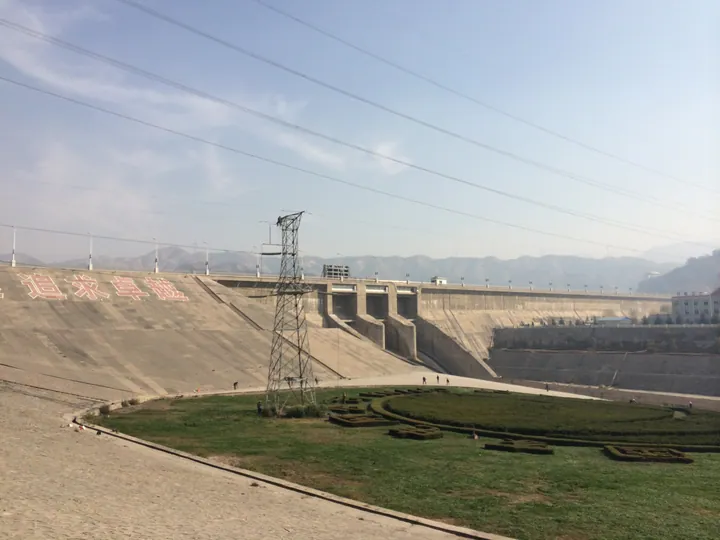 Liujiaxia Dam on the Yellow River, Yongjing County, Linxia Prefecture · 临夏回族自治州永靖县刘家峡水电站大坝 Source-recorded photograph date: 2013-11-20 14:15.
Liujiaxia Gorge刘家峡
Yellow River gorge at Yongjing, Gansu, closed by the 147 m Liujiaxia Dam (built 1958–1974); its reservoir leads to the Bingling Temple grottoes.
Read the place guide → The giant carved Maitreya Buddha statue at Bingling Temple Grottoes, Yongjing County, Linxia Prefecture · 临夏回族自治州永靖县炳灵寺石窟大佛 Source-recorded photograph date: 1987-09-13.
Bingling Temple Grottoes炳灵寺石窟
The Bingling Temple Grottoes (炳灵寺石窟) are a Buddhist cave site in the Xiao Jishi mountains 35 km south-west of Yongjing county town, Gansu, which the provincial gazetteer office page records as called Tangshu Cave in the Wei and Jin period and Bingling Temple from the Song.
Read the place guide →Plan your visit
Getting there
Yongjing County is about 40 km in a straight line from central Linxia Hui Autonomous Prefecture. Search for 永靖县 in a map app to find stations and your accommodation.
Where to stay →Build your route
Liujiaxia Gorge and Bingling Temple Grottoes are both listed here. The linked place guides have entrance and visit details.
Continue with Linxia Hui Autonomous Prefecture →More in Linxia Hui Autonomous Prefecture
Sources & geographic information
Administrative names and parent areas: Official geographic directory · Reference date 2026-09-06.
Photo: Liujiaxia Gorge · guan · CC BY 3.0. Full frame retained; proportionally resized and converted to WebP. No retouching or changes to the photographed subject. Card displays may crop the view.

Photo: Bingling Temple Grottoes · Bernard Gagnon · CC BY-SA 4.0. Full frame retained; proportionally resized and converted to WebP. No retouching or changes to the photographed subject. Card displays may crop the view.

Map data © OpenStreetMap contributors. Pins mark approximate centres, not entrances or boundaries.