


Get to know Debao County
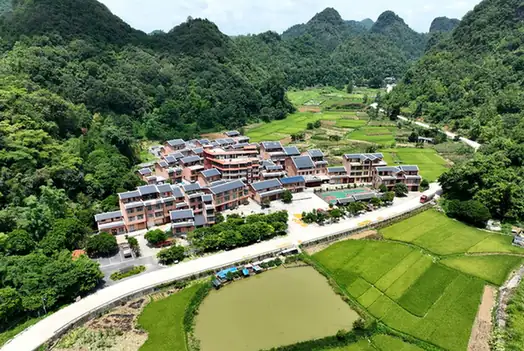
Photo adjustments
EXIF orientation normalized; resized without changing aspect ratio; converted to WebP. No subject edits.
- Administrative area
- County · 县
- Part of
- Baise
- Chinese name
- 德保县
- Local areas
- County guide
Area & population
- Area in the source
- 2,575.00 km²
- Population · 2010
- 350,800
- Administrative seat
- Chengguan
Source: cited geographic source, as of the dates shown.
History
Under the Yuan, a Zhen'an Prefecture (镇安州) was set up here in 1281 and became Zhen'an Circuit (镇安路) in 1292. The Ming turned it into a native prefecture ruled by local chiefs in 1368, and in 1369 moved its seat from Gantuo Cave (感驮岩) in present-day Napo to Debao. Direct imperial rule replaced the chiefs in 1663, and in 1739 Tianbao County was created as the county attached to Zhen'an Prefecture, one of the 18 prefectural seats of Qing Guangxi. Zhao Yi (赵翼), the Qing poet and historian, served here as prefect.
Jingde County was created in January 1935 where Jingxi (靖西), Tianbao, Enyang (恩阳) and Baise met, with its seat at Duojing market (多敬圩). After the 1951 merger, Debao kept the old Tianbao county town as its seat.
What to see
Red Leaf Forest Park (红叶森林公园), a national AAAA scenic area 3.5 kilometres north-east of the county town, is built around a maple lake and a red-leaf valley. Its autumn colour comes mostly from sweetgum trees, and a local saying claims Debao's leaves rival Jiuzhaigou. The county government counts more than 100,000 mu of red-leaf forest, spread over Chengguan (城关), Najia (那甲), Ma'ai (马隘) and Batou (巴头) townships.
Jixing Cave (吉星岩), also rated AAAA, is 13 kilometres south of the county town at Nabu village (那布村) in Yandong township (燕峒乡). The cave has four levels, and a visitor route of about two kilometres runs through the second; its terraced calcite pools cover more than 6,000 square metres. The county government also names Laohu Cave (老虎洞), which it calls the world's largest constant-temperature wine cellar, and the Baiyue Ancient Road (百粤古道), which it links to the early history of the Baiyue peoples.
Food and local products
Star anise and anise oil have long been produced here, and the county has 360,000 mu of star anise forest; a local boast says Paris perfume would not smell without Tianbao anise oil. Gecko wine (蛤蚧酒) is another county product. The Debao pony (德保矮马) stands under 106 centimetres, the smallest only 85, and is surefooted on mountain paths. The Debao cycad (德保苏铁) is a nationally protected plant under first-class protection.
Getting oriented
The county town is 230 kilometres from Nanning (南宁) and 129 kilometres from Baise to the north; the Longbang (龙邦) border crossing lies 76 kilometres to the south-west. Railways run to Tiandong (田东) and Jingxi, and the Baise–Debao–Jingxi–Napo expressway passes through.
Highlights
- Red Leaf Forest Park 红叶森林公园: AAAA forest park of sweetgum around a maple lake, 3.5 km north-east of the county town.
- Jixing Cave 吉星岩: Four-level AAAA cave in Yandong township with more than 6,000 square metres of calcite pools.
- Debao pony 德保矮马: Local breed under 106 cm tall, the smallest only 85 cm.
- Tianbao anise oil 天保茴油: Anise oil from the county's 360,000 mu of star anise forest.
Sources for this guide
德保概况 · Debao County People's Government, Baise
历史沿革 · Debao County People's Government, Baise
德保矮马 · Debao County People's Government, Baise
红叶森林公园 · Debao County People's Government, Baise
德保吉星岩 · Debao County People's Government, Baise
Original English written from the listed sources and checked sentence by sentence against quoted extracts by a separate reviewer. Updated 2026-09-23.
Explore Debao County
Core places to explore, with English and Chinese names.
Debao County 德保县
Plan your visit
Getting there
Debao County is about 65 km in a straight line from central Baise. Search for 德保县 in a map app to find stations and your accommodation.
Where to stay →More in Baise
Sources & geographic information
Administrative names and parent areas: Official geographic directory · Reference date 2026-09-06.
Map data © OpenStreetMap contributors. Pins mark approximate centres, not entrances or boundaries.