

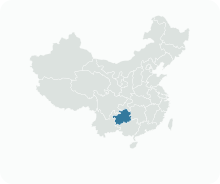
Get to know Qixingguan District
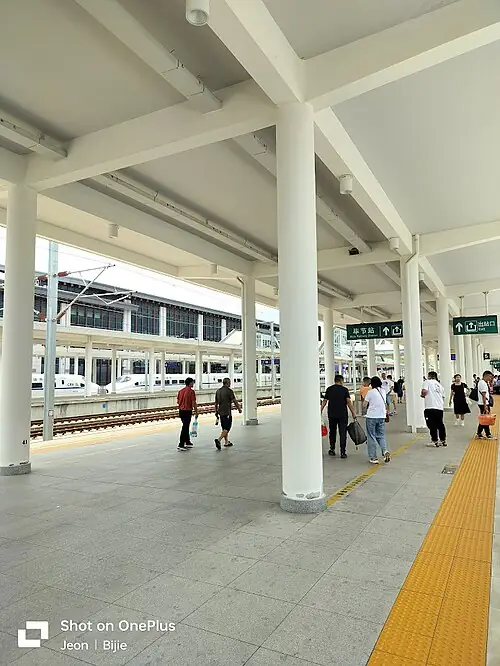
Photo adjustments
Full-frame source proportionally resized and converted to WebP for display. No subject alteration. Source-supplied marks and edits remain; cards may crop the view.
- Administrative area
- District · 市辖区
- Part of
- Bijie City
- Chinese name
- 七星关区
- Local areas
- District guide
Area & population
- Area in the source
- 3,414.90 km²
- Population · 2020 census
- 1,305,066
- Administrative seat
- Shidong Subdistrict
Source: cited geographic source, as of the dates shown.
History
The area was the seat of Pingyi commandery (平夷郡) under the Han and of Pingman commandery (平蛮郡) under the Eastern Jin. The Yuan built a post station here, the Ming set up a garrison, and a county was created in 1687. It became the county-level city of Bijie in 1993, which was abolished in 2011 and replaced by Qixingguan District.
The name comes from the Qixing Pass (七星关), counted with the Loushan (娄山关) and Shengjing (胜景关) passes as Guizhou's three historic passes. Local tradition says Zhuge Liang (诸葛亮) made lamp offerings to the seven stars here while campaigning against Meng Huo (孟获). The district calls itself the "red capital of three provinces": it keeps the former seat of the Sichuan–Yunnan–Guizhou Revolutionary Committee of the Chinese Soviet Republic (川滇黔革命委员会旧址), the headquarters of the Guizhou Anti-Japanese National Salvation Army and the Red 6th Army Group's political department.
What to see
Older sites include the Laoyadong Palaeolithic site at Qingchang (青场老鸭洞旧石器时代遗址), the ruins at Qixing Pass, the Lu family's Hanlin villa (路氏翰林山庄) and the Datun chieftain's manor (大屯土司庄园). The Sanguan Yi village (三官彝寨) and the Danan Mountain Miao village (大南山苗寨) are among the district's ethnic-culture sights, and Gonglongping National Forest Park (拱拢坪国家森林公园) carries the title "China forest oxygen bar".
At Gaoliu village (高流村) in Shengji town (生机镇), the karst held no rainwater and the Chishui River (赤水河) ran out of reach below a cliff about a hundred metres high. In the 1950s and 1960s villagers cut a canal into the rock face, working suspended on hemp ropes. A path now follows the channel, with a gorge about a hundred metres deep on the other side; chisel marks still show on the walls. Shengji has ten such cliff canals.
Setting and climate
The mean annual temperature is 13.8°C, and temperatures above 30°C in the hottest month last only about a week, which the district promotes for summer stays. It also holds the title "China's home of ancient tea trees", and eucommia (杜仲), gastrodia (天麻) and pinellia (半夏) are among its medicinal plants.
Getting oriented
Bijie Feixiong Airport (毕节飞雄机场) is about 20 kilometres from the main urban area. The Xiamen–Chengdu, Hangzhou–Ruili, Bijie–Weining, Bijie–Zhenxiong and Dongqing (东清) expressways cross the district, and the Chengdu–Guiyang high-speed railway and the Zhijin–Bijie railway are in service.
Highlights
- Qixing Pass 七星关: One of Guizhou's three historic passes and the source of the district's name.
- Gaoliu cliff canal 高流绝壁天渠: Canal cut into a cliff by Gaoliu villagers in the 1950s and 1960s, now with a walkway.
- Datun chieftain's manor 大屯土司庄园: Listed by the district among its historic sites.
- Gonglongping National Forest Park 拱拢坪国家森林公园: Holds the title China forest oxygen bar.
Sources for this guide
七星关区简介 · Qixingguan District People's Government, Bijie
跟着《四渡》,打卡七星关“生命之渠”! · Qixingguan District People's Government, Bijie
Original English written from the listed sources and checked sentence by sentence against quoted extracts by a separate reviewer. Updated 2026-09-24.
Explore Qixingguan District
Core places to explore, with English and Chinese names.
Qixingguan District 七星关区
Plan your visit
Getting there
Qixingguan District covers the centre of Bijie City. Search for 七星关区 in a map app to find stations and your accommodation.
Where to stay →More in Bijie City
Sources & geographic information
Administrative names and parent areas: Official geographic directory · Reference date 2026-09-06.
Map data © OpenStreetMap contributors. Pins mark approximate centres, not entrances or boundaries.