

Get to know Majiang County
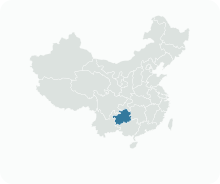
- Administrative area
- County · 县
- Part of
- Qiandongnan Miao and Dong Autonomous Prefecture
- Chinese name
- 麻江县
- Local areas
- County guide
Area & population
- Area in the source
- 1,222.00 km²
- Population · 2010
- 167,596
- Administrative seat
- Xingshan
Source: cited geographic source, as of the dates shown.
Setting and landscape
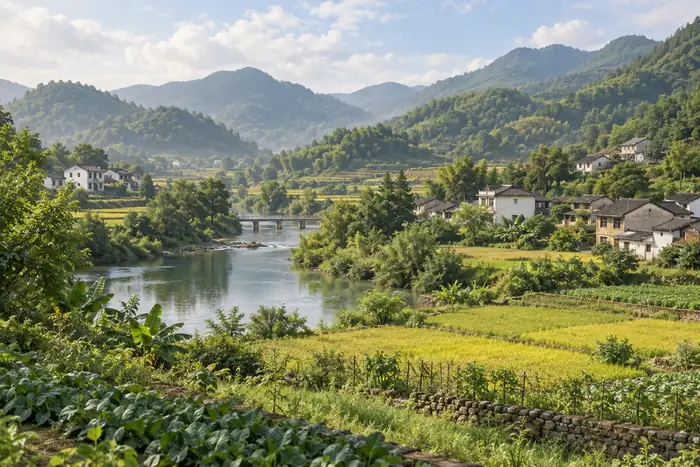
The county lies on the slope where the Yunnan–Guizhou Plateau (云贵高原) falls toward the hills of Hunan and Guangxi. The land is higher in the west and south and lower in the east and north: the county town stands at 930 m and the highest point reaches 1,862 m. All its rivers belong to the Qingshui system, and the main stream of the Qingshui runs 37.5 km through the county. The climate is subtropical and monsoonal, with annual means from 16.6°C at Longshan (龙山) in the lower east down to 14.6°C at Bamang (坝芒) and Jingyang (景阳) in the higher west.
History
Under the Qin and Han the area belonged to Qielan county (且兰县). The Southern Song set up pacification offices at Leping (乐平) and Maha (麻哈), and in 1494 the Ming made it Maha department (麻哈州). The department became Maha County in 1914 and was renamed Majiang in 1930. The county joined Qiandongnan in 1956, was merged into Kaili in 1959 and restored in 1961. In 2014 its towns of Xiasi (下司) and Bibo (碧波) were transferred to Kaili.
What to see
The county has two 4A scenic areas: the Tonghe Zhuangyuan Mansion (同龢状元府), named after Xia Tonghe, and the blueberry eco-tourism area with its 10,000-mu blueberry orchards. Xia Tonghe's former residence is a provincial protected site. Other sights named by the county include the Lanmenggu (蓝梦谷) national forest wellness base, the Wuyangma Miao village (乌羊麻苗寨), the 36 hairpin bends of the Miaoling road (苗岭36道拐) and Heba (河坝), a traditional village where Yao culture is well preserved.
Food and local products
Besides blueberries, Majiang is known for red garlic and zinc- and selenium-rich rice. Fuxing ash tofu (复兴灰拔豆腐) is made from soybeans and local plant ash by a traditional Mulao (仫佬族) method, and can be fried, stir-fried or boiled. The county counts 58 intangible-heritage items, among them maple-resin dyeing (枫香印染), Miao brocade weaving, Miao sour soup fish, the She (畲族) phoenix costume, the Yao New Year and the Mulao New Year (仫佬年).
Highlights
- Tonghe Zhuangyuan Mansion 同龢状元府: 4A scenic area named after the late-Qing top graduate Xia Tonghe, whose former residence is a provincial protected site.
- Majiang blueberry eco-tourism area 蓝莓生态旅游景区: 4A scenic area with 10,000 mu of blueberry orchards.
- Fuxing ash tofu 复兴灰拔豆腐: Tofu made with local plant ash by a traditional Mulao method.
- Maple-resin dyeing 枫香印染技艺: One of the county's 58 intangible-heritage items.
Sources for this guide
麻江县情 · Majiang County People's Government
历史沿革 · Majiang County People's Government
麻江县自然地理 · Majiang County People's Government
复兴灰拔豆腐 · Majiang County People's Government
Original English written from the listed sources and checked sentence by sentence against quoted extracts by a separate reviewer. Updated 2026-09-24.
Explore Majiang County
Core places to explore, with English and Chinese names.
Majiang County 麻江县
Plan your visit
Getting there
Majiang County is about 40 km in a straight line from central Qiandongnan Miao and Dong Autonomous Prefecture. Search for 麻江县 in a map app to find stations and your accommodation.
Where to stay →More in Qiandongnan Miao and Dong Autonomous Prefecture
Sources & geographic information
Administrative names and parent areas: Official geographic directory · Reference date 2026-09-06.
Map data © OpenStreetMap contributors. Pins mark approximate centres, not entrances or boundaries.