

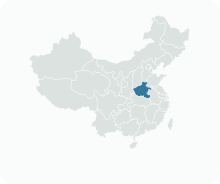
Get to know Zhanhe District

- Administrative area
- District · 市辖区
- Part of
- Pingdingshan
- Chinese name
- 湛河区
- Local areas
- District guide
Area & population
- Area in the source
- 124.00 km²
- Population · 2019
- 293,100
Source: cited geographic source, as of the dates shown.
Setting and landscape
The district government calls Zhanhe the city's "land of fish and rice" for its good water supply. Baigui Lake holds 730 million cubic metres and is a national pilot site for urban wetland protection. The district is also Pingdingshan's southern gateway, the link between the city and southwest Henan (豫西南): Pingdingshan railway station, the long-distance bus station and the south exit of the Nanjing–Luoyang Expressway (宁洛高速) are all inside it.
History
Archaeology and written records place people here more than 6,000 years ago. Under the Western Zhou the land was the fief of the Marquis of Ying (应侯), from the royal house of King Wu; Ying was conquered by Chu in the Spring and Autumn period. In 477 the Northern Wei founded Gaoyang County (高阳县), seated at what is now Houcheng village (后城村).
In the mid-1950s, as Pingdingshan's coal was opened up and the city founded, villages from Ye (叶县), Baofeng (宝丰县), Xiangcheng (襄城县) and Jia (郏县) counties were placed under the new city. A suburban district (郊区) was set up in March 1962, turned into an urban district in 1993, and renamed Zhanhe District with State Council approval in September 1994.
What to see
Bronze chime bells from the Shang and Zhou periods were dug up at Shawang village (沙王村), and at Yuling Hill (鱼陵山) Warring States and Han tombs lie one on top of another. A sand ridge at Jingshan village (荆山村) was the burial ground granted to Matuta'er (马秃塔儿), a Mongol general of the Yuan dynasty; his tomb and the Qing-dynasty Chen Family Compound (陈家大院) at Xitielu village (西铁炉村) are on the Henan provincial list of protected sites. Jingshan is today a Mongol village, and five other villages in the district are Hui Muslim communities, each with its own mosque.
The district government also claims the Qing writer Li Lüyuan (李绿园) of Songzhai village (宋寨村) in Caozhen township (曹镇乡), author of the long novel "Lamp at the Crossroads" (歧路灯), which it ranks alongside "The Scholars" (儒林外史).
Highlights
- Baigui Lake 白龟湖: Reservoir on the district's western side, the city's drinking-water source and a national urban wetland pilot site.
- Tomb of Matuta'er 马秃塔儿墓: Yuan-dynasty burial ground of a Mongol general at Jingshan village, on the Henan provincial list of protected sites.
- Chen Family Compound 陈家大院: Qing-dynasty building group at Xitielu village, on the Henan provincial list of protected sites.
Sources for this guide
区情概览 - 湛河区人民政府门户网站 · Zhanhe District People's Government, Pingdingshan
历史沿革 - 湛河区人民政府门户网站 · Zhanhe District People's Government, Pingdingshan
社会文化 - 湛河区人民政府门户网站 · Zhanhe District People's Government, Pingdingshan
湛河区各级文物保护单位列表 · Wikipedia (Chinese) · CC BY-SA 4.0
Original English written from the listed sources and checked sentence by sentence against quoted extracts by a separate reviewer. Updated 2026-09-24.
Explore Zhanhe District
Core places to explore, with English and Chinese names.
Zhanhe District 湛河区
Plan your visit
Getting there
Zhanhe District is about 9 km in a straight line from central Pingdingshan. Search for 湛河区 in a map app to find stations and your accommodation.
Where to stay →More in Pingdingshan
Sources & geographic information
Administrative names and parent areas: Official geographic directory · Reference date 2026-09-06.
Some facts checked against 湛河区各级文物保护单位列表 — Wikipedia contributors, CC BY-SA 4.0.
Map data © OpenStreetMap contributors. Pins mark approximate centres, not entrances or boundaries.