

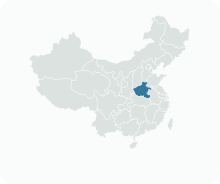
Get to know Huaiyang District

Photo adjustments
Full frame retained; proportionally resized and converted to WebP. No retouching or changes to the photographed subject. Card displays may crop the view.
- Administrative area
- District · 市辖区
- Part of
- Zhoukou
- Chinese name
- 淮阳区
- Local areas
- District guide
Area & population
- Area in the source
- 1,321.00 km²
- Population · 2019
- 976,500
Source: cited geographic source, as of the dates shown.
History
Local tradition holds that Fuxi made his capital here under the name Wanqiu (宛丘), and that King Wu of Zhou (周武王) later enfeoffed a descendant of Shun, Gui Man (妫满), as ruler of the state of Chen. In the Warring States period the city served as a Chu capital, Chenying (陈郢). The name Huaiyang dates from the Huaiyang commandery of 200 BC. Chen Sheng's (陈胜) rebel army took Chen in 209 BC and set up the Zhangchu (张楚) regime there. The county became a district of Zhoukou in 2019.
The district government lists the Pingliangtai (平粮台) ancient city as China's earliest known square city with the earliest complete drainage system, and the Shizhuang (时庄) site, described as the oldest granary settlement yet found, was named among the national top ten archaeological discoveries for both 2019 and 2020.
What to see
The Taihao Mausoleum faces south and combines a tomb with a palace-style temple; it became a national key cultural relic site in 1996. Its layout dates from the Hongwu reign of the Ming, and its largest hall, the Tongtian Hall (统天殿), rises 15.7 metres under yellow glazed tiles. From the second day of the second lunar month to the third day of the third, a steady stream of visitors comes to honour Fuxi, and the mausoleum's temple fair holds a Guinness record of 825,000 visitors in one day. East of it stands the Chenzhou Fuxi Stele Forest (陈州伏羲碑林), inscriptions praising Fuxi.
Dragon Lake covers close to 11 square kilometres and is a national wetland park; the mausoleum and parts of the lake together form a 5A scenic area. In the lake stands the Bagua Terrace (画卦台), a turtle-shaped platform whose name means "terrace where the trigrams were drawn". By Nantan Lake (南坛湖) lies the tomb of Duke Hu of Chen (陈胡公), ancestral grave of the Chen surname.
Food and crafts
Huaiyang clay dogs (淮阳泥泥狗), a national intangible heritage item since 2014, are made in villages east and north-east of the mausoleum and serve as offerings at its fair; they are painted on a black ground with sorghum-stalk pens, and besides dogs they include birds, beasts, insects and fish. District food guides list Kongji roast chicken (孔集烧鸡), with tender meat and crisp sinews, and small crisp-fish soup (小焦鱼汤) from Nanguan (南关), where the Yang and Duan families both trace their recipes to the late Qing. Huaiyang daylilies (淮阳黄花菜) are a geographical-indication product.
Highlights
- Taihao Mausoleum 太昊陵: Ming-period tomb-temple of Fuxi, national key site since 1996, with a spring temple fair.
- Dragon Lake 龙湖: Lake of almost 11 square kilometres around the town; national wetland park.
- Pingliangtai ancient city site 平粮台古城遗址: Listed by the district as China's earliest known square city.
- Huaiyang clay dogs 淮阳泥泥狗: Painted clay toys offered at the temple fair; national intangible heritage, 2014.
- Bagua Terrace 画卦台: Turtle-shaped platform in the lake north of the town, protected by the county since 1962.
Sources for this guide
淮阳概况-走进淮阳 · Huaiyang District Party Committee and People's Government, Zhoukou
太昊陵——AAAAA_周口市人民政府 · Zhoukou Municipal People's Government
旅游资源 · Huaiyang District Party Committee and People's Government, Zhoukou
泥塑(淮阳泥泥狗) - 中国非物质文化遗产网·中国非物质文化遗产数字博物馆 · China Intangible Cultural Heritage Network (Chinese National Academy of Arts)
淮阳名吃 · Huaiyang District Party Committee and People's Government, Zhoukou
淮阳区 - 维基百科,自由的百科全书 · Wikipedia (Chinese) · CC BY-SA 4.0
Original English written from the listed sources and checked sentence by sentence against quoted extracts by a separate reviewer. Updated 2026-09-24.
Explore Huaiyang District
Core places to explore, with English and Chinese names.
Places to explore around Huaiyang District
Wuchao Gate at Taihao Mausoleum · 太昊陵午朝门 Photograph date recorded by the source: Taken on 16 September 2009.Taihao Mausoleum太昊陵
Taihao Mausoleum in Huaiyang is a temple-and-tomb complex dedicated to the cultural ancestor Fuxi. The surviving layout follows a plan established in the Ming period and repaired under the Qing.
Read the place guide → AI illustration · AI 示意图(仅供参考,非该地点实拍)
Longhu Lake龙湖
Longhu (龙湖), or Dragon Lake, is a roughly 11-square-kilometre freshwater lake that encircles the old town of Huaiyang in Huaiyang District, Zhoukou, and is protected as the Henan Huaiyang Longhu National Wetland Park.
Read the place guide →Plan your visit
Getting there
Huaiyang District is about 15 km in a straight line from central Zhoukou. Search for 淮阳区 in a map app to find stations and your accommodation.
Where to stay →Build your route
Taihao Mausoleum and Longhu Lake are both listed here. The linked place guides have entrance and visit details.
Continue with Zhoukou →More in Zhoukou
Sources & geographic information
Administrative names and parent areas: Official geographic directory · Reference date 2026-09-06.
Some facts checked against 淮阳区 — Wikipedia contributors, CC BY-SA 4.0.
Photo: Taihao Mausoleum · 山海风 · CC BY-SA 3.0. Full frame retained; proportionally resized and converted to WebP. No retouching or changes to the photographed subject. Card displays may crop the view.

Map data © OpenStreetMap contributors. Pins mark approximate centres, not entrances or boundaries.