

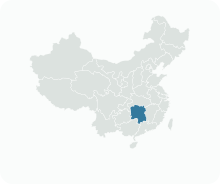
Get to know Fenghuang County
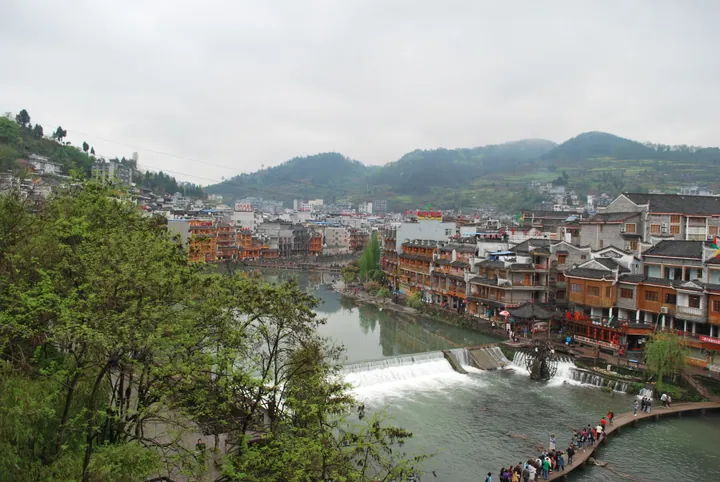
Photo adjustments
Full frame retained; proportionally resized and converted to WebP. No retouching or changes to the photographed subject. Card displays may crop the view.
- Administrative area
- County · 县
- Part of
- Xiangxi Tujia and Miao Autonomous Prefecture
- Chinese name
- 凤凰县
- Local areas
- County guide
Area & population
- Area in the source
- 1,751.10 km²
- Population · 2010
- 350,195
Source: cited geographic source, as of the dates shown.
Setting and landscape
The county is mostly mountainous. The Tuo River crosses its middle from west to east, passing nine townships including Tuojiang Town (沱江镇), the county seat, and runs 96.9 kilometres inside the county before joining the Wu River in Luxi (泸溪) and then the Yuan (沅江).
History
The Miao are the area's native people; many Tujia arrived as garrison soldiers. In 686 the Tang set up Weiyang County (渭阳县) west of Fenghuang Mountain, and its seat is identified with today's Huangsiqiao old town (黄丝桥古城). Under the Yuan a native office was based at Zhenjian (镇筸), the present county town. The Qing raised the Zhenjian garrison to a regional command in 1700, set up the Fenghuang camp (凤凰营) in the town in 1704 and turned it into a directly administered subprefecture in 1797; it became Fenghuang County in 1913. For more than a century before 1949 the old town was the political, economic and cultural centre of western Hunan.
What to see
The old town (凤凰古城), laid out in 1704, keeps its east and north gate towers, stilt houses of timber along the river, and buildings such as the Chaoyang Palace (朝阳宫), Tianwang Temple (天王庙), Dacheng Hall (大成殿) and Wanshou Palace (万寿宫). Much has been rebuilt: the riverside walls were re-laid for tourism, and the covered Hong Bridge (虹桥) was rebuilt in modern materials as a footbridge.
Shen Congwen's former residence (沈从文故居) on Zhongying Street (中营街) is a timber courtyard house built in 1866 by the writer's grandfather; Shen Congwen (沈从文) was born there on 28 December 1902, and his ashes lie below Tingtao Mountain (听涛山). It became a national protected site in 2006. Outside the town stand Huangsiqiao and remains of the "Southern Great Wall" of the Miao frontier (南方苗疆长城). Miao market days come every five days at Laershan (腊尔山), Heku (禾库) and Shanjiang (山江), drawing traders from Guizhou and Chongqing.
Food and local products
Fenghuang paper crafts (凤凰纸扎), national intangible heritage since 2008, use bamboo-strip frames covered with bast-fibre paper and painted. In the late Qing and early Republican years the county town had more than ten paper-craft shops; lion heads, dragon heads, boats and lanterns are made for the Spring Festival, and the Nie family (聂氏) workshop is singled out for its lifelike figures.
Highlights
- Fenghuang Ancient Town 凤凰古城: Laid out in 1704 on the Tuo River; east and north gate towers survive.
- Shen Congwen's former residence 沈从文故居: 1866 courtyard house where the writer was born; national protected site since 2006.
- Huangsiqiao old town 黄丝桥古城: Identified with the seat of Tang-era Weiyang County.
- Fenghuang paper crafts 凤凰纸扎: Painted paper-and-bamboo figures; national intangible heritage since 2008.
Sources for this guide
凤凰县 - 维基百科,自由的百科全书 · Wikipedia (Chinese) · CC BY-SA 4.0
沈从文故居 - 维基百科,自由的百科全书 · Wikipedia (Chinese) · CC BY-SA 4.0
彩扎(凤凰纸扎) - 中国非物质文化遗产网·中国非物质文化遗产数字博物馆 · China Intangible Cultural Heritage Network (National ICH Protection Centre)
Original English written from the listed sources and checked sentence by sentence against quoted extracts by a separate reviewer. Updated 2026-09-25.
Explore Fenghuang County
Core places to explore, with English and Chinese names.
Places to explore around Fenghuang County
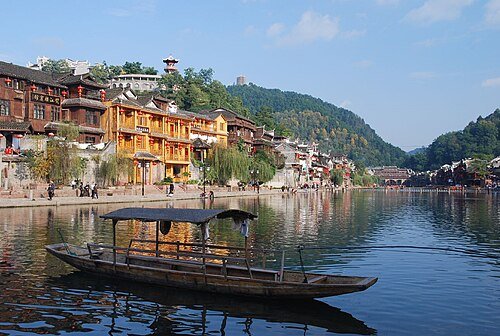 Phoenix Ancient Town ·
 Local life & food
Fenghuang County local specialties
凤凰县特色美食 · 1 specialties to discover
 Fenghuang duck with blood-rice cakes 凤凰血粑鸭AI dish illustration / AI 菜品示意图
The dish is rich and savoury, with tender duck contrasting against firmer rice cakes. Chilli and aromatics vary by restaurant.
Source ↗Read the dish guide →All dish names · 全部菜名 (1)
More dishes from across Hunan are in the Hunan food guide.
Plan your visit
Getting there
Fenghuang County is about 40 km in a straight line from central Xiangxi Tujia and Miao Autonomous Prefecture. Search for 凤凰县 in a map app to find stations and your accommodation.
Where to stay →Build your route
Start with Fenghuang Ancient Town. The linked place guides have entrance and visit details.
Continue with Xiangxi Tujia and Miao Autonomous Prefecture →More in Xiangxi Tujia and Miao Autonomous Prefecture
Sources & geographic information
Administrative names and parent areas: Official geographic directory · Reference date 2026-09-06.
Some facts checked against 凤凰县 — Wikipedia contributors, CC BY-SA 4.0.
Some facts checked against 沈从文故居 — Wikipedia contributors, CC BY-SA 4.0.
Photo: Fenghuang Ancient Town · Vera & Jean-Christophe · CC BY-SA 2.0. Wikimedia thumbnail; fitted to the ranking-card frame.

Map data © OpenStreetMap contributors. Pins mark approximate centres, not entrances or boundaries.