

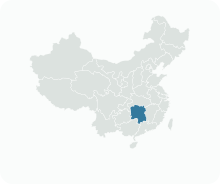
Get to know Dong'an County
- Administrative area
- County · 县
- Part of
- Yongzhou
- Chinese name
- 东安县
- Local areas
- County guide
Area & population
- Area in the source
- 2,210.94 km²
- Population · 2010
- 543,453
- Administrative seat
- Baiyashi
Source: cited geographic source, as of the dates shown.
Setting and landscape
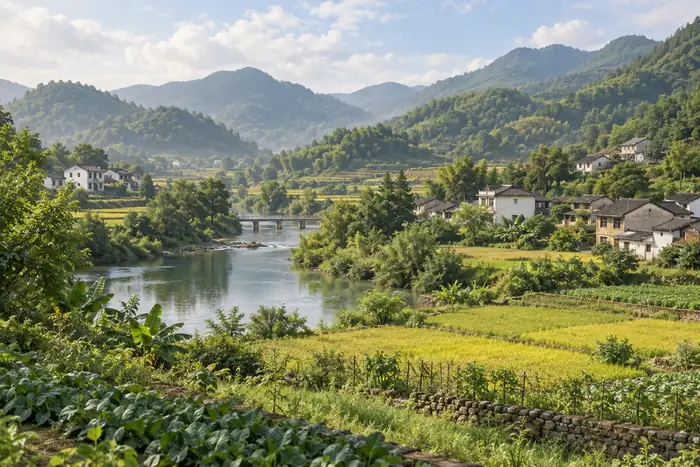
The county lies where the Nanling mountains give way to the hills of central Hunan, and where the Yuecheng Range (越城岭) meets the Lingqi basin (零祁盆地). Mountains rise in the west and northwest, while the centre and southeast are low hills scattered with small valley basins; karst is well developed across the county. Shunhuang Mountain (舜皇山) rises to 1,882.4 metres. Of the county's 191 rivers most drain to the Xiang, including the Luhong (芦洪江) and Zishui (紫水河), with a smaller share flowing to the Zi.
History
According to the county annals, Yingyang County (应阳县) was set up here in 290 under the Western Jin, with its seat at Luhongshi (芦洪市) north of the Ying River. It was merged into Lingling in 589; a trading post called Dong'an was founded at Zixishi (紫溪市) in 898 and raised to a county in 984. The county seat moved to Baiyashi (白牙市) in March 1947.
What to see
Shunhuang Mountain National Forest Park (舜皇山国家森林公园), 29 kilometres southwest of the county town on the Guangxi border, became a provincial nature reserve in 1982, a national forest park in 1992 and a 4A scenic area in 2016. Legend says the mountain, once called Hongyun Shan, was renamed after the sage-king Shun (舜) stopped here on a southern tour. Its sights include the Yangjiang valley, the Laoshanjie pass and the Nüying Creek waterfalls. Shude Manor (树德山庄), built in 1927 in Zhaojiajing village (赵家井村) of Luhongshi, was the home of the general Tang Shengzhi (唐生智) and is a national key cultural relics protection unit. The Chenxiang Temple (沉香寺) at Lubutou (渌埠头) on the upper Xiang dates from 1783 and keeps a seven-storey, six-sided stone pagoda built in 1869.
Food and local products
Dong'an chicken (东安鸡) is traced by county tradition to a small Tang-dynasty restaurant run by three old women in the county town. The county government's recipe uses a young hen poached until about seventy percent cooked, boned and cut into strips, then stir-fried in lard with shredded ginger and dried chilli and briefly braised with vinegar and Shaoxing wine, giving a red, glossy, sour-hot dish. It notes that chickens raised in Luhongshi have small legs and plump breasts, and recommends a bird less than a year old. Other dishes on the county's food list include blood duck (血鸭), Ziyun cured pork (紫云腊肉) and Shankoupu oil tofu (山口铺油豆腐).
Highlights
- Shunhuang Mountain National Forest Park 舜皇山国家森林公园: Forest park and 4A scenic area around a 1,882.4-metre peak linked by legend with Shun.
- Shude Manor 树德山庄: Tang Shengzhi's 1927 residence, a national key cultural relics protection unit.
- Chenxiang Temple 沉香寺: Temple of 1783 on the upper Xiang with a seven-storey stone pagoda of 1869.
- Dong'an chicken 东安鸡: Sour-hot braised chicken with ginger, chilli and vinegar, traced by legend to the Tang.
Sources for this guide
地理位置_地理位置_东安县人民政府网 · Dong'an County People's Government
风景名胜_风景名胜_东安县人民政府网 · Dong'an County Bureau of Culture, Tourism, Radio, Television and Sports
史于唐朝的东安鸡_饮食文化_东安县人民政府网 · Dong'an County People's Government
历史沿革_历史沿革_东安县人民政府网 · Dong'an County People's Government (from the Dong'an County Annals)
饮食文化_东安县人民政府网 · Dong'an County People's Government
Original English written from the listed sources and checked sentence by sentence against quoted extracts by a separate reviewer. Updated 2026-09-25.
Explore Dong'an County
Core places to explore, with English and Chinese names.
Dong'an County 东安县
Plan your visit
Getting there
Dong'an County is about 30 km in a straight line from central Yongzhou. Search for 东安县 in a map app to find stations and your accommodation.
Where to stay →More in Yongzhou
Sources & geographic information
Administrative names and parent areas: Official geographic directory · Reference date 2026-09-06.
Map data © OpenStreetMap contributors. Pins mark approximate centres, not entrances or boundaries.