

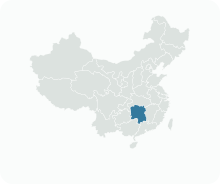
Get to know Lingling District

Photo adjustments
Full frame retained; proportionally resized and converted to WebP. No retouching or changes to the photographed subject. Card displays may crop the view.
- Administrative area
- District · 市辖区
- Part of
- Yongzhou
- Chinese name
- 零陵区
- Local areas
- District guide
Area & population
- Area in the source
- 1,959.11 km²
- Population · 2010
- 528,637
- Administrative seat
- Xujiajing Subdistrict
Source: cited geographic source, as of the dates shown.
History
The name goes back to the Shiji (史记), which says the sage-king Shun (舜) died on a southern tour and was buried at Jiuyi (九疑), "and this is Lingling". The district government dates the building of the city to 124 BC and ranks it second only to Changsha (长沙) among Hunan cities by age. Lingling Commandery (零陵郡) was set up in 111 BC and moved its seat to Quanling (泉陵), the present district, under the Eastern Han. In 589 the Sui replaced the commandery with Yongzhou, and the town stayed a seat of government through the Qing. A giant lingzhi fungus said to have grown at the examination hall in 1267 gave it the nickname "Zhi City" (芝城). The district was named Zhishan (芝山区) in 1995 and took back the name Lingling in 2005.
What to see
The Liu Zongyuan Cultural Tourism Area (柳宗元文化旅游区), a national 4A scenic area, follows the Yu Stream (愚溪). Liuzi Street (柳子街) is a 550-metre street named after Liu and first built in the Tang; the double-arched Yuxi Bridge (愚溪桥) dates from the Qianlong reign. Liuzi Temple (柳子庙) stands on the west bank of the Xiao where the Yu Stream flows in. A shrine to Liu was founded in 1056, moved to this site in 1144 and rebuilt in 1877; its courtyards hold an opera stage and front and rear halls, and it has been a national key protected site since 2001.
Also on the west bank, Chaoyang Rock (朝阳岩) was named by the Tang poet Yuan Jie (元结) and keeps 125 inscriptions, including works by Mi Fu (米芾) and Huang Tingjian (黄庭坚). Pingzhou Academy (蘋洲书院) sits on the island where the Xiao and Xiang meet; Li Da (李达), a founder of the Communist Party of China, studied there. Boats from the old-town pier pass Huilong Pagoda (廻龙塔). The Dongshan Scenic Area (东山景区), a national 4A scenic area on Dongshan hill, covers the Lütian Hermitage (绿天庵), Fahua Temple (法华寺) and a stone inscription of the Thousand Character Classic (千字文) by Huaisu (怀素). About 26 km from town, the Zhou Family Compound (周家大院) is a group of six Ming, Qing and Republican-era courtyards, founded in 1450 by descendants of the Song philosopher Zhou Dunyi (周敦颐).
Food and local products
The Ministry of Culture and Tourism names four local specialities: Lingling blood duck (零陵血鸭), Lingling river snails (零陵嗦螺), Lingling braised beef (零陵牛扣) and Lingling coiled eel (零陵盘龙鳝鱼).
Highlights
- Liuzi Temple 柳子庙: Temple to Liu Zongyuan where the Yu Stream meets the Xiao, rebuilt in 1877; national key protected site since 2001.
- Liuzi Street 柳子街: A 550-metre street named after Liu Zongyuan, first built in the Tang.
- Chaoyang Rock 朝阳岩: Riverside cliff named by Yuan Jie, with 125 inscriptions including works by Mi Fu and Huang Tingjian.
- Pingzhou Academy 蘋洲书院: Academy on the island where the Xiao and Xiang meet; Li Da studied here.
- Zhou Family Compound 周家大院: Six Ming, Qing and Republican-era courtyards founded in 1450 by descendants of Zhou Dunyi.
Sources for this guide
零陵概况 · Lingling District People's Government
零陵古城史话 · Lingling District People's Government
零陵区 · Wikipedia (Chinese) · CC BY-SA 4.0
柳子庙 · Wikipedia (Chinese) · CC BY-SA 4.0
湖南·潇湘之源 古建零陵 · Ministry of Culture and Tourism of the PRC
Original English written from the listed sources and checked sentence by sentence against quoted extracts by a separate reviewer. Updated 2026-09-24.
Explore Lingling District
Core places to explore, with English and Chinese names.
Places to explore around Lingling District
Entrance gate of Liuzi Temple, Yongzhou. Photograph date recorded by the source: 2017-01-02 14:23:52.Liuzi Temple柳子庙
Liuzi Temple commemorates the Tang writer Liu Zongyuan beside Yu Stream in Yongzhou’s Lingling district. The gate-stage arrangement and successive halls provide an architectural setting for inscriptions associated with his life…
Read the place guide →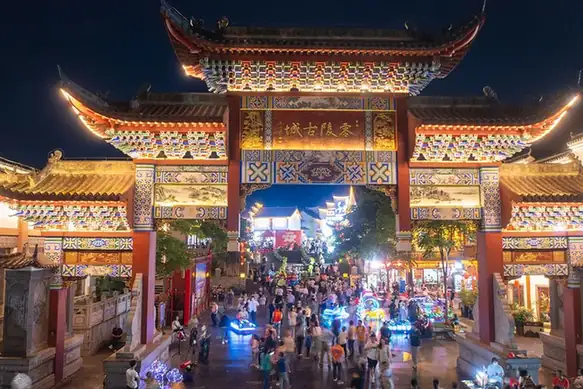 Lingling Ancient City · 零陵古城
Lingling Ancient City零陵古城
Lingling Ancient City (零陵古城) is a Yongzhou municipal development in Lingling District, Hunan, built around a genuinely historic core: the Liuzi Temple beside the Yu stream and the old Liuzi Street beside it, both associated with the Tang writer Liu Zongyuan.
Read the place guide →Plan your visit
Getting there
Lingling District is about 20 km in a straight line from central Yongzhou. Search for 零陵区 in a map app to find stations and your accommodation.
Where to stay →Build your route
Liuzi Temple and Lingling Ancient City are both listed here. The linked place guides have entrance and visit details.
Continue with Yongzhou →More in Yongzhou
Sources & geographic information
Administrative names and parent areas: Official geographic directory · Reference date 2026-09-06.
Some facts checked against 零陵区 — Wikipedia contributors, CC BY-SA 4.0.
Some facts checked against 柳子庙 — Wikipedia contributors, CC BY-SA 4.0.
Photo: Liuzi Temple · Huangdan2060 · CC0. Full frame retained; proportionally resized and converted to WebP. No retouching or changes to the photographed subject. Card displays may crop the view.

Photo: Lingling Ancient City · Source photographer · License not provided. EXIF orientation normalized; resized without changing aspect ratio; converted to WebP. No subject edits.
Map data © OpenStreetMap contributors. Pins mark approximate centres, not entrances or boundaries.