

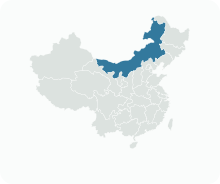
Get to know Yuquan District
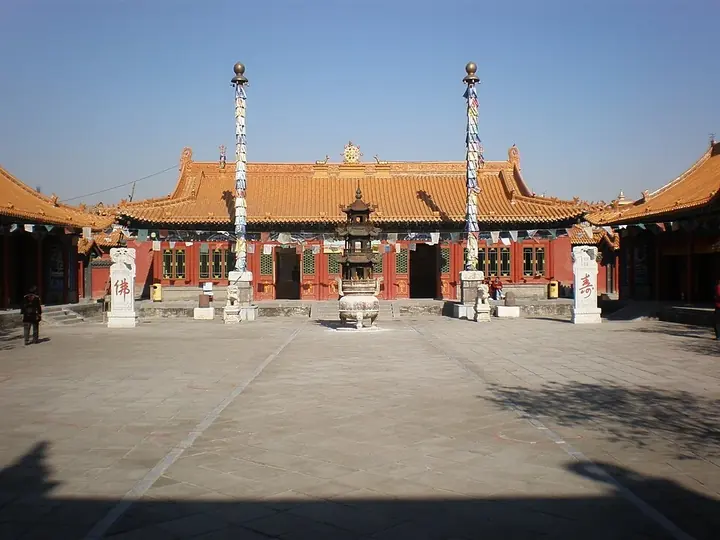
Photo adjustments
Full frame retained; proportionally resized and converted to WebP. No retouching or changes to the photographed subject. Card displays may crop the view.
- Administrative area
- District · 市辖区
- Part of
- Hohhot
- Chinese name
- 玉泉区
- Local areas
- District guide
Area & population
- Area in the source
- 179.30 km²
- Population · 2020
- 524,573
- Administrative seat
- Zhaojun Road Subdistrict
Source: cited geographic source, as of the dates shown.
History
The district's name comes from a legend of a spring dug out by an imperial horse's hoof. In 1571 the Tumed (土默特) leader Altan Khan (阿勒坦汗) reached a tribute-and-trade agreement with the Ming, and the next year he began building a walled town south of the Daqing Mountains (大青山), modelled on the Yuan capital. Finished in 1575, it was named Kokegota, "blue city", and the Ming called it Guihua. After it was destroyed at the end of the Ming, the Qing rebuilt it; when Suiyuan (绥远城) was built to the north-east in the early Qianlong reign, Guihua became known as the "old town", a name still used. The name Yuquan dates from June 1954, when the city's Third District was renamed.
What to see
Dazhao Temple (大召寺), a Gelug lamasery founded by Altan Khan in 1579, is the earliest Yellow Hat monastery built in Hohhot and is also called the Silver Buddha Temple for the silver statue it houses. Xilitu Temple (席力图召), begun in 1585, takes its name from the Mongolian for "seat"; it was once the seat of the third and fourth Dalai Lamas, and two Kangxi-era stelae survive there. The Five Pagoda Temple (五塔寺) keeps only its Qing Diamond Throne pagoda: five small towers on a platform, the Diamond Sutra in Mongolian, Tibetan and Sanskrit, 1,119 small gilded Buddha figures in its thousand-Buddha niches, and a stone star chart labelled in Mongolian, with more than 1,550 stars. The district government describes Guanyin Temple (观音寺) as the only intact Qing-dynasty Chinese Buddhist temple left in the city.
The district also holds the Zhaojun Museum (昭君博物院), the Dashengkui (大盛魁) creative park on the history of the Mongolia trade, and Saishang Old Street (塞上老街), listed among the first national tourism and leisure streets.
Food and local products
The district's culture and tourism bureau promotes Hohhot's old-style dishes through "Hohhot's first shaomai street" (呼和浩特烧麦第一街), a food street on Tongshun Lane (通顺大巷) and the old Deshunyuan (德顺源) brand. Its shaomai street has been named a municipal intangible-heritage street.
Setting and landscape
Yuquan lies on the Tumochuan (土默川) plain at an average of about 1,035 m, sloping from north-east to south-west. The Dahei River, a Yellow River tributary, runs 19.37 km through the district. Its tributary the Xiaohei (小黑河) also crosses the district and is fed by the Zhadagai (扎达盖河), known locally as the Niuqiao River, which comes down from the Daqing Mountains.
Highlights
- Dazhao Temple 大召寺: Gelug lamasery founded by Altan Khan in 1579, the earliest in Hohhot; national protected site since 2006.
- Xilitu Temple 席力图召: Lamasery begun in 1585, once seat of the third and fourth Dalai Lamas; two Kangxi stelae survive.
- Five Pagoda Temple 五塔寺: Diamond Throne pagoda of a Qing temple, with 1,119 small gilded Buddha figures and a Mongolian-labelled stone star chart.
- Guanyin Temple 观音寺: The district government describes it as the only intact Qing Chinese Buddhist temple remaining in Hohhot.
- Saishang Old Street 塞上老街: Historic street listed among the first national tourism and leisure streets.
Sources for this guide
玉泉区区情简介 · Yuquan District People's Government, Hohhot
旅游概况 · Yuquan District Culture, Sports, Tourism, Radio and Television Bureau
Original English written from the listed sources and checked sentence by sentence against quoted extracts by a separate reviewer. Updated 2026-09-25.
Explore Yuquan District
Core places to explore, with English and Chinese names.
Places to explore around Yuquan District
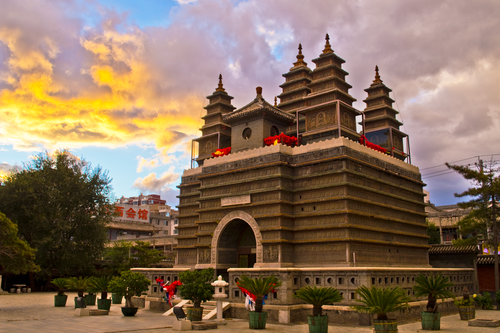 Hohhot Five-Pagoda Temple (Wuta Si) · 五塔寺
Five Pagoda Temple五塔寺
Five Pagoda Temple takes its name from the five small towers rising from a single diamond-throne base. Rows of individually varied Buddha images cover the masonry, making close observation as rewarding as the overall silhouette…
Read the place guide → Dazhao Temple · 大召寺
Dazhao Temple大召寺
Dazhao anchors the temple quarter of old Hohhot. Its main hall combines Chinese and Tibetan building forms and preserves a celebrated silver image of Shakyamuni. Golden dragons coil around the columns in front of the image…
Read the place guide →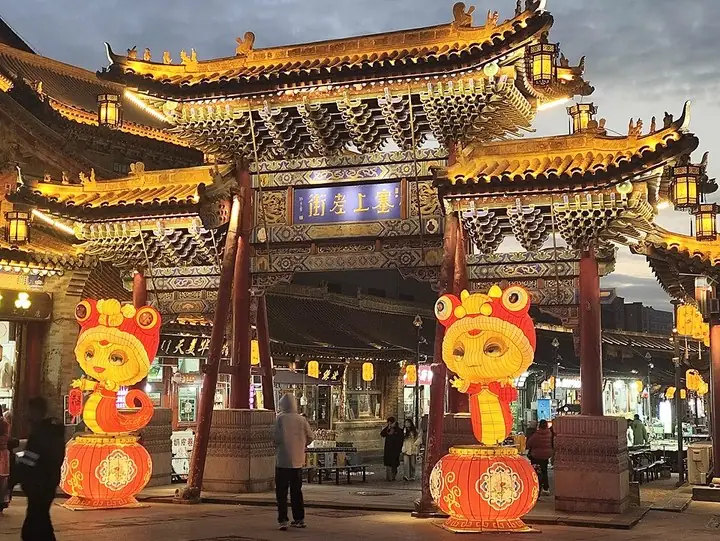 Saishang Old Street gateway in 2025 decorations · 塞上老街牌坊与 2025 年装饰 Photograph date recorded by the source: 3 January 2025.
Saishang Old Street塞上老街
Saishang Old Street runs west from Dazhao through Hohhot's historic trading quarter. Brick-and-timber shopfronts recall the period when goods from the grasslands met tea, silk and other products from farther south. Today's shops…
Read the place guide →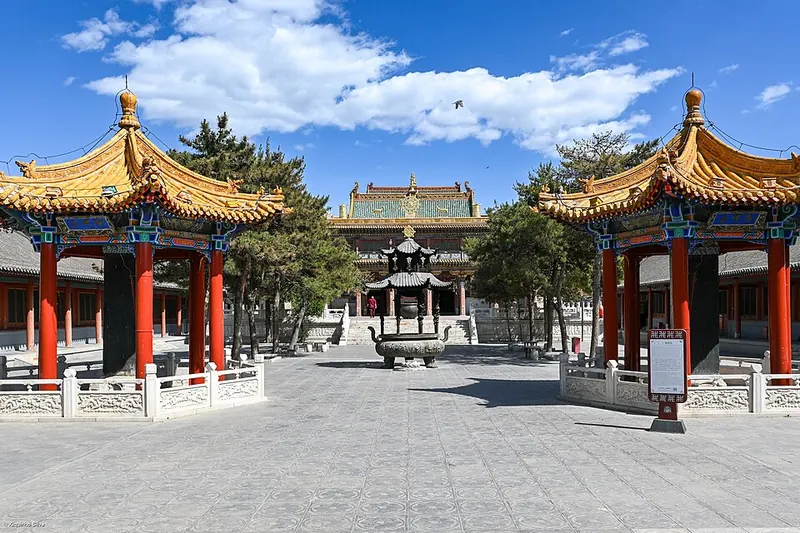 Courtyard of Xilitu Temple in Hohhot. Photograph date recorded by the source: 2024-05-14 10:04.
Xilitu Temple席力图召
Xilitu Temple stands among Hohhot's old-city monasteries but has its own sequence of shrines and landmarks. The older Buddha hall preserves the memory of its early foundation, while the larger main hall reflects later expansion…
Read the place guide →Plan your visit
Getting there
Yuquan District is about 10 km in a straight line from central Hohhot. Search for 玉泉区 in a map app to find stations and your accommodation.
Where to stay →Build your route
Five Pagoda Temple and Dazhao Temple are less than 1 km apart. The linked place guides have entrance and visit details.
Continue with Hohhot →More in Hohhot
Sources & geographic information
Administrative names and parent areas: Official geographic directory · Reference date 2026-09-06.
Photo: Five Pagoda Temple · unatnight · CC BY-SA 3.0. Wikimedia thumbnail; fitted to the ranking-card frame.

Photo: Dazhao Temple · 兜兜 · CC BY-SA 3.0. Wikimedia thumbnail; fitted to the ranking-card frame.
_Temple_of_Hohhot2.JPG)
Photo: Saishang Old Street · HCCB3947 · HCCB3947 — 呼和浩特塞上老街牌坊(2025蛇年装饰).jpg — CC BY-SA 4.0 · CC BY-SA 4.0. The exact downloaded source bytes are separately retained and hashed. Prepared JPEG is proportionally reduced to a maximum 720-pixel long edge; full frame retained, no subject alteration. Final website rendition: full frame retained, proportionally resized to at most 720 pixels and converted to WebP. No additional retouching or subject alteration. Card displays may crop the view.

Photo: Xilitu Temple · xiquinhosilva · CC BY 2.0. Full frame retained; proportionally resized and converted to WebP. No retouching or changes to the photographed subject. Card displays may crop the view.
.jpg)
Map data © OpenStreetMap contributors. Pins mark approximate centres, not entrances or boundaries.