


Get to know Peixian
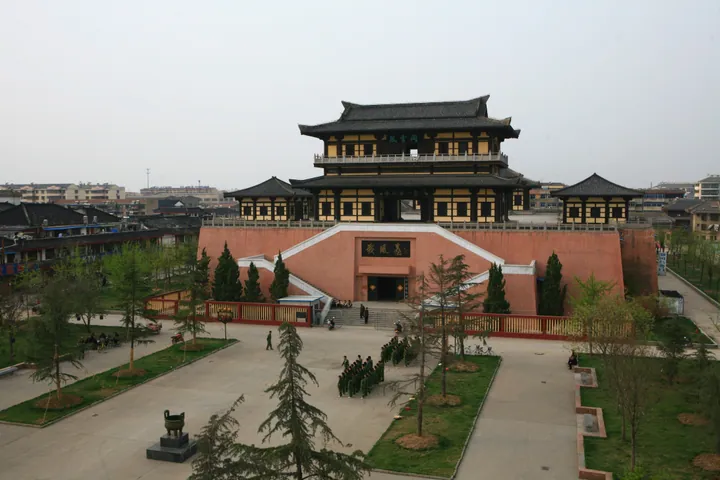
Photo adjustments
Full frame retained; proportionally resized and converted to WebP. No retouching or changes to the photographed subject. Card displays may crop the view.
- Administrative area
- County · 县
- Part of
- Xuzhou
- Chinese name
- 沛县
- Local areas
- County guide
Area & population
- Population · 2020 census
- 1,038,337
Source: cited geographic source, as of the dates shown.
Setting and landscape
The county has no hills: it is all alluvial plain in the middle of the Huang–Huai plain, falling from about 41 metres above sea level in the southwest to about 31.5 metres in the northeast. Nine main rivers, part of the Nansi Lakes (南四湖) system in the Huai basin, mostly flow northeast into the lakes, while the Grand Canal and four other channels run north–south. To the east it adjoins Weishan County (微山县) in Shandong; Yutai (鱼台) borders it to the northwest, Fengxian (丰县) to the west and Tongshan (铜山) to the south.
History
Its old name, Peize (沛泽), means "Pei marsh". Chu took the area when Qi, Chu and Wei destroyed the state of Song in 286 BC and made it a county. In 209 BC, after Chen Sheng (陈胜) and Wu Guang (吴广) rose against the Qin, the elders of Pei killed the county magistrate and made Liu Bang the Lord of Pei (沛公). Of the 18 kings Liu Bang created, the county government counts ten from Pei, and the Pei men Xiao He (萧何), Cao Shen (曹参), Zhou Bo (周勃), Fan Kuai (樊哙) and Wang Ling (王陵) all served as chancellor. The county was assigned to Shandong in 1948 and transferred to Jiangsu in 1953.
What to see
Sishui Pavilion (泗水亭), in a park in the county town, recalls Liu Bang's post as head of Sishui station; a stele inside carries the Han historian Ban Gu's (班固) rhapsody on it. The Gefeng Terrace (歌风台) marks where Liu Bang, home after putting down Ying Bu's (英布) revolt in 196 BC, feasted the local elders and composed the Song of the Great Wind (大风歌). It keeps three steles of the song, from the Han, the Yuan and modern times, and both terrace and steles are protected at provincial level. The county government also lists the Hanzhiyuan scenic area (汉之源景区), Peixian Museum (沛县博物馆), and the Qiandao (千岛湿地) and Anguo Lake (安国湖湿地) wetlands.
Food and local products
People in Pei have eaten dog meat since the late Qin and early Han, a custom tied to Fan Kuai, a founding general of the Han who was a dog butcher by trade. Peixian dog meat is mostly eaten cold and torn by hand rather than cut with a knife. Local products named by the county include Peigong liquor (沛公酒) and Dafengge paper-cuts (大风歌剪纸).
Highlights
- Gefeng Terrace 歌风台: Where Liu Bang sang the Song of the Great Wind in 196 BC; three steles of the song, provincially protected.
- Sishui Pavilion 泗水亭: Recalls Liu Bang's post as head of Sishui station; stele with Ban Gu's rhapsody.
- Peixian dog meat 沛县狗肉: Eaten cold and torn by hand; linked to Fan Kuai.
- Anguo Lake Wetland 安国湖湿地: One of the wetlands on the county's tourism list.
Sources for this guide
自然地理 · Peixian County People's Government, Xuzhou
历史沿革 · Peixian County People's Government, Xuzhou
人文历史 · Peixian County People's Government, Xuzhou
游在沛县 · Peixian County People's Government, Xuzhou
沛县 · Chinese Wikipedia · CC BY-SA 4.0
Original English written from the listed sources and checked sentence by sentence against quoted extracts by a separate reviewer. Updated 2026-09-25.
Explore Peixian
Core places to explore, with English and Chinese names.
Plan your visit
Getting there
Peixian is about 55 km in a straight line from central Xuzhou. Search for 沛县 in a map app to find stations and your accommodation.
Where to stay →More in Xuzhou
Sources & geographic information
Administrative names and parent areas: Official geographic directory · Reference date 2026-09-06.
Some facts checked against 沛县 — Wikipedia contributors, CC BY-SA 4.0.
Map data © OpenStreetMap contributors. Pins mark approximate centres, not entrances or boundaries.