

Get to know Xihu District
- Administrative area
- District · 市辖区
- Part of
- Nanchang
- Chinese name
- 西湖区
- Local areas
- District guide
Area & population
- Area
- 34.80 km²
- Population · 2019
- 495,600
Source: English Wikipedia, as of the dates shown.
Setting and landscape
The district covers 35.3 square kilometres and is divided into ten subdistricts, among them Guangrunmen (广润门), Shengjinta (绳金塔) and Chaoyangzhou (朝阳洲), where the district government sits. The district government says about six-tenths of Nanchang's 8.28-square-kilometre national historic and cultural city area lies in Xihu. It describes the district's waterways as "one river with two lakes, two lakes linked to three rivers", and places the zoo and Jiuzhou Park (九洲公园) along the water.
What to see
The Nanchang Uprising Memorial Hall (南昌八一起义纪念馆) at 380 Zhongshan Road (中山路) occupies the former Jiangxi Grand Hotel (江西大旅社), a five-storey brick-and-timber building of 1923 with 96 rooms set around a central light well. It served as the uprising's general headquarters on 1 August 1927, and Zhou Enlai (周恩来) had an office and bedroom on the second floor's east side. The museum was founded in 1956 and opened on 1 October 1959; the headquarters sites were placed on the first list of national key cultural relics protection units in 1961. The district also holds the exhibition hall at the former headquarters of the New Fourth Army (新四军军部旧址陈列馆).
Shengjin Pagoda (绳金塔) was first built in the Tianyou reign of the Tang dynasty (904–907). Its name recalls a legend that an iron casket holding four loops of golden rope, three swords and 300 relic grains was dug up when the pagoda was built. The present brick-and-timber tower dates from a 1713 rebuilding; it is 50.86 metres tall, with seven outer storeys on an octagonal plan, a bell on each storey tuned to a different note, and an internal stair to the top. Objects found in its underground chamber and spire during 1988 repairs are shown in the Qianfo Temple (千佛寺) in the same grounds. A yearly temple fair with snacks from across China is held there from mid-September to early October.
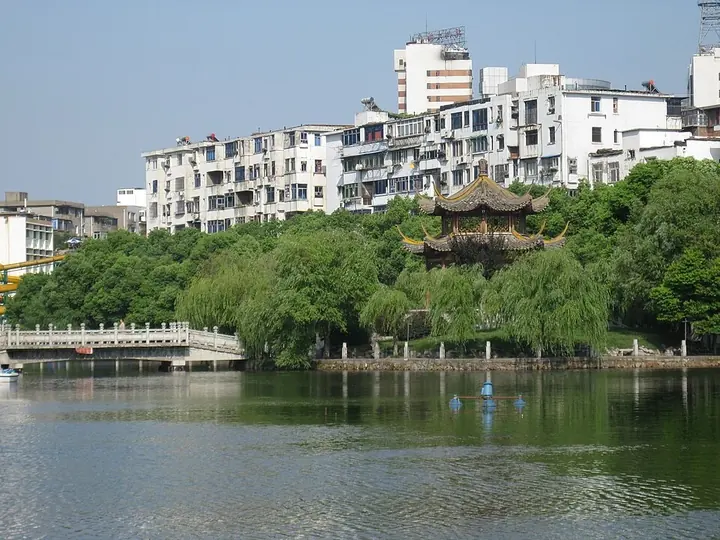
Wanshou Palace (万寿宫), on Cuihua Street (翠花街) inside Guangrunmen, is a Taoist temple founded in 312 in honour of Xu Jingyang (许旌阳), patriarch of the Jingming school (净明派). It was burned during the Cultural Revolution; rebuilding on the original site began in 2013 and it reopened in 2021. Ruzi Pavilion Park (孺子亭公园), by the city's West Lake, marks the fishing spot of the Eastern Han scholar Xu Zhi (徐稚), whose host Chen Fan (陈蕃) kept a couch only for him; the Chinese expression xiata (下榻) for an honoured guest's stay comes from that story. The pavilion was rebuilt in 1930, listed by the province in 1957 and made a park in 1982.
Highlights
- Nanchang Uprising Memorial Hall 南昌八一起义纪念馆: General headquarters of the 1 August 1927 uprising in the former Jiangxi Grand Hotel; museum opened in 1959.
- Shengjin Pagoda 绳金塔: 50.86-metre brick-and-timber pagoda first built 904–907 and rebuilt in 1713, with a bell on each of its seven storeys.
- Wanshou Palace 万寿宫: Taoist temple founded in 312 for Xu Jingyang, rebuilt on its original site and reopened in 2021.
- Ruzi Pavilion Park 孺子亭公园: Lakeside pavilion honouring the Eastern Han scholar Xu Zhi, rebuilt in 1930 and made a park in 1982.
Sources for this guide
南昌市西湖区情_西湖概况_西湖区人民政府 · Xihu District People's Government, Nanchang
西湖区 (南昌市) - 维基百科,自由的百科全书 · Wikipedia (Chinese) · CC BY-SA 4.0
南昌八一起义纪念馆 - 维基百科,自由的百科全书 · Wikipedia (Chinese) · CC BY-SA 4.0
绳金塔_游在西湖_西湖区人民政府 · Xihu District People's Government, Nanchang
南昌万寿宫 - 维基百科,自由的百科全书 · Wikipedia (Chinese) · CC BY-SA 4.0
孺子亭公园_游在西湖_西湖区人民政府 · Xihu District People's Government, Nanchang
Original English written from the listed sources and fact-checked against them. Updated 2026-09-25.
Explore Xihu District
Core places to explore, with English and Chinese names.
Places to explore around Xihu District
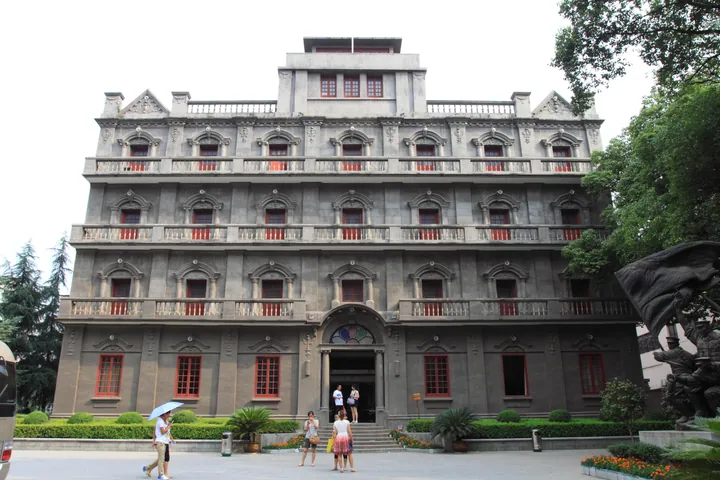 The Nanchang August 1st Uprising Memorial Hall building, Xihu District · 南昌八一起义纪念馆(原江西大旅社),西湖区 Source-recorded photograph date: 2012-07-12 16:24:51.
Nanchang Uprising Memorial Hall八一起义纪念馆
Museum on Zhongshan Road, Nanchang, built around the former Jiangxi Grand Hotel, general headquarters of the Communist-led uprising of 1 August 1927.
Read the place guide → The stone memorial archway entrance to the Wanshou Palace Historic and Cultural Block in Nanchang · 南昌万寿宫历史文化街区牌坊入口 Source-recorded photograph date: 2021-10-23.
Wanshou Palace Historic District万寿宫历史文化街区
The Wanshougong historic and cultural quarter (万寿宫历史文化街区) occupies the old commercial core of Xihu district in Nanchang, Jiangxi, around the site of the Tiezhu Wanshougong, the temple regarded as the parent house of the Wanshougong shrines and the Jiangxi guild halls.
Read the place guide →Plan your visit
Getting there
Xihu District is about 3 km (straight-line distance) from central Nanchang. Search for 西湖区 in a map app to find stations and your accommodation.
Where to stay →Build your route
Nanchang Uprising Memorial Hall and Wanshou Palace Historic District are both listed here. The linked place guides have entrance and visit details.
Continue with Nanchang →More in Nanchang
Sources & geographic information
Administrative names and parent areas: Official geographic directory (dmfw.mca.gov.cn) · Reference date 2026-09-06.
Some facts checked against 西湖区 (南昌市) — Wikipedia contributors, CC BY-SA 4.0.
Some facts checked against 南昌八一起义纪念馆 — Wikipedia contributors, CC BY-SA 4.0.
Some facts checked against 南昌万寿宫 — Wikipedia contributors, CC BY-SA 4.0.
Photo: Nanchang Uprising Memorial Hall · Zhangzhugang · CC BY-SA 4.0. Resized for the web; the photo itself has not been edited. Thumbnails may show a cropped view.

Photo: Wanshou Palace Historic District · 钉钉 · CC BY-SA 4.0. Resized for the web; the photo itself has not been edited. Thumbnails may show a cropped view.

Map data © OpenStreetMap contributors. Pins mark approximate centres, not entrances or boundaries.
Image credits & notes (1)
- Ruzi Pavilion beside the lake in Xihu District, Nanchang. Photograph date recorded by the source: 2009-08-18.Photo: Marchrius · CC BY-SA 4.0Resized for the web; the photo itself has not been edited. Thumbnails may show a cropped view.
