

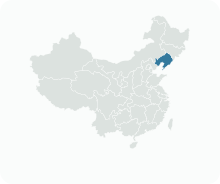
Get to know Xinmin

- Administrative area
- County-level city · 县级市
- Part of
- Shenyang
- Chinese name
- 新民市
- Local areas
- County-level city guide
Area & population
- Area in the source
- 3,318.00 km²
- Population · 2020
- 565,634
Source: cited geographic source, as of the dates shown.
History
The Qing government carved Xinmin out of land on the western edge of Chengde (承德, today's Shenyang) and the east of Guangning (广宁) in 1813. In 1902 it was raised to a prefecture governing Zhen'an (镇安, today's Heishan) and Zhangwu (彰武), and in 1913 it became an ordinary county. It passed to Shenyang at the end of 1958 and became a county-level city in 1993.
Under a 1905 treaty between the Qing and Japan, Xinmin was one of 14 cities opened to foreign trade, and Japan opened a consulate here on 15 November 1906. The surviving consulate building at 40 Xinhua Road (新华路) dates from 1926 and was later used by the Japanese military police, with a basement and a water cell; it is protected as a Shenyang municipal heritage site.
What to see and hear
The Xiushui River (秀水河) joins the Liao River (辽河) just southwest of Liaobinta village (辽滨塔村) in Gongzhutun town (公主屯镇). The village on the left bank of the river mouth was the seat of Liaozhou (辽州) under the Liao dynasty, and its Liaobin Pagoda (辽滨塔) is a Liaoning provincial heritage site.
Xinmin holds the national intangible-heritage listing, made in 2006, for the folk tales of Tan Zhenshan (谭振山), a storyteller born in 1925 in Taipingzhuang village (太平庄村), Luojiafang (罗家房). He could tell some 600 tales — local legends, ghost and fox-spirit stories, legends of historical figures, everyday stories and jokes — and a selection of 53 was published in 1988.
Food and local products
Liangshan watermelon (梁山西瓜), also called Xiaoliangshan watermelon, is a Chinese geographical-indication product, and towns such as Zhangjiatun (张家屯) and Damintun (大民屯) make pickled cabbage, suancai (酸菜).
Highlights
- Liaobin Pagoda 辽滨塔: Provincial heritage site in Liaobinta village, once the seat of Liao-dynasty Liaozhou.
- Former Japanese Consulate in Xinmin 日本驻新民领事馆旧址: 1926 building at 40 Xinhua Road, a Shenyang municipal heritage site.
- Tan Zhenshan folk tales 谭振山民间故事: National intangible heritage since 2006; a repertoire of about 600 stories.
- Liangshan watermelon 梁山西瓜: Chinese geographical-indication product.
Sources for this guide
新民市 · Wikipedia (Chinese) · CC BY-SA 4.0
谭振山民间故事 · China Intangible Cultural Heritage Network
秀水河 · Wikipedia (Chinese) · CC BY-SA 4.0
日本驻新民领事馆旧址 · Wikipedia (Chinese) · CC BY-SA 4.0
Original English written from the listed sources and checked sentence by sentence against quoted extracts by a separate reviewer. Updated 2026-09-26.
Explore Xinmin
Core places to explore, with English and Chinese names.
Plan your visit
Getting there
Xinmin is about 55 km in a straight line from central Shenyang. Search for 新民市 in a map app to find stations and your accommodation.
Where to stay →More in Shenyang
Sources & geographic information
Administrative names and parent areas: Official geographic directory · Reference date 2026-09-06.
Some facts checked against 新民市 — Wikipedia contributors, CC BY-SA 4.0.
Some facts checked against 秀水河 — Wikipedia contributors, CC BY-SA 4.0.
Some facts checked against 日本驻新民领事馆旧址 — Wikipedia contributors, CC BY-SA 4.0.
Map data © OpenStreetMap contributors. Pins mark approximate centres, not entrances or boundaries.