

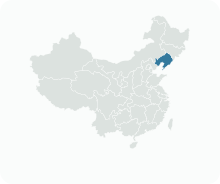
Get to know Diaobingshan

Photo adjustments
Full frame retained; proportionally resized and converted to WebP. No retouching or changes to the photographed subject. Card displays may crop the view.
- Administrative area
- County-level city · 县级市
- Part of
- Tieling
- Chinese name
- 调兵山市
- Local areas
- County-level city guide
Area & population
- Area in the source
- 262.70 km²
- Population · 2020 census
- 206,058
Source: cited geographic source, as of the dates shown.
History
The name means 'mountain where troops were mustered'. According to Wikipedia, in the autumn of 1126 the Jin general Wanyan Zongbi (完颜宗弼), known as Wuzhu (兀术), gathered his armies here before sending them south in three columns to overthrow the Northern Song. The city government adds a local legend that the captured Song emperors Huizong and Qinzong were held here, and names the 'Dianjiang Terrace' (点将台) and 'Suolong Well' (锁龙井) as sites tied to the story.
Modern Diaobingshan grew from coal. Mining began in 1958, the Tiefa Mining Bureau was formed in 1960, and the State Council approved Tiefa as a city in 1981. It was renamed Diaobingshan in 2002.
What to see
The Steam Locomotive Museum (蒸汽机车博物馆) is a national AAAA-rated scenic area, which the city government calls an important base for filming steam locomotives; it says more than 160 films and documentaries have been shot here. During the city's sixteenth steam-locomotive tourism season, in the winter of 2026, a train hauled by the American-built KD6-487, which the city calls the only one of its type left in working order, and the SY-class 1772, described as the final product of China's steam-locomotive industry, ran from Diaobingshan station to Haojiagou (郝家沟). There visitors could try firing and driving an engine. Photo points along the line include the Xiaoming mine (晓明矿).
Wuzhu Old Town (兀术古城), which the Liaoning tourism bureau once rated among the 'four great Liao–Jin ancient buildings', and Mingyue Chan Temple (明月禅寺) are the city's other named sights. Forested hills rise on the west side of the city.
Food
On the tourist steam train, Diaobingshan specialities such as sweet potatoes and smoked and sauce-braised dishes (熏酱菜) under the name 'Wuzhu Banquet' (兀术宴) were laid out for passengers.
Highlights
- Steam Locomotive Museum 蒸汽机车博物馆: AAAA-rated scenic area; the city government says more than 160 films and documentaries were shot here.
- Wuzhu Old Town 兀术古城: Rated by the Liaoning tourism bureau among the four great Liao–Jin ancient buildings.
- Mingyue Chan Temple 明月禅寺: Buddhist temple named by the city government among its main sights.
Sources for this guide
调兵山市 · Wikipedia (Chinese) · CC BY-SA 4.0
城市概况 · Diaobingshan Municipal People's Government
调兵山市第十六届国际蒸汽机车旅游推广季燃动冬日 · Diaobingshan Municipal People's Government (from Tieling Fabu)
Original English written from the listed sources and checked sentence by sentence against quoted extracts by a separate reviewer. Updated 2026-09-26.
Explore Diaobingshan
Core places to explore, with English and Chinese names.
Diaobingshan 调兵山市
Plan your visit
Getting there
Diaobingshan is about 30 km in a straight line from central Tieling. Search for 调兵山市 in a map app to find stations and your accommodation.
Where to stay →More in Tieling
Sources & geographic information
Administrative names and parent areas: Official geographic directory · Reference date 2026-09-06.
Some facts checked against 调兵山市 — Wikipedia contributors, CC BY-SA 4.0.
Map data © OpenStreetMap contributors. Pins mark approximate centres, not entrances or boundaries.