


Get to know Pingyin County
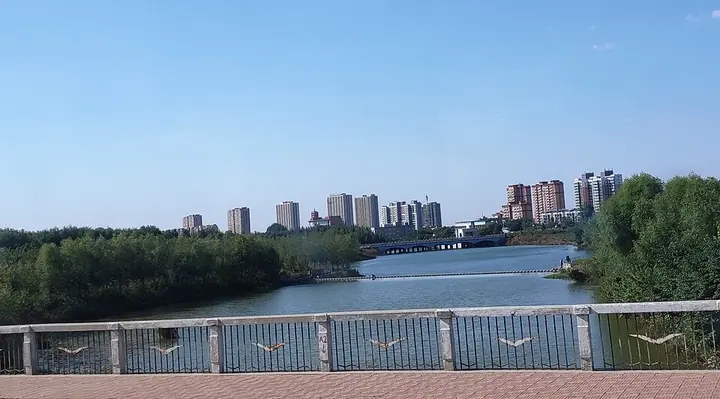
Photo adjustments
Full frame retained; proportionally resized and converted to WebP. No retouching or changes to the photographed subject. Card displays may crop the view.
- Administrative area
- County · 县
- Part of
- Jinan
- Chinese name
- 平阴县
- Local areas
- County guide
Area & population
- Area in the source
- 827.00 km²
- Population · 2018
- 374,900
Source: cited geographic source, as of the dates shown.
Setting and landscape
The county is where Jinan, Tai'an (泰安) and Liaocheng (聊城) meet, 67 km from Jinan, 72 km from Tai'an and 63 km from Liaocheng. The ground is high in the south and low in the north, with more than 800 hilltops, and a local saying sums it up as "six parts hills, three parts floodland, one part plain" (六山、三滩、一平原). Dazhai Mountain (大寨山, 494.8 m) is the highest point. Shaodai Mountain (少岱山, 82.1 m), west of Dong'e Town (东阿镇), is counted as the westernmost end of the Mount Tai range.
The Yellow River enters at Jianggou village in Dong'e Town and runs 40.5 km through four towns, forming the boundary with Dong'e County (东阿县). The Hui River (汇河) appears in the Commentary on the Water Classic (水经注) as the Bi River (泌水). The Langxi River (浪溪河) forms where three gullies that take in spring water meet, hence the saying "three springs join to make the Langxi"; springs on the right bank of its upper and middle course form the Hongfan Pool spring group (洪范池泉群), of which Shuyuan Spring (书院泉) is the largest.
History
The name Pingyin first appears in the Zuo Zhuan (左传). In the Spring and Autumn period the state of Qi (齐) built the walled town of Pingyin here as a military base and armoury, together with a section of the Qi Great Wall (齐长城). In 555 BC the state of Jin (晋) led an alliance against Qi and defeated it at the Battle of Pingyin (平阴之战). The Sui dynasty set up Yushan County (榆山县) in 596 and Pingyin County in 606, the first time the name was used for a county; from 1735 it belonged to Tai'an prefecture (泰安府).
Food and local products
Historical records place the start of concentrated rose growing in Pingyin in the Han dynasty, and by the late Ming the flowers were used to make wine and paste. In 1959 a Pingyin rose research institute was set up in Meigui Town (玫瑰镇, "Rose Town"), where an engineer's 1966 success in propagating roses by grafting greatly raised yields.
Dong'e Town, for centuries the seat of the old Dong'e county, gave e-jiao its name; the county dates production back more than 2,500 years. More than ten Ming and Qing e-jiao workshop sites, among them the Deng family's Shude Hall (邓氏树德堂), can still be seen in the old town, and donkeys were traditionally grazed on Shi'er Mountain (狮耳山) in the county.
Highlights
- Hongfan Pool spring group 洪范池泉群: Springs on the upper and middle Langxi River; Shuyuan Spring is the largest in the county.
- Dong'e Town old workshops 东阿镇: More than ten Ming and Qing e-jiao workshop sites survive in the old county town.
- Meigui Town 玫瑰镇: Centre of Pingyin rose growing, with a rose research institute founded in 1959.
- Dazhai Mountain 大寨山: Highest point of the county at 494.8 m.
Sources for this guide
自然地理_平阴县人民政府 · Pingyin County People's Government
平阴史实综述_平阴县人民政府 · Pingyin County People's Government
平阴玫瑰发展简史_平阴县人民政府 · Pingyin County People's Government
阿胶原产地_平阴县人民政府 · Pingyin County People's Government
平阴县 - 维基百科,自由的百科全书 · Wikipedia (Chinese) · CC BY-SA 4.0
Original English written from the listed sources and checked sentence by sentence against quoted extracts by a separate reviewer. Updated 2026-09-23.
Explore Pingyin County
Core places to explore, with English and Chinese names.
Pingyin County 平阴县
Plan your visit
Getting there
Pingyin County is about 65 km in a straight line from central Jinan. Search for 平阴县 in a map app to find stations and your accommodation.
Where to stay →More in Jinan
Sources & geographic information
Administrative names and parent areas: Official geographic directory · Reference date 2026-09-06.
Some facts checked against 平阴县 — Wikipedia contributors, CC BY-SA 4.0.
Map data © OpenStreetMap contributors. Pins mark approximate centres, not entrances or boundaries.