


Get to know Shanghe County
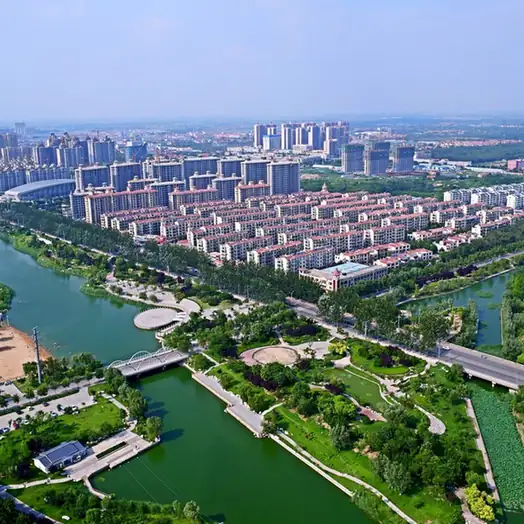
Photo adjustments
EXIF orientation normalized; resized without changing aspect ratio; converted to WebP. No subject edits.
- Administrative area
- County · 县
- Part of
- Jinan
- Chinese name
- 商河县
- Local areas
- County guide
Area & population
- Area in the source
- 1,163.19 km²
- Population · 2018
- 580,600
Source: cited geographic source, as of the dates shown.
Setting and landscape
The county is roughly diamond-shaped, 51 km from north to south and 43 km across. It sits where three cities and six counties meet: Huimin (惠民) and Yangxin (阳信) of Binzhou (滨州) lie to the east, Linyi (临邑) of Dezhou (德州) to the west, Laoling (乐陵) to the north and Jiyang District (济阳区) of Jinan to the south. The Tuhai River (徒骇河) crosses the south of the county and the Dehui New River (德惠新河) the north. The climate is warm-temperate and monsoonal: July averages 26.9°C, January minus 3.1°C, and summer brings 68.4 percent of the year's rain.
The county government describes Shanghe as the largest geothermal reserve in North China and a main base of Jinan's "China hot-spring capital" brand. The main hot-water layer, the Guantao formation (馆陶组), underlies about 98.6 percent of the county, with its top 1,000 to 1,200 m below ground.
History and culture
In the Spring and Autumn period the area was Maiqiu (麦丘邑), a town of the state of Qi (齐), and Shanghe is listed among China's 100 "millennium-old counties" (千年古县). Known ancient remains include an old city site, the Dongxin site (东信遗址) and the Liangwang mound (梁王冢遗址).
Shanghe drum yangge (商河鼓子秧歌) entered the first national list of intangible cultural heritage in 2006, and the flower-whip drum dance (花鞭鼓舞) the second. A yangge performance is organised like a battle array, with a leader giving orders and five roles: umbrella, drum, stick, flower and clown. Generations of dancers have built up more than a hundred formations, such as "two dragons leave the water" (二龙出水). Three local styles are told apart by the umbrella: planted in the county town and the east, carried on the shoulder in the north and held aloft in the west. The Ministry of Culture named Shanghe a "home of folk art" in 1996.
Food and local products
Local products include shaobing flatbread (烧饼), which a story links to a Qianlong Emperor visit, sugar-crisp huoshao (糖酥火烧), old-style tofu (老豆腐) and old-style coarse cloth (老粗布).
Highlights
- Shanghe drum yangge 商河鼓子秧歌: National intangible heritage (first batch, 2006); danced like a battle array with more than a hundred formations.
- Flower-whip drum dance 花鞭鼓舞: On the second national list of intangible cultural heritage.
- Shanghe hot springs 商河温泉: Geothermal water from the Guantao formation, which underlies about 98.6 percent of the county.
Sources for this guide
商河概况简介_商河县人民政府 · Shanghe County People's Government
商河县地理气候_商河县人民政府 · Shanghe County People's Government
鼓乡文化简介_商河县人民政府 · Shanghe County People's Government
商河温泉简介_商河县人民政府 · Shanghe County People's Government
商河县 - 维基百科,自由的百科全书 · Wikipedia (Chinese) · CC BY-SA 4.0
Original English written from the listed sources and checked sentence by sentence against quoted extracts by a separate reviewer. Updated 2026-09-23.
Explore Shanghe County
Core places to explore, with English and Chinese names.
Shanghe County 商河县
Plan your visit
Getting there
Shanghe County is about 70 km in a straight line from central Jinan. Search for 商河县 in a map app to find stations and your accommodation.
Where to stay →More in Jinan
Sources & geographic information
Administrative names and parent areas: Official geographic directory · Reference date 2026-09-06.
Some facts checked against 商河县 — Wikipedia contributors, CC BY-SA 4.0.
Map data © OpenStreetMap contributors. Pins mark approximate centres, not entrances or boundaries.